


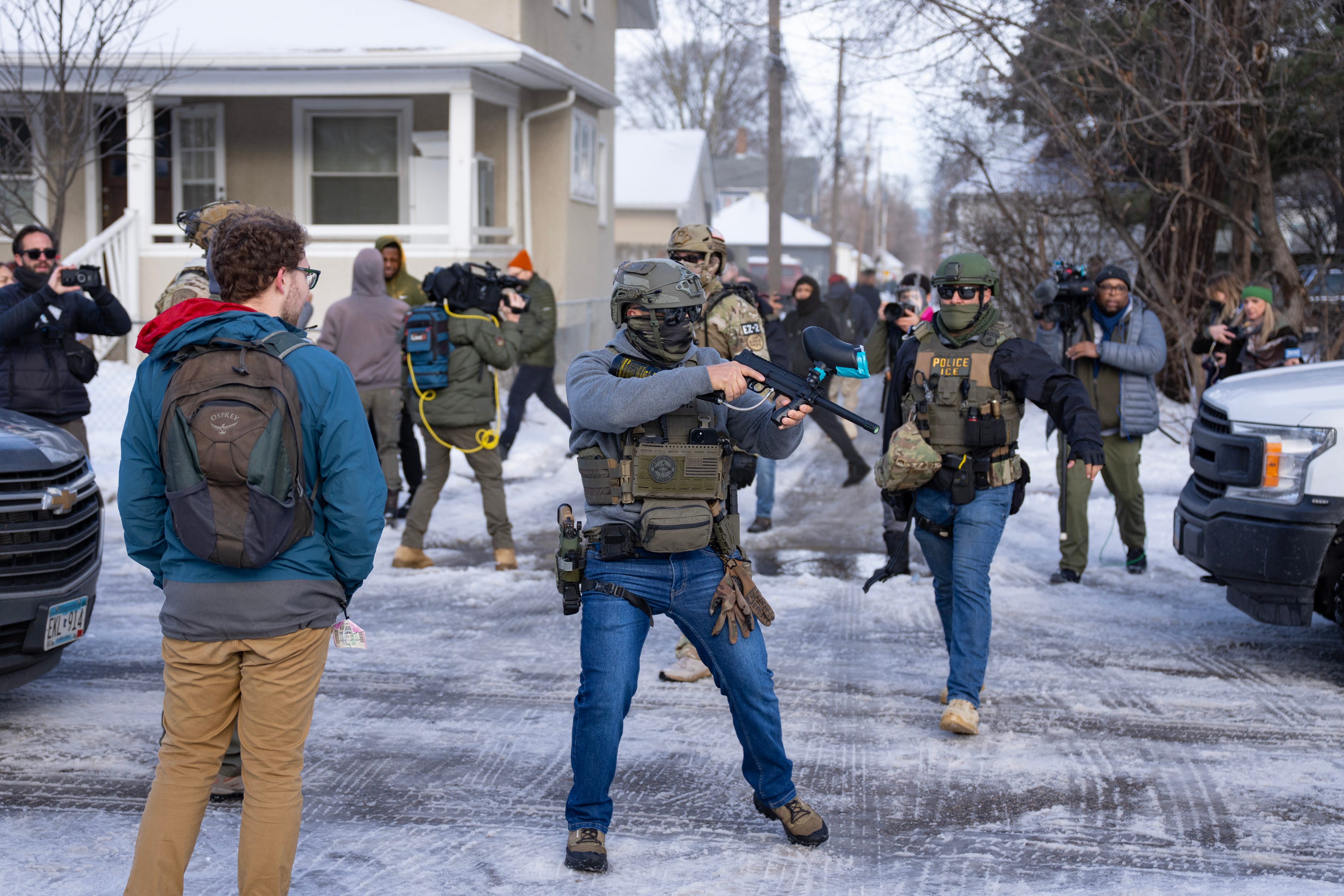
In the wake of an ICE agent’s grotesque shooting of an unarmed woman – a US citizen – in Minneapolis on Wednesday, it has become chillingly evident that no one is safe in America from President Donald Trump’s 21st-century Gestapo.
Video shows a masked ICE agent yelling “get out of the fucking car” as he attempted to open the door of the SUV that 37-year-old Renee Nicole Good was driving before she turned the car in an apparent attempt to leave. That’s when another ICE agent, who had appeared in front of the car, drew his weapon and fired three rounds, killing her.
According to Frank Figliuzzi, former assistant director of Counterintelligence for the FBI, who was in charge of agent shooting inquiries when he served as chief Inspector, “the agents should not have even introduced guns into this scenario” because it was unclear “what crime she was committing that justified not letting her drive off.” He told me in a text that “many police departments now won’t even chase you unless the underlying offense is a violent felony.”
The killing, as well as the Trump administration’s response – wrongly labeling Good a “domestic terrorist,” freezing out state investigators, and attempting to paint the killing as self-defense, despite contradictory evidence – has rightly caused outrage nationwide. As protests grow – and as Trump continues to ramp up his federal immigration operations, especially in Democratic-led states – it’s important now more than ever for anyone in the US to know their rights. But let’s be clear here: as a law enforcement entity, ICE is a uniquely dangerous menace. It’s increasingly evident that special precautions are needed to stay safe despite the technical protections of the law.
Here are five general guidelines if ICE shows up (which do not constitute legal advice):
1. If ICE stops or intimidates you, do not precipitously flee
ICE is only supposed to detain people upon “reasonable suspicion” that a person has committed or is about to commit a violation of immigration laws. But in September, the far-right justices on the Supreme Court held in an “emergency” ruling for Trump that ICE can detain people based on factors like race, ethnicity, or speaking Spanish or English with an accent. So it makes sense, if you believe you are being detained, to ask the agent, “Am I being detained?” If the answer is “no,” calmly leave.
As for well-meaning (and courageous) bystanders, bear in mind that shielding an undocumented immigrant can amount to a felony. Many citizens have been arrested for allegedly obstructing, assaulting, or impeding officers – including high-profile elected officials. Federal immigration law allows agents to make arrests for any federal offense committed in their presence or for which they have probable cause.
Legally, ICE agents are likewise only supposed to stop a vehicle if they have reasonable suspicion that immigration laws are being violated. Routine traffic violations are for local police, not ICE.
All that said, the most prudent and potentially life-saving advice that Figliuzzi gave in light of last week’s tragedy is this: if an ICE agent approaches your car and orders you to get out, “turn your engine off, put your hands up. Ask if you are being arrested and what for. But ultimately comply with reasonable requests.”
2. If detained (even temporarily), you can stay silent
The Fifth Amendment and the Supreme Court’s 1966 ruling in Miranda v. Arizona protect the right to remain silent if ICE agents ask questions. Simply tell the officer, “I wish to remain silent.” In some states, you do need to give your name if asked (according to a 2004 decision by the Supreme Court).
ICE has no legal authority to detain or arrest US citizens. But if an identified immigration agent requests to see immigration documentation, the burden is on the citizen to prove it. (Do not lie, of course, and don’t sign anything that’s put in front of you.) Most people don’t carry their passports around with them, which is partly how ICE has managed to wrongly detain multiple US citizens.
3. ICE can make certain arrests without a warrant, but it cannot search your home without either a judicial warrant or your consent
The general constitutional standard for making an arrest is “probable cause” that a crime has been committed. When it comes to ICE, probable cause must mean suspicion that an individual is in the US illegally and might try to escape before a warrant can be secured. Under the Fourth Amendment, an officer can alternatively get a warrant from a judge authorizing an arrest. ICE must obtain a warrant to search your home, office, or property (common or public areas do not count). ICE also issues its own civil warrants for arrests for immigration violations (not searches of private property); they do not establish probable cause of a crime, and they are not reviewed by a judge.
If ICE agents come to your home or business, you do not need to open the door unless they produce a warrant that is signed by a judge. They can slip it under the door or display it through a window, but you do not need to open the door until you’ve seen the signed warrant. This is important because there are reports of ICE agents pretending to be local police or probation officers to “trick” people into entering private spaces.
4. If detained, you can ask the ICE agent to identify themselves
Federal regulations state that “[a]t the time of the arrest, the designated immigration officer shall, as soon as it is practical and safe to do so . . . [i]dentify himself or herself as an immigration officer who is authorized to execute an arrest.” That doesn’t mean they must give their names, however.
5. You can hire a lawyer after an arrest, but whether you can immediately call one depends on state law
The Miranda warnings derive from the right against self-incrimination, which doesn’t implicate the right to make a phone call immediately after arrest. But if arrested, you can say you want a lawyer. The Sixth Amendment guarantees the right to retain a lawyer, but the government does not necessarily have to pay for one – that depends on a number of factors.
Deadly Force
Bear in mind that this all assumes – probably wrongly – that ICE will abide by the law and respect legal and constitutional rights if you insist on it. DHS’s official policy on the use of deadly force is clear: an officer must have “a reasonable belief that the subject of such force poses an imminent threat of death or serious bodily injury to the [officer] or to another person.” The policy goes on to say that “[d]ischarging a firearm against a person constitutes the use of deadly force and shall be done only with the intent of preventing or stopping the threatening behavior that justifies the use of deadly force.” Additionally, NBC News reported that federal immigration agents are trained to approach a vehicle from a “tactical L” 90-degree angle, never from the front.
ICE is also, according to DHS policy, required to “obtain appropriate medical assistance for any subject who has visible or apparent injuries, complains of being injured, or requests medical attention” as soon as practicable following a use of force and the end of any perceived public safety threat.” This, the policy says, “may include . . . requesting emergency medical services, and/or arranging transportation to an appropriate medical facility.”
This did not happen in the case of Good, as video shows a doctor at the scene trying to approach Good after her car crashed into a parked vehicle, leaving her body lodged behind a bloody airbag: “Can I check her pulse?” he said. “I’m a physician!” ICE blocked him from helping her while an agent can be heard responding to the doctor, “I don’t care.” Another said, “Just give us a second, we have our own medics.” Paramedics reportedly did not arrive until 15 minutes later. ICE agents blocked them, too, opting to carry her “limp” body down the street to be loaded into an ambulance.
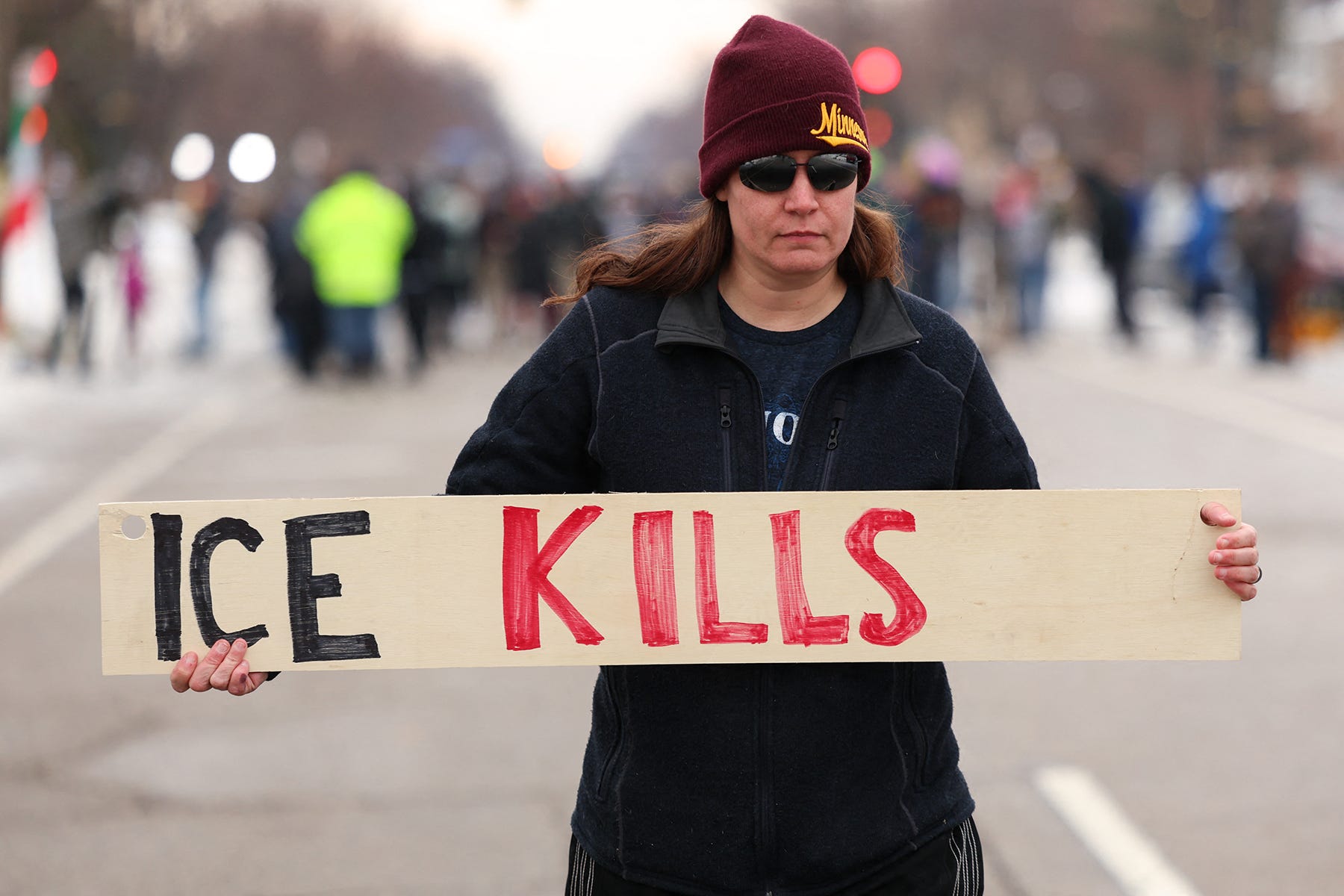
In a normal world, whether killing Good was justified is a question that would be addressed by prosecutors investigating whether this was a homicide or, in a civil case, whether the officer violated Good’s constitutional rights. On Thursday, however, Minnesota’s Bureau of Criminal Apprehension (BCA) – the entity that would investigate whether this incident constituted a crime under state law – was informed by the FBI that, although they initially envisioned a joint investigation between federal and state authorities, “the investigation would now be led solely by the FBI, and the BCA would no longer have access to the case materials, scene evidence or investigative interviews necessary to complete and thorough investigation.”
In other words, the Trump administration is kneecapping the likelihood that any state charges will be brought against the ICE officer who, after killing Good, can be heard on video calling her a “fucking bitch,” and walking away. DHS guidelines state that “respect for human life and the communities we serve shall continue to guide [agents] in the performance of their duties.” Times have obviously changed. Given that Vice President JD Vance has already declared the officer protected by “absolute immunity” (dead wrong), it looks like Good’s death will only reinforce what his goons already believe: That, like the president himself, they can shoot someone in the middle of Fifth Avenue and get away with it.
Kimberly Wehle, Zeteo’s legal contributor and author of ‘Constitution in Crisis,’ is a constitutional law professor at the University of Baltimore School of Law. Follow her on Bluesky.
The views expressed in this article are the author’s own and do not necessarily reflect those of Zeteo.
We are making this piece free to all subscribers, given the importance of the topic. If you’re not already a paid subscriber, consider becoming one today to get access to all Zeteo content. And if you’re already a paid subscriber, you can always make a donation to support our work further.
Don’t Miss It: If you’ll be in the DC area later this month, Zeteo is hosting a special LIVE in-person event you won’t want to miss: Join Mehdi, Swin, Rep. Ro Khanna, Joy Reid, Jim Acosta, Sarah Matthews, and Miles Taylor for a powerful evening at the Howard Theatre in Washington, DC, on Tuesday, Jan 20, 2026!
Check out more from Zeteo:


Thank you for this very timely advice.
ICE is acting more like a Trump Street Gang/Enforcers than a Law Enforcement agency. And Kristi Noem is acting like a Gang Leader. Not surprising considering the type of person she is. Keep gathering the Receipts........