


Note: We are sharing this article without a paywall. Please subscribe or donate to support our work.
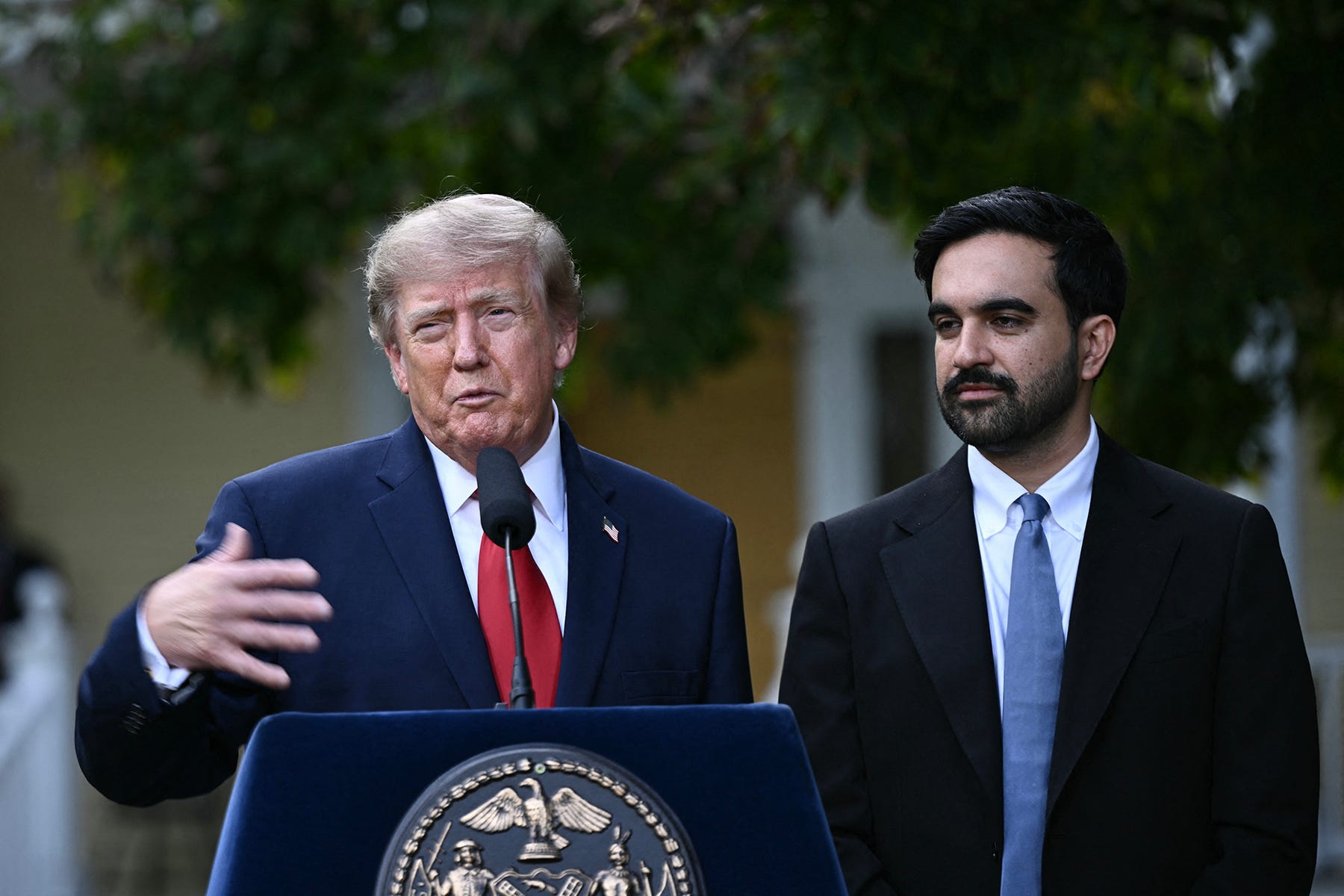
At this time last year, I wrote about a question very dear to me: how we speak to one another, how we love one another, and thus, how we exist as political beings. I referred to Zohran Mamdani and Donald Trump’s surprisingly warm relationship as a loose demonstration of what I was getting at. Since then, that relationship has continued, much to Mamdani’s benefit.
All the while, as we enter the holiday season, and approach 2028 – and many people you know are already adopting Pundit Brain instead of just saying what they think – my argument is, for better or for worse, relevant once again. That’s why we are resharing my piece on how to talk about politics at Thanksgiving with people you love. I’d love to hear your response to it in the comments below.
Every Thanksgiving, at least in the U.S., there’s routine fodder plated up as an appetizer: ‘Here’s what experts say’-style articles providing tips to script away discomfort. Be careful whom you invite. You don’t have to argue about everything. Agree to disagree. Leave politics off the table. Compromise. And so forth.
This advice is not always necessarily wrong. But the genre feels mere degrees away from the guidance politicians get from overpaid suits-and-ties: Sanitize your views, preempt tough conversations, smooth over possible friction by ‘meeting someone where they are’ (which they ultimately translate to mean ‘watering yourself down’). It’s all about appearing pragmatic, respectable, realistic.
Sometimes, it feels like we put on those ties, too. Instead of just saying what we think, we hyper-focus on what we believe other people think. Fixating on polls and odds and whether something helps a political party overshadows the stakes of an issue itself.
We don’t talk about displaced migrants, we talk about campaign ads. We don’t talk about poisoned lakes or dying bees, we talk about how a hypothetical median voter feels about kids defacing a glass-protected painting in an act of climate-inspired protest. We don’t talk about 20,000 killed children in Gaza, we talk about how discussing this or that does not help your cause.
Political discussions can end up being so steeped in secondhand opinion it becomes unclear what we ourselves think. And when we behave this way, we actually aren’t fueling this “more productive” discourse we’re told we create by diluting ourselves. We’re simply mimicking the same political class that’s helped make us feel so polarized, and so unproductive, in the first place.
So, my Thanksgiving plea: Just say what you think! Stop behaving like unpaid political consultants and pollsters and party cogs!
And we have an ongoing example of what this looks like in practice, at least for elected officials: Zohran Mamdani and Donald Trump.
Showing How It’s Done
Last year, Mamdani went to the Oval Office, amid earlier threats by Trump to pull funding from New York City and to deploy troops to it. My interest in the meeting was not in psychoanalyzing the president’s surprising warmth toward the New York City mayor-elect. Politics, as Trump’s shown us for a decade, is wrapped up in performance, and the connoisseur himself is doubtful to forget that. And performance is something all politicians participate in. They’re modeling aesthetic and behavior as a signal to other politicians and big media and lobbyists – and downwards, to journalists and commentators and ultimately the rest of us.
Let’s consider Mamdani’s signaling. In a room crowded with more reporters than some world-leader visits, the 34-year-old mayor-elect didn’t falter. He didn’t back down on his positions. He didn’t even take back calling Trump a fascist! He was walking a tightrope, seeking to show both Trump – and importantly, everyone else – he was there to advocate for his constituents. But that didn’t lead him to preemptively show himself as malleable, chameleonic. Heck, he straight-up condemned Israel’s genocide of Palestinians, right next to a man complicit in it.
Mamdani earnestly appealed to Trump’s purported focus on common goals like affordability and their mutual love of New York. He used that commonality as an entry point, such that even if he hadn’t connected with Trump, he at least would’ve connected with those watching. He didn’t sanitize Trump, or even say Trump was actually achieving his purported goals. Pragmatism didn’t necessitate losing himself. He stood by his convictions, maintaining what drew people to him in the first place: authenticity.
Pull Up a Chair to the Kitchen Table
“Authenticity” – like “affordability” and its cousin, “kitchen-table issues” – have been haplessly tossed around consultancy offices like hacky sacks for years, especially after Trump’s defeat of Hillary Clinton in 2016. Mamdani’s campaign succeeded in making these words mean more than just prop jargon.
He does this by laying his cards out, and inviting you to join in the next hand. I feel this way about X. Regardless of your views on it, I want you to be cared for, I want you to afford to live in my city. The entry point that enables him to reach someone who may disagree with him still nevertheless clearly reflects his morals. And because that entry point is tied to his broader moral universe, Mamdani can bring someone closer to him and his other convictions, without having to apologize for them.
Virginia Woolf once wrote: “If you do not tell the truth about yourself you cannot tell it about other people.” She wrote it as a critique of the literary “ivory tower,” of those whose perspectives may be distant from those they’re writing about. That, failing to see your own complexities, positive or negative, would distort your sense of reality and thus your perception of others.
This applies to us – with our own background and experiences and perspective – trying to connect and commiserate with another who carries all their own. I can’t fairly meet you where you are, without recognizing I may not know where you are. And I can’t hope for you to meet me (or for us to meet each other) if I mislead you on where I am.
Some of our fears regarding political conversation revolve around respectability. Well, I find it respectful to treat others as you would yourself. If you see yourself as capable of absorbing information, analyzing it, and responding sincerely, you ought to extend that to others. Diluting yourself in anticipation of what you suppose is more palatable to another is actually what’s disrespectful – to you and to them.
As a reporter in Washington, DC, I’ve witnessed how disrespectfully the media and political apparatus view people: as static, as fixed in their views – as data on charts that determine whether to even bother to appeal to them. That cynical attitude trickles downward – into articles we read, talking heads we listen to, and finally into us, especially if we put on those suits and ties and start absorbing that attitude, too.
This attitude discourages curiosity. It disregards the reality that we shape each other. It forecloses the possibility that we could be for each other, and not simply in spite of each other. It’s anti-political.
The word “politics” can make you tense up. But the act of politics – imagining a vision, and trying to bring others to believe in it too – is actually quite beautiful. But you can’t do it if you view people as static, as people to placate rather than bring closer to you.
My own worldview has shifted a bunch – shaped by the places I’ve lived, the people I’ve met, the experiences that have challenged and clarified me. Through all that, I’ve found a throughline of humility, softness, generosity. Those attitudes have served me better than seeing the world as fixed, as composites of polls and predicted behaviors and things that are beyond my grasp. It’s been more empowering to know that since I’ve changed, so can someone else, and I can be part of that just as much as they’ve been for me.
Empathy, or meeting someone where they are, is not at odds with conviction. Welcoming someone into your moral universe is much more powerful than trying to disguise it out of anticipation that they don’t deserve the dignity of your full self.
This rubric applies to elected officials, surely. But I’m concerned more so with the rest of us – because I think we’re usually better at earnest political discourse than the political machinery that looks at us so cynically. It seems we only get worse when we absorb their own cynical habits.
James Baldwin is attributed as saying: “If I love you, I have to make you conscious of the things that you do not see.” If you find yourself alongside friends or family you may disagree with over the holidays, realize there may be at least one commonality, one entry point that can bring you closer to them: love.
And if your love and your graciousness can help bring those around you a little closer to the rest of your moral universe, the conversation might just feel a bit more heartening, and a bit less dreadful.
The holiday season can hold many conflicting, potent emotions for us. The hope is, in the mix of all that, we get at least a moment of sacred stillness, to step back from life, look at it, and feel moved by all the love and beauty inside it. What better time to make our world feel closer, our discourse feel softer, than when we may feel most sentimental, reverent of the best parts of our lives – and surrounded by some of them?
Have a tip for Prem? Send via Signal to premthakker.35.
Check out more from Zeteo:


Beautifully written, Prem!! Thank you, I hope to expand my circle of empathy.
Loved reading it again. You are a gem of a human being Prem. And your thoughts on love, for those we love, are poignant and contagious. With deep gratitude ❤️