


In May 2021, I was reading the news on my phone when a headline stopped me, not because it shocked me, but because it carried the familiar tone that Western media outlets have perfected in constructing their narrative of Palestine. The article was about Palestinians being forced out of their homes in East Jerusalem. I remember pausing, then rereading the headline and subhead to take in the careful linguistic choices and the essential information that was missing. As a historian of the region, I was not surprised to see the way the media reflected the official account of their country’s foreign policy positions.
The headline used the word “evictions,” which suggested paperwork, municipal procedure, and real estate disputes. It did not say that East Jerusalem is recognized under international law as occupied Palestinian territory and that these expulsions were just another episode in a long history of forced displacement and land theft. This history was not denied outright, but it was laundered to erase Israeli violence and Palestinian victimhood. The language was softened enough to dull its meaning, referring to “contested neighborhoods” instead of “occupation,” saying “to remove” rather than “to ethnically cleanse.” These word choices were no accident.
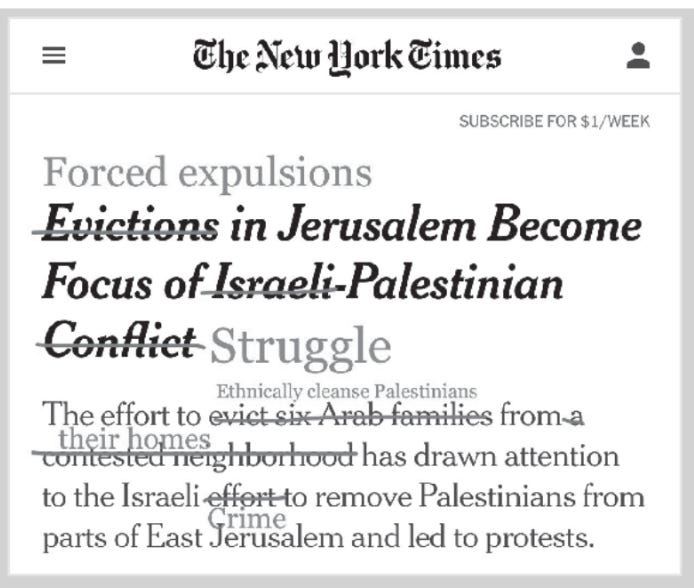
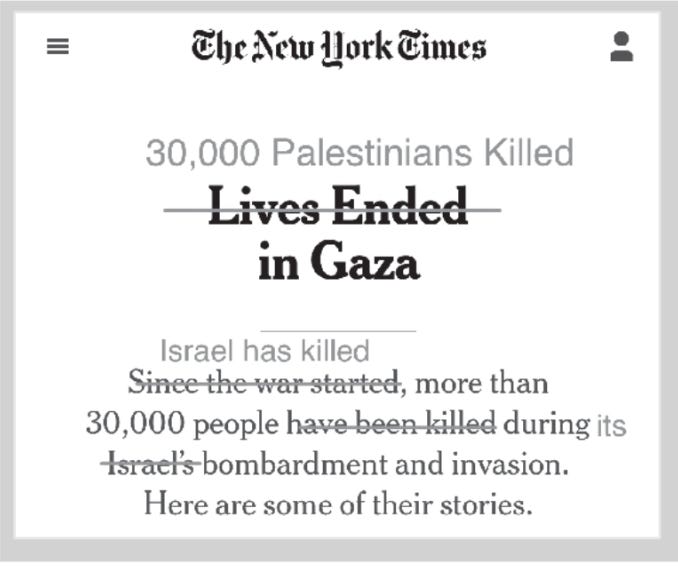
I found myself mentally rewriting it, inserting the missing context, restoring the agency and violation that had been carefully edited out. What would happen, I wondered, if the headline actually said what was happening? If it distinguished the occupier and the occupied? So, I decided to make those changes. I took a screenshot, crossed out the problematic language, made my edits in red, and posted it. I did not expect a strong reaction. But as the post gained traction and the image spread, I realized it could do more than correct headlines. It offered a way to expose how reality itself had been slanted to fit our political ecosystem.
This work only became more pertinent as the genocide in Gaza unfolded starting in October 2023. Previous studies have examined how so-called papers of record like the New York Times have long distorted stories about the Palestinian struggle to serve the policy objectives of the U.S. and Israeli governments. However, because the Gaza Genocide was live-streamed to our devices, the gap between reality and its media representation became undeniable. The same euphemisms and omissions I had once corrected with some public engagement were now visible to anyone comparing what they were watching in real time with what they were reading in the news. The scale of Israel’s violence in Gaza laid bare the hypocrisies of the Western world and the anti-Palestinian bias that drives public discourse in a manner that was undeniable.
For years, mainstream media have helped to normalize Israeli occupation and cruelty against Palestinians, with carefully chosen language to construct a narrative that suited Israeli talking points and the Western governments that repeated them. By adopting frameworks that obscure Israel’s decades-long military occupation, its blockade of Gaza, and its apartheid policies, Western media normalized war crimes and helped maintain the illusion of Israel’s perpetual victimhood. Worse still, they used euphemistic language and misleading narratives to dilute public understanding of international law and immunize Israel from accountability in order to justify the worst crime against humanity: genocide.
I spent more than two years tracking, documenting, and analyzing Western media’s coverage of the genocide in Gaza. My goal was not to nitpick headlines or play semantic games. It is to show how language is used as a weapon to obscure and sanitize. When indiscriminate bombing is called “targeted strikes,” a policy of starvation is described as a “humanitarian challenge,” and genocide is reframed as “self-defense,” these linguistic choices are not accidental. They are political decisions that determine whose lives count and whose deaths are permissible.
Headlines matter because people often do not read beyond them. People regularly consume headlines, social media posts, push notifications, and news sound bites passively while scrolling on their phones or seeing a news ticker in the background of their daily lives. This everyday intake then becomes the language entrenched in the public mind. Most people do not follow specific events closely or have expertise, and articles are often behind a paywall. Thus, what is passively consumed from the news media, combined with popular culture and political discourse, is crucial in influencing public opinion. The words chosen in those headlines – especially in outlets seen as objective or authoritative – affect how the public understands global events. That polling among Americans often shows a gap between the reality on the ground and their knowledge of the facts speaks to the way information is presented to them.
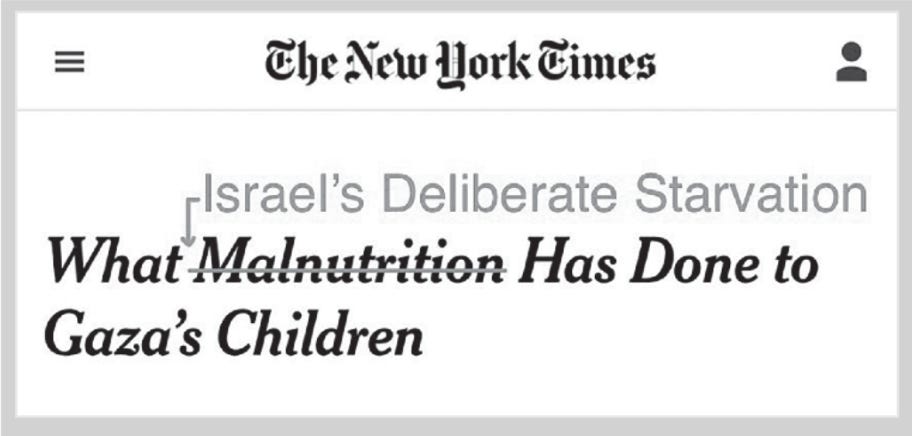
If the truth were plainly stated – that a U.S.-backed ally is carrying out mass atrocities against a besieged civilian population – it might provoke outrage, demands for accountability, and a crisis of legitimacy for U.S. foreign policy. But if the story is blurred – if Israel is abstracted, Palestinians are dehumanized, and a war crime like starvation is rendered as an unfortunate emergency of “malnutrition” – then the machinery of consent can continue to function.
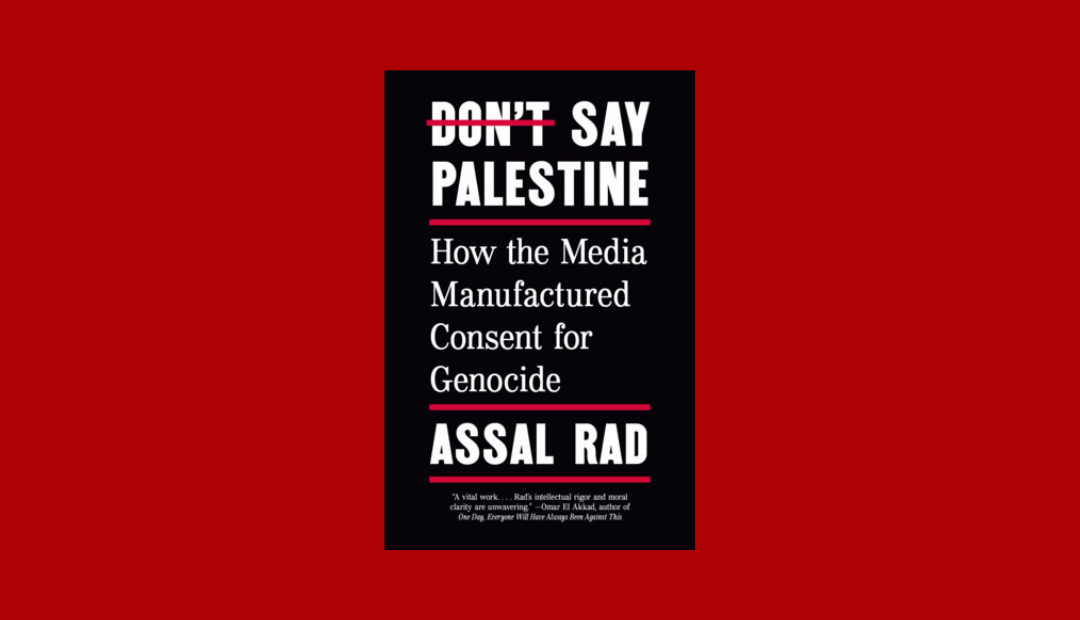
Of course, not all coverage was bad, and this is not a case against individual journalists, many of whom did excellent and essential reporting. Instead, the central point of my book, Don’t Say Palestine, is to look at the overall narrative construction and an institutional media ecosystem that whitewashed Israel’s genocide against Palestinians.
Coverage like that of the horrific case of 5-year-old Hind Rajab in early 2024, which lacked emotive language to lessen the impact of Israel’s actions, provides a striking example of this tendency. Even the killing of Hind, a child trapped in a car surrounded by her dead relatives, calling for help for hours before she too was killed by Israeli fire, was reported with clinical detachment. The story made headlines, but the language drained it of outrage, even though Hind’s car was riddled with more than 300 bullets fired by an Israeli tank at close range, the medics who were sent to save her were also killed, and she was left to die alone in absolute terror. There were no words like “massacre” or “murder” to describe this monstrosity. Headlines from major outlets like the New York Times, CNN, and the BBC simply stated that Hind was “found dead,” without bothering to name her killer.
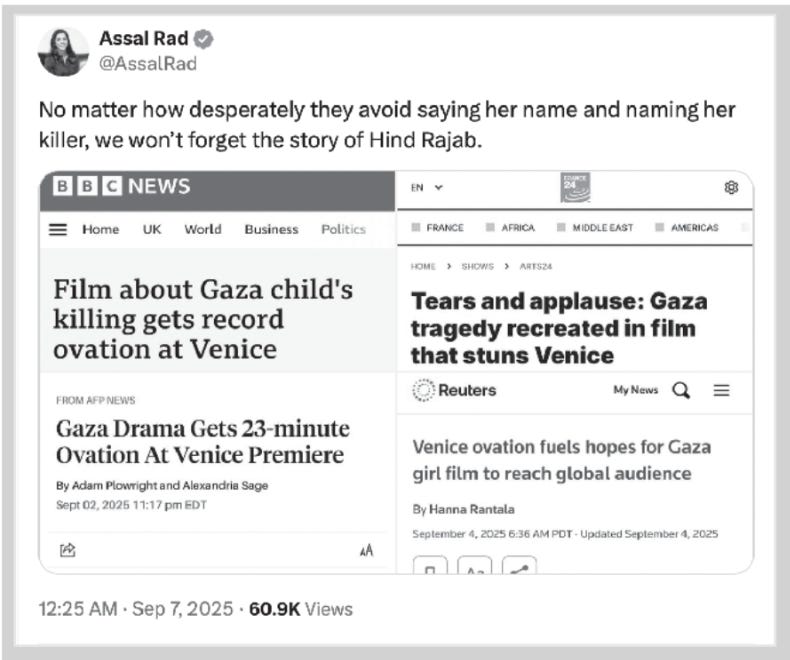
The story of Hind Rajab was so appalling that it inspired a film, ‘The Voice of Hind Rajab,’ directed by Kaouther Ben Hania, which used the haunting recording of her call with rescue workers in which she pleaded for help. Headlines about the movie, like the incident itself, left out her killer and even her name.
As press freedom groups decried Israel as the biggest killer of journalists – having killed more journalists since October 2023 than any other country on record since 1992 – respected international agencies like UNICEF stated that a “whole classroom of children” was being killed every day in Gaza, and when we reached major death toll milestones, legacy media often underreported or erased Israel from their headlines to shield it from responsibility.
When Israeli officials openly stated their intention to occupy Gaza, Western media used euphemisms like “Israeli presence” and “open-ended control” to sanitize occupation. The media’s complicity in Gaza, however, came at a time when people were no longer reliant solely on legacy media for information.
Before intensified content censorship, shadow banning, and platform restructuring that happened in the wake of public shifts in opinion about Israel, social media feeds were flooded with images and videos recorded by Palestinians in Gaza themselves. For more than two years, anyone with a social media account could wander into a constant stream of unedited glimpses of apocalyptic destruction, mass slaughter, and helpless civilians being carpet-bombed with nowhere safe to go. People watched entire apartment buildings collapse, neighborhoods flattened, hospitals blown up, doctors documenting overflowing hospitals with the injured and dead spread across the floor, children amputated without anesthetics, press vehicles targeted, bodies torn to shreds, entire families buried in rubble, and so much more.
With social media, smartphones, and the brave work of Palestinian journalists on the ground, the world watched what was happening with their own eyes. Platforms like Twitter/X, TikTok, and Instagram brought these raw scenes directly to millions of phones around the world. This is exactly why these platforms came under mounting legal and political pressure, triggering increased content suppression and restrictions, and even the forced sale of TikTok, in which the platform’s U.S. operations were restructured and came under the control of U.S. investors with a history of support for Israel. These shifts raise urgent questions about what kinds of content will continue to be visible and what more might be suppressed in years to come.
I corrected media headlines throughout the Gaza Genocide to illustrate how a simple change in tone or structure, and the elimination or addition of a few words – sometimes only one word – changed the way the story was being told. It was also meant to show that the way it was being told – to defend Israel’s actions and minimize the cruelties Palestinians endured – was a deliberate choice that echoed the official positions of Western governments. Gaza destroyed whatever credibility remained – albeit tenuous – in the Western-led global order and its lauded notions of a free press.
Media coverage on Palestine: What are problematic patterns?
Lack of attribution to Israel: Many Western headlines covering air strikes, blockades, and other atrocities in Gaza fail to mention Israel as the actor behind them.
Not naming the victims: The media often fail to use the word “Palestinian” to identify the victims of Israel’s atrocities in Gaza, even though the victims are Palestinian.
Dehumanizing language: The words used to describe Israelis versus Palestinians are often different, leading to the dehumanization of Palestinians. For example, Israeli soldiers are labeled “hostages,” while Palestinian children detained without charge are labeled “prisoners.”
Avoiding criminalizing language: The media whitewash Israeli crimes by avoiding specific language that describes what Israel is doing, such as “genocide,” “occupation,” “war crime,” and “ethnic cleansing.”
Normalizing war crimes: By presenting Israeli actions—such as targeting hospitals, killing journalists, and using starvation as a weapon of war—as the application of pressure tactics or in pursuit of valid targets, the media are helping to normalize war crimes. For example, headlines that legitimize Israel striking a hospital or school by stating it was “targeting Hamas,” even as civilians are killed.
“Israel says” – Repeating Israeli statements or talking points: The media often uncritically repeat statements from Israeli officials and the Israeli military as fact, despite repeated cases of Israel being caught in lies, ICC arrest warrants for Israeli war crimes, and the global consensus that Israel is committing genocide.
Casting doubt on Palestinians: While treating Israeli statements as fact, the media treat Palestinian sources with suspicion. You can see this in the media’s use of “Hamas-run” to cast doubt on Gaza’s death toll as well as every institution in Gaza.
Underreporting: In some cases, the media simply avoid reporting news that paints Israel in a poor light. There is little to no coverage of such news, and if it is published, it has fewer posts on their social media platforms and is not often sent as a push notification to raise public awareness.
Separating issues: By using terms like “Gazans” and “West Bank residents,” the media present issues of Palestinian liberation and Israel’s long history of occupation and apartheid as disconnected. In reality, all of the abuses Palestinians endure – whether in Gaza, the occupied West Bank, or East Jerusalem – are related and must be contextualized as part of Israel’s broad policies against Palestinians and Palestine. Though they are unique identities and experiences, the media’s separation is misleading.
As of this writing, the Gaza Genocide continues under the banner of a “ceasefire.” Israel still occupies the territory; the daily mass killing in Gaza has lessened, but Palestinian death has been normalized to the point that smaller-scale killing often goes unreported, all as aid and reconstruction are obstructed. Accurate death toll numbers are difficult to produce due to relentless bombardment, the collapse of medical and administrative systems, and the inability to recover thousands of bodies trapped beneath the rubble. The official death toll, according to the Gaza Health Ministry, is more than 73,780, with over 174,000 injured. These figures are widely understood to be undercounts; epidemiological studies and analysis suggest that the true death toll – including indirect deaths caused by hunger, disease, and destruction of the health-care system – may ultimately reach into the hundreds of thousands.
Despite every sickening image, every piece of evidence, every report, Israel continues to act with total impunity, and the future of Gaza – and Palestinians as a whole – remains uncertain. What will come to pass will be written in history books. But the stories of Palestinians must also be told, not just as numbers and statistics, and not as victims alone, but also as a people whose struggle for freedom transcends borders and generations. The stories of the people we came to know and can never forget, like Hind Rajab, Anas Al-Sharif, Khaled Nabhan and his granddaughter Reem, and so many others. As well as the stories of those yet unnamed, buried in the rubble, waiting for their just peace.
From Don’t Say Palestine: How the Media Manufactured Consent for Genocide by Assal Rad. Reprinted by permission of Vintage Books, an imprint of the Knopf Doubleday Publishing Group, a division of Penguin Random House LLC. Copyright © 2026 by Assal Rad.
Assal Rad is a historian of the Middle East. She is also the author of The State of Resistance: Politics, Culture, and Identity in Modern Iran.
The views expressed in this article are the author’s own and do not necessarily reflect those of Zeteo.
Check out more from Zeteo:


Well done!
Free Palestine