


Note from our Editor-in-Chief:
We are very privileged to unveil this new series on Gaza’s death toll from our newest Zeteo contributor, Dr. Feroze Sidhwa, a trauma surgeon from California who volunteered in Gaza’s besieged hospitals in both 2024 and 2025. He was also the author of the acclaimed and viral New York Times op-ed, “65 Doctors, Nurses and Paramedics: What We Saw in Gaza.” Please do follow this three-part investigation of his over the next three days, and please do support Zeteo’s ongoing expansion by becoming a paid subscriber and/or donor. A free press isn’t free! - Mehdi
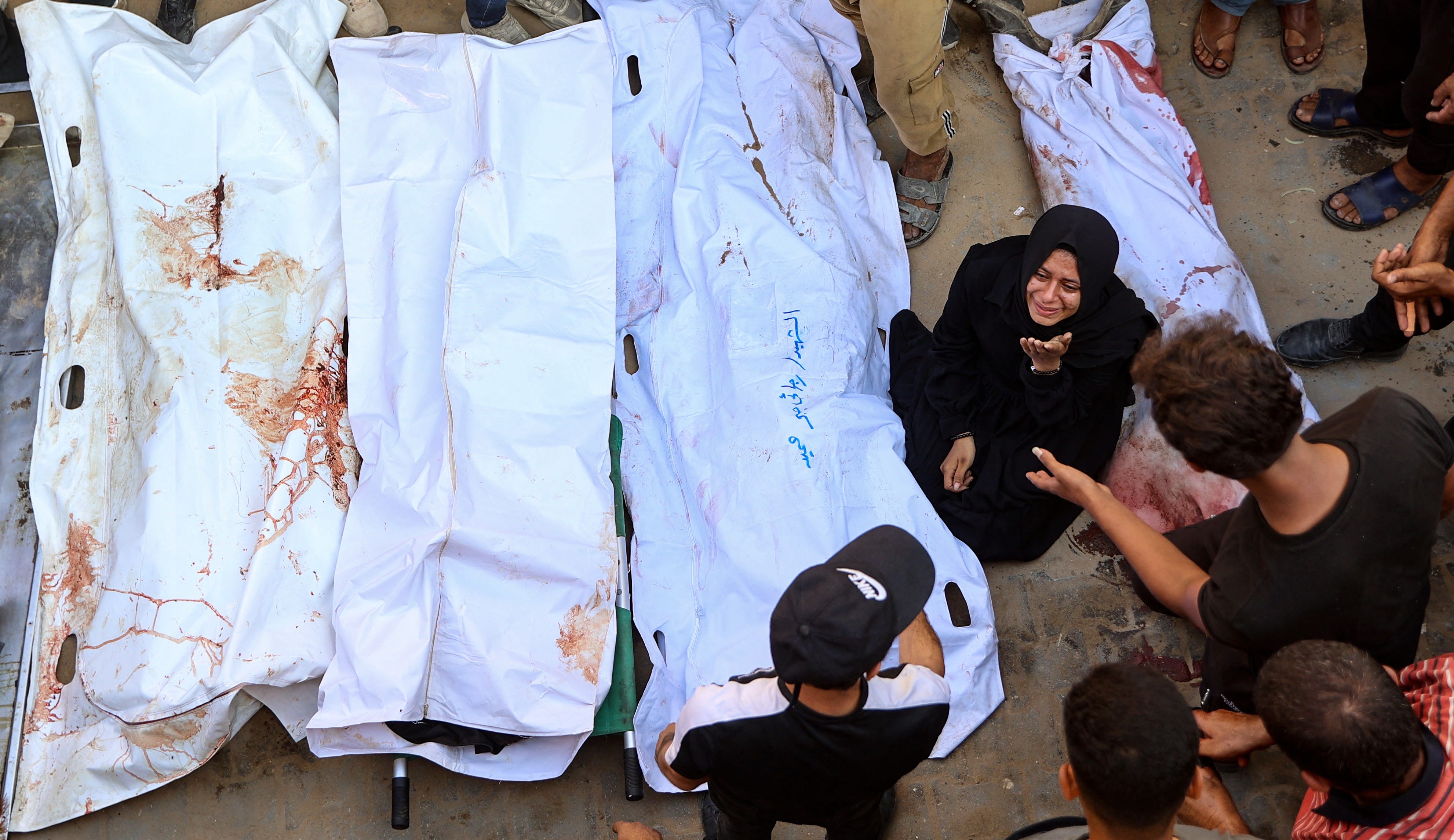
“If we are to envision a less violent world, we must first understand how violent the world is.”
-Avid Reza, James A Mercy, and Etienne Krug
In prepared remarks that recently went viral, former Obama speechwriter Sarah Hurwitz lamented that she “can’t have a sane conversation” about Israel and Gaza because “you have TikTok just smashing our young people’s brains all day long with video of carnage in Gaza… I want to give data and information and facts and arguments, and they are just seeing in their minds carnage, and I sound obscene.” Not to be outdone, Hillary Clinton followed suit. In an unusually blunt statement directed at a former American secretary of state, the Lemkin Institute for Genocide Prevention and Human Security noted that “Secretary Clinton appears not to be bothered by the reality of genocidal violence – in fact, she did not mention anything about it.”
Hurwitz continued: young people believe the “lesson of the Holocaust” is that “you fight the big powerful people hurting the weak people,” so “when on TikTok all day long they see powerful Israelis hurting weak, skinny Palestinians, it’s not surprising that they think, ‘Oh, I know the lesson of the Holocaust is you fight Israel.’” Hurwitz drew the obvious conclusion: young people took the wrong lesson from Holocaust education.
Leaving aside the evident lack of self-awareness, Hurwitz raises an important question: what do the “data and information and facts” tell us about what happened in Gaza in the past two years?
The latest US-Israeli attack on Gaza is “one of the most severe and indiscriminate uses of military violence against a civilian population in the 21st century,” as my co-authors and I recently wrote in The New England Journal of Medicine. I refer to it as a “US-Israeli attack” due to the US’s longstanding, crucial, and largely unconditional support for Israeli militarism. Just since Oct. 2023, the US has spent upwards of $32 billion on material and support, deployed the American military against groups that sought to stop the assault, vetoed seven UN Security Council resolutions while ignoring or undermining the four resolutions it didn’t veto, and repeatedly sanctioned the International Criminal Court after it issued arrest warrants for Israeli and Hamas officials.
The International Association of Genocide Scholars, the UN Human Rights Council, the UN Special Rapporteur on Human Rights in the Occupied Palestinian Territory, Amnesty International, B’Tselem (a leading Israeli human rights organization), Physicians for Human Rights Israel, virtually every Palestinian human rights organization, hundreds of international legal scholars, the Lemkin Institute for Genocide Prevention and Human Security, and many of Israel’s and the world’s leading Holocaust and genocide scholars including Omer Bartov, Raz Segal, Amos Goldberg, Martin Shaw, Marianne Hirsch, Daniel Blatman, and Michael Rothberg have all concluded that Israel is committing genocide in Gaza. The only relevant authority that hedged on this question is Human Rights Watch (HRW), which concluded that Israel’s actions “may amount to the crime of genocide” in Gaza. Meanwhile, Kenneth Roth, who served as director of HRW for nearly three decades, and Aryeh Neier, the organization’s co-founder and a Holocaust survivor, have both concluded that Israel is committing genocide in Gaza. The world’s highest legal body, the International Court of Justice (ICJ), ruled in January 2024 that the Israeli assault could violate the 1948 Convention on the Prevention and Punishment of the Crime of Genocide. It ordered Israel to halt the assault on Rafah, stop impeding humanitarian access to Gaza, and facilitate an international commission of inquiry into the genocide allegations. The orders were ignored; the ICJ case is ongoing.
As Israeli Prime Minister Benjamin Netanyahu and his ministers have repeatedly, publicly, and plainly stated throughout the entirety of the assault – in Hebrew and English, on official government websites and social media, and in the Israeli and American media – the release of all Israeli hostages and captives will trigger a renewed Israeli assault on Gaza. “If there is a deal – and I hope there will be – Israel will return to fighting afterward,” Israel’s Channel 12 quoted Netanyahu as saying in December 2024. “There’s no reason to obscure or conceal this because resuming fighting is intended to complete the war’s objectives,” he continued.
Defense Minister Israel Katz echoed Netanyahu, stating matter-of-factly two days after the October 2025 Israel-Hamas agreement was signed that once Israel’s hostages are returned, Israel will resume the assault. Israel’s finance minister (a self-described “fascist homophobe”) and national security minister (recently condemned by Yair Lapid as a “dangerous Jewish fascist”) both head ultranationalist Jewish supremacist parties. They have consistently opposed any permanent halt to the assault. “Both men,” the New York Times reported, “wield outsize influence because their small parties are critical to keeping Mr. Netanyahu’s governing coalition in power.” Indeed, two days after the repatriation of the remains of the last Israeli captive, Netanyahu announced that the reconstruction of Gaza “will not happen” and that Israel plans to demilitarize the Strip and disarm Hamas, which can only be done by resuming the assault. Unless the Israeli and US governments radically break with decades of established behavior, and taking into account political and military realities, the US and Israel will be free to continue the destruction of Gaza and the Palestinians living there under pretexts that are already being publicly established and reported uncritically, regardless of their absurdity.
Israeli attacks on Gaza continue, keeping with a nearly century-long pattern of Israel breaking ceasefires by continuously intensifying attacks until an adversary has no choice but to respond. As Haaretz editorialized, the “fact that all the living hostages have been returned to Israel, as well as most of the bodies of the dead, gives Netanyahu the freedom to raise and lower the flames as he pleases.” Western media will undoubtedly continue a long pattern of reporting the inevitable armed response from the Palestinians as unprovoked aggression, justifying Israel’s military response. Indeed, American corporate media are performing their usual function by ignoring daily Israeli ceasefire violations or laundering them with absurdist headlines such as “Israeli Strikes Kill at Least 25 in Gaza Amid Truce” (New York Times) or “Israel launches strikes in Gaza ceasefire’s latest test” (NBC News).
Over the next few days, I will publish a series of articles on Zeteo that focus on the question raised by Hurwitz’s remarks: what do we know about how many Palestinians have died in the US-Israeli assault on Gaza? The answer is both quite a bit and very little, but it’s more than enough to draw conclusions about what Americans like me should be doing about it.
I’ve volunteered as a trauma surgeon in Gaza twice since October 2023 (Israel’s Shin Bet security service blocked me from a third humanitarian deployment in November 2025). This event called “the Gaza genocide” is not an abstraction or something I experienced through a screen. It is the blood of my patients, some of whom were my own colleagues’ children, soaking through my scrubs and onto my skin in hospitals lacking soap and running water. It’s the terror I saw in my mother’s eyes when I recounted the story of Israel bombing Nasser Medical Complex, killing one of my patients, and setting the hospital ablaze while I was working there. Still, I hope to present this information dispassionately so that it can be clearly understood.
This series of articles details for the layperson what is known about the death toll of the US-Israeli assault on Gaza that began after the Hamas-led Oct. 7 attacks. Today’s article – the first in the three-part series – orients the reader with the historical background of Gaza since the early 2000s. The second piece will detail what is known about the Ministry of Health’s count of the dead, and what scientific investigations of the death toll from violence in Gaza since Oct. 2023 reveal. The last article will examine robust but non-scientific inquiries into the violence in Gaza.
Those who care about what the United States is doing in the world and what awaits the Palestinians in Gaza if we continue with the Israeli government down its openly announced path should be armed with the information contained herein. That starts with understanding the historical context of the Strip and how we got to today.
Gaza on October 6
Geographically, the Gaza Strip is the panhandle of the Egyptian Sinai Peninsula. It’s the land west and south of the 1949 armistice line between Israeli and Egyptian forces. During and after the 1947-49 Arab-Israeli War, Israeli forces expelled approximately 250,000 Palestinians from the newly created state into the Strip, turning them into stateless refugees and overwhelming the 80,000 inhabitants of the area. The length of a marathon and the width of a quick jog, at 141 square miles (365 square kilometers), the Gaza Strip is the size of Philadelphia.
On Oct. 6, 2023, approximately 2.2 million Palestinians lived in the Strip, making it one of the most densely populated places in the world. Overall, the territory was more densely populated than Boston, while its largest urban center, Gaza City, was more crowded than New York City. Gaza’s refugee camps were among the most densely populated places on Earth, with Shati Camp and Jabalia reaching 184,000 and 85,000 people per square kilometer, respectively, compared to the less than 30,000 per square kilometer in the world’s most densely populated city, Mumbai. Gaza City was the largest metropolis in the occupied Palestinian territory, with a population of 731,000. About 66% of the Strip’s people are refugees and the descendants of refugees. About 52% of the population was 19 or younger, 40% was age 14 or younger, and 13% was age 4 or younger, also making Gaza one of the world’s youngest places.
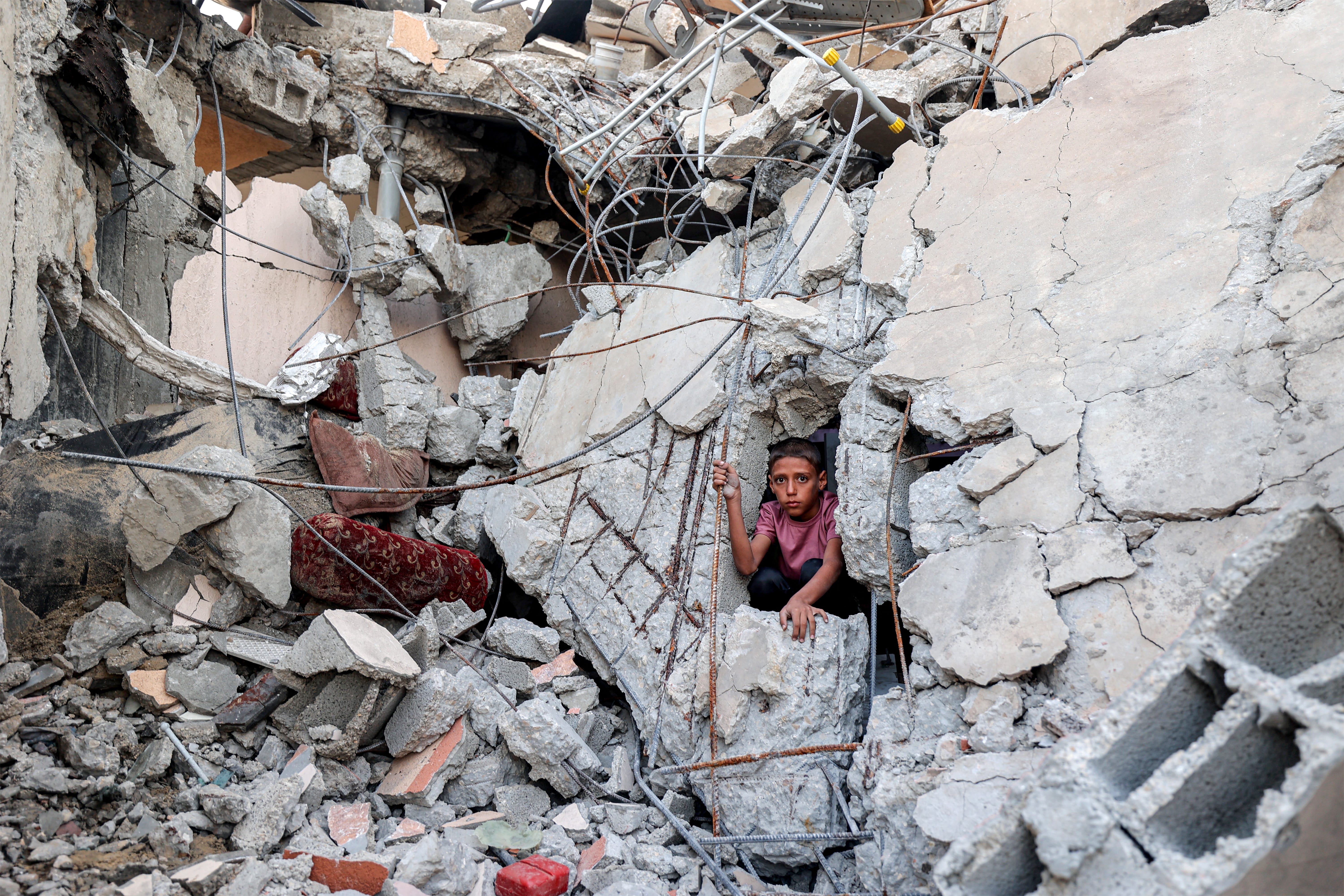
By October 2023, living in Gaza, according to the UN Conference on Trade and Development, “meant confinement in one of the most densely populated spaces in the world, without electricity half the time, and without adequate access to clean water or a proper sewage system. It meant a 65% probability of being poor, 41% probability of dropping out of the labour force in despair, and for those looking for work, a 45% probability of being unemployed…” The British Economist magazine was blunt: “Gaza is a human rubbish heap that everyone would rather ignore.”
Norman Finkelstein’s 2018 book, Gaza: An Inquest into its Martyrdom, begins: “This book is not about Gaza. It is about what has been done to Gaza.” What has been done since 2005 steadily turned Gaza from a desperately poor and heavily repressed “giant open prison” (former British Prime Minister David Cameron) or “huge concentration camp” (former head of Israel’s National Security Council, Retired Major General Giora Eiland) into something for which no descriptor exists.
To understand the death toll from violence since Oct. 7, 2023, we need to review the history of US-backed Israeli violence in Gaza until that point.
‘A Curve Steadily Regressing into Barbarism’
From 2004 to October 2023, Israel carried out at least 13 military assaults on Gaza. These attacks saw American warplanes burning American jet fuel and dropping American bombs designed to destroy military objects on homes, apartment buildings, and civilian infrastructure, and the destruction of entire neighborhoods, farms, and industries with American bulldozers and American M15 mines. The US taxpayer has financed Israeli militarism to the tune of well over $300 billion (in 2024 dollars) since 1946.
The US-backed Israeli attacks on Gaza qualitatively and quantitatively changed in 2008-2009 with Operation Cast Lead, the first truly massive US-Israeli air and ground assault since the imposition of a land, air, and sea blockade in 2007. The human rights reports from Cast Lead and subsequent attacks illustrate that almost nothing that was done to Gaza after Oct. 7, 2023, was new; only the intensity increased.
After Cast Lead, Human Rights Watch detailed the killing of Palestinian women and children waving white flags, the deliberate and precise targeting of civilians with drones, and the indiscriminate firing of white phosphorus (burning at 1,500 degrees Fahrenheit) at hospitals, shelters, and UN compounds. Amnesty International’s report, “22 Days of Death and Destruction,” described airstrikes targeting civilians and civilian objects, tank fire at “anything that moves,” the deliberate shooting at close range of unarmed women and children, indiscriminate firing of white phosphorus and flechette shells, repeated firing on ambulances, killing paramedics, the use of civilians (including children) as human shields, repeated attacks on aid convoys and UN compounds, the targeting of UN and humanitarian workers, deliberate blocking of humanitarian aid, and “wanton destruction” of homes, public buildings, industry, and agriculture. A UN fact-finding mission reached much the same conclusions, characterizing Cast Lead as “a deliberately disproportionate attack designed to punish, humiliate and terrorize a civilian population, radically diminish its local economic capacity both to work and to provide for itself, and to force upon it an ever-increasing sense of dependency and vulnerability.”
Biennial aerial bombardments of Gaza continued, but the next massive air and ground assault was Operation Protective Edge in 2014. This attack was far deadlier and more destructive than Cast Lead. Finkelstein notes that with each new attack on Gaza, “Israel’s evolving modus operandi…described a curve steadily regressing into barbarism.” More recent analyses agree. In Cast Lead, Israel killed at least 1,387 Palestinians, including 339 children, while in Protective Edge, Israel killed at least 2,202 Palestinians, including 526 children. In Cast Lead, Israel destroyed 8,000 Palestinian homes and generated 600,000 tons of rubble, while in Protective Edge, it was 18,000 homes and 2.5 million tons of rubble. Peter Maurer, the former president of the International Committee of the Red Cross (whose job is to visit and assess war zones), visited Gaza in August 2014 and tweeted “I’ve never seen such massive destruction ever before #Shujaia,” referring to the neighborhood of Gaza City where on one day, July 20, 2014, Israel dropped over one hundred 2,000lb US-made bombs, each with a lethal radius of 400 yards, and 600 artillery shells with a lethal radius of 54 to 164 yards. Two years after the attack, an Israeli journalist described Protective Edge as a “wild war of revenge” that “turned the entire Gaza population into an ‘infrastructure’ to be destroyed.”
There are many more events in the timeline of Gaza’s destruction, not least of which is the 2018 Great March of Return and Israel’s US-backed maiming and mass killing of women, children, journalists, medics, and even double amputees who were participating in a weekly celebration of Palestinian culture and music. But for reasons of space and the task at hand the reader should appreciate that on Oct. 6, 2023, Gaza was a territory the size of Philadelphia, populated largely by refugee children, almost entirely isolated from the outside world and even from the rest of the occupied Palestinian territory, where nearly everyone had fled massive US-backed Israeli bombing campaigns multiple times in their lives, and where family and social solidarity were deeply held virtues.
Part 2 in this series examines what the Palestinian Ministry of Health in Gaza and the scientific public health literature reveal about the death toll from direct violence in Gaza since Oct. 7, 2023.
Want to read Parts 2 and 3 of this series? Check them out here:
The Truth About Gaza's Death Toll – Part 2: A Gross Undercount

Editor’s note: This is the second part of a three-part series unpacking the real death toll in Gaza. To read part one, which examines the historical context of Israel’s decades of assaults on Gaza, click here.
The Truth About Gaza's Death Toll – Part 3: What Do We Actually Know?

Editor’s note: This is the last article of a three-part series unpacking the real death toll in Gaza. To read part one, which examines the historical context of Israel’s decades of assaults on Gaza, click here. For part two, which dives deep into the scientific studies about the undercount of those killed, click
Dr. Feroze Sidhwa is a general, trauma, and critical care surgeon in California. He is also a humanitarian surgeon who has worked in Palestine, Ukraine, Haiti, Zimbabwe, and Burkina Faso. He most recently volunteered at Nasser Medical Complex in Khan Younis, Gaza. He was blocked from entering Gaza by Israel’s Shin Bet intelligence service in November 2025.
The views expressed in this article are the author’s own and do not necessarily reflect those of Zeteo.
Editor’s note: Due to an editing error, this piece has been updated to correct the percentages of youth in Gaza who were aged 19 or younger, 14 or younger, and 4 or younger prior to Oct. 7, 2023.
Check out more from Zeteo:
When these horrible people say the Tik Tok generation don’t know “facts and figures”, I lose all hope that politicians will ever listen. The young people I’ve encountered who have been unfortunate enough to witness a Holocaust on their screens are very educated on the history of the region. We all grew up learning the horrors of the Holocaust and the lesson was never again for anyone! As I browsed my Instagram feed and saw a baby shaking in pain from the burns she suffered I broke down in tears. I am never numb to the atrocities, but I am a bit broken wondering how we live in a world where this can occur. Empathy is gone and the sanctity of life seems to mean nothing to those in powerful positions.
This is outstanding Doc. Thanks for doing this series. I am surprised you decided not to use the “…wall of dead children” quote for Hurwitz. That one stuck with me for days, but I think all this speaks for itself.