


This piece was first published by Project Syndicate. We are republishing with its permission, as it includes analysis about the growing protests in Iran.
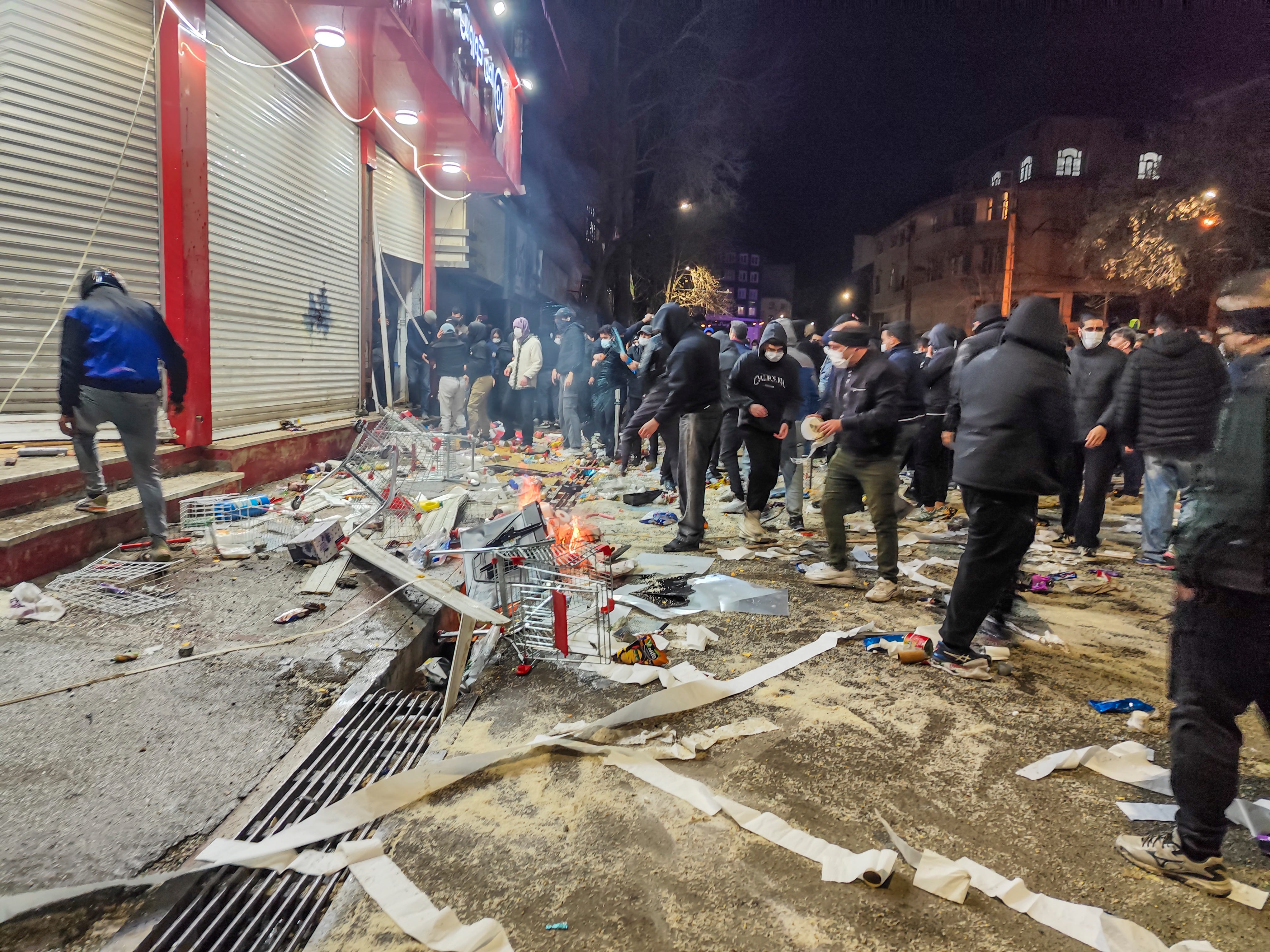
BLACKSBURG, VIRGINIA – The protests that erupted in Tehran on December 28 and quickly spread across Iran were triggered by a specific grievance: the collapse of the country’s currency, the rial. Currency devaluation in Iran is never merely a technical matter; it quickly drives up prices and reduces purchasing power, especially given that many wages are set annually. In December, as the rial’s value fell by 16% – for a total decline of roughly 84% over the past year – food inflation reached an annual rate of 72%, nearly double its recent average.
These developments follow decades of economic isolation. Starting in 2011, sanctions on Iranian oil sharply reduced the country’s foreign-exchange earnings and slowed GDP growth from a respectable 5-9% annually in the early 2000s to less than 3% thereafter. The loss of oil revenues created chronic budget deficits that the government has financed through monetary expansion, fueling inflation.
Iran’s economic situation deteriorated further last year, when sanctions gave way to open confrontation. While the 12-day war with Israel and the United States in June 2025 caused limited physical damage, it exposed Iran’s vulnerability to sudden escalation, belying the regime’s claims to have things under control and raising the country’s risk premium. Investment, already too low to compensate for rial depreciation, fell further, owing to fears of additional attacks by Israel and the US.
Iranian President Masoud Pezeshkian’s attempt to impose long-delayed economic reforms has compounded the pressure. His proposed budget for the new Iranian year (starting on March 20, 2026), submitted to parliament in November, was more contractionary than expected. Taxes were scheduled to rise from 42% to 57% of government revenues, reflecting the anticipated drop in oil income.
At the same time, public-sector wages were set to increase by less than half of the government’s projected inflation rate of 46% for the next year. Although parliament later softened the blow, cutting the proposed value-added tax from 12% to 10% and doubling the wage increase, the message of austerity had already been sent.
While austerity is a hard sell under any circumstances, it becomes politically combustible in a society that views official corruption as pervasive and constantly confronts ostentatious displays of wealth. Perceptions of rampant inequality have been reinforced by the Iranian economy’s distortionary system of multiple exchange rates.
As oil exports fell from more than two million barrels per day before 2011 to as little as 300,000 barrels in 2019, the government allocated a portion of its scarce foreign exchange at highly subsidized rates in order to shield Iranians from the impact of sanctions. But the system ended up facilitating rent-seeking and capital flight, with many recipients spending the money not on imports of essential goods, but rather on luxury items or overseas travel, or reselling the foreign exchange at market rates.
Iran’s government later introduced managed foreign-exchange markets, which enabled licensed exporters to sell their foreign-currency earnings to importers under government supervision, at rates that are between subsidized and market prices. But it remained reluctant to eliminate the multiple exchange-rate system, fearing backlash from influential traders with privileged access.
Pezeshkian, however, was willing to take this step. But his move to eliminate one of Iran’s most visible sources of corruption undoubtedly angered entrenched interests, possibly contributing to the initial strike among merchants in Tehran’s Grand Bazaar, which triggered the broader protests. While that strike might have been politically motivated – reformers have often accused their conservative rivals of using their institutional power to resist change – the protests quickly spiraled into a crisis so acute that both factions are now looking for a way out.
The challenge is economic as much as it is political. The government’s efforts to increase revenues, narrow the budget deficit, and reduce its reliance on money creation could eventually lower inflation. But, in the short term, the reforms will carry economic costs. Eliminating foreign-exchange subsidies immediately raises prices for certain goods, potentially fueling broader inflation and putting downward pressure on the rial.
To compensate households, the government has introduced monthly transfers of ten million rials per person (about $7, or $40 in purchasing-power-parity terms). It has already deposited payments for roughly 80 million beneficiaries, excluding only the wealthiest decile. But whether this will be enough to tame the protests is far from clear.
The objectives of Iran’s last nationwide uprising – the “Women, Life, Freedom” movement of September 2022 – were more straightforward. Sparked by the killing of 22-year-old Mahsa Amini by the country’s morality police, the protests were met with a brutal crackdown. Nonetheless, they are widely considered to have achieved at least one of their goals: to stop the enforcement of the hijab law. A growing number of Iranian women and girls now choose not to wear the hijab in public.
By contrast, the benefits of Pezeshkian’s reforms are uncertain, likely to materialize only in the longer term, and difficult to communicate to a population battered by years of economic volatility. Iran’s government cannot credibly promise to stabilize exchange rates or tame inflation any time soon. The one move that could offer relatively quick economic relief – and to which the government could credibly commit – is a cessation of hostilities with Israel and the US. But this might prove far more difficult for Iran’s leadership than compromising on hijab enforcement.
In any case, ordinary Iranians are wary of any promises from Israel, especially after its devastation of Gaza, occupation of Syria, and intense bombing of Iran last year, which reportedly killed more than a thousand people. The same goes for the US, which has proven under President Donald Trump that it cannot be trusted even by its closest allies.
Iran’s protests reflect not only economic despair, but also the tension between mistrust of internal reform and fear of external pressure. As such, they may not be easily subdued.
Djavad Salehi-Isfahani is a professor of economics at Virginia Tech and a fellow at the Economic Research Forum in Cairo.
Subscribe to Project Syndicate for more of his writing and other commentaries from writers worldwide.
The views expressed in this article are the author’s own and do not necessarily reflect those of Zeteo.
Don’t Miss It: If you’ll be in the DC area later this month, Zeteo is hosting a special LIVE in-person event you won’t want to miss: Join Mehdi, Swin, Rep. Ro Khanna, Joy Reid, Jim Acosta, Sarah Matthews, and Miles Taylor for a powerful evening at the Howard Theatre in Washington, DC, on Tuesday, Jan 20, 2026!
Check out more from Zeteo:


This is an excellent article. Thanks so much for locating a reliable source.
This is a crucial analysis of Iran’s economic collapse. The protests are real and rooted in material suffering, but there’s a second layer shaping the external response. From the geopolitical behavioral patterns I map in World Ahead 2026 Part 2, Iran is now the next boundary test for a doctrine that no longer distinguishes foreign from domestic policy.
The November 2025 National Security Strategy authorizes sphere‑of‑influence operations. Venezuela proved the playbook works without institutional resistance. Iran is the next proof‑of‑concept, not because of Iranian freedom, but because the doctrine requires demonstrating that U.S. power can scale beyond the Western Hemisphere.
The pattern is systematic: identify a strategic asset, construct a moral pretext, apply force, and redirect the benefits. Venezuela followed that sequence. The Iran threats follow the same logic, now layered onto a state already collapsing under sanctions and corruption.
Selective outrage fits the pattern too. Silence on Gaza and sudden moral urgency on Iran isn’t about human rights, it’s geopolitical convenience. That’s classic moral licensing: humanitarian language used to justify strategic operations while ignoring equivalent suffering elsewhere.
Iran’s uprising is genuine. But the external framing isn’t about justice. It’s about testing whether the Venezuela doctrine can operate globally without constraint. That’s the through‑line connecting Venezuela, ICE killings, Greenland threats, and now Iran.
Appreciate the depth of your economic analysis. Adding the behavioral and strategic layer: this follows predictable authoritarian expansion patterns, and understanding that structure is essential to understanding what comes next.
—Johan
Former Foreign Service Officer