

Supreme Court Blocks Trump’s Tariffs in 6-3 Vote
The Supreme Court blocked the ‘emergency’ tariffs Trump had imposed, breaking with its track record of greenlighting his overreaching claims to power.


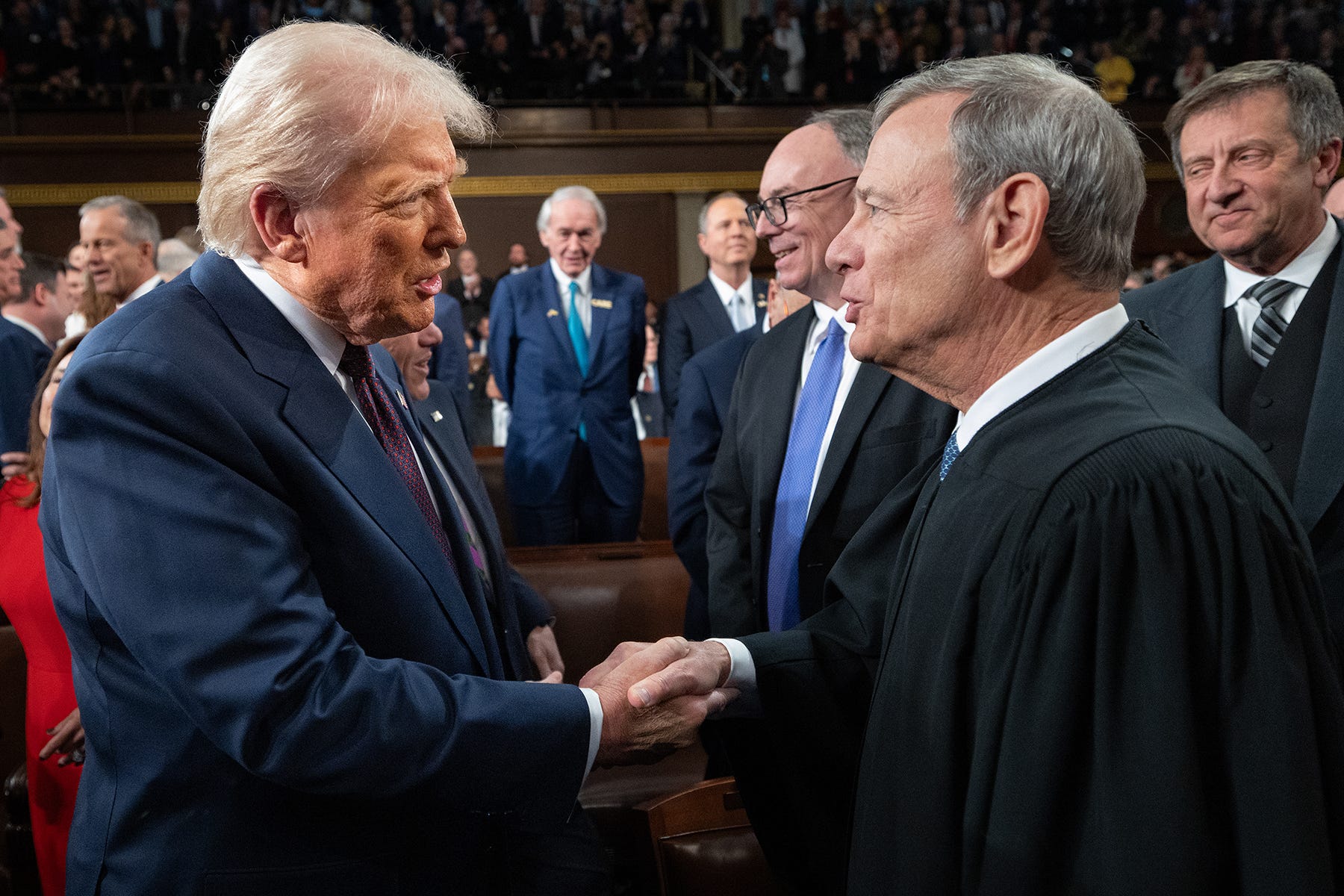
The Supreme Court ruled in a 6-3 decision that Donald Trump did not have the unilateral authority to issue sweeping tariffs, effectively stripping the president of his favorite foreign policy tool – one that has raised prices and helped alienate the US from the world.
“The president asserts the extraordinary power to unilaterally impose tariffs of unlimited amount, duration, and scope,” Chief Justice John Roberts wrote in the court’s lead opinion. “In light of the breadth, history, and constitutional context of that asserted authority, he must identify clear congressional authorization to exercise it.”
Roberts concludes the statute Trump cited as the supposed basis for his tariffs “does not authorize the president to impose tariffs.”
Friday’s ruling comes 10 months after Trump’s self-proclaimed “Liberation Day,” where he imposed a blanket 10% tariff on over 180 countries at once, with some tariff rates exceeding 90%. He summed up his move in one brazen sentence from the White House lawn: “In many cases, the friend is worse than the foe.”
While the conservative-dominated Supreme Court gave Trump sweeping immunity from prosecution and has frequently greenlit key parts of his authoritarian agenda, the president has periodically lashed out at the Supreme Court over its anticipated rejection of his tariffs. Last month, he wrote on Truth Social that “if the Supreme Court rules against the United States of America on this National Security bonanza, WE’RE SCREWED!” Next week, Trump will give his State of the Union speech to Congress – and Supreme Court justices will likely be in attendance.
Not everyone in Trumpworld is furious about the ruling, though. Moments after the decision was released, Stephen Moore, a “Trumponomics” author and an outside economics adviser to the president, told Zeteo in a brief phone call: “It is my personal view that the tariffs are taxes, and all taxes have to start at the US House of Representatives, not the executive branch. That’s in the Constitution. This [decision] is a big deal.”
Several Trump administration officials had privately said in the weeks leading up to the ruling that they expected the high court to rule against the president’s “emergency” tariff regime. However, the Trump officials stressed, they have already briefed the president on Plan B options, which include how to exploit other authorities that they say the president can wield on import fees. It remains to be seen how far the administration will go in terms of trying to work its way around the Supreme Court on this, but officials insist that Trump is still committed to his hyper-belligerent ideas of tariff salvos as a form of leverage over allies and routine economic warfare.
Robert Lawrence, a professor of international trade and investment at Harvard Kennedy School, tells Zeteo that unlike many of Trump’s regional foreign policy moves, including his assaults on Venezuela and the Middle East, his unprecedented – and unlawful – tariffs amounted to “adverse treatment for virtually every country in the world,” Lawrence says, effectively isolating the US in one fell swoop.
While tariff powers are typically reserved for Congress, the US president has some authority to issue them such as for national security reasons, but those provisions don’t authorize blanket tariffs on several countries at once.
To sidestep the limitations, Trump invoked the International Emergency Economic Powers Act, a 1977 law reserved for national emergencies that gives the president broad authority to regulate financial dealings. But the IEEPA does not specifically grant executive power to impose tariffs, and the US Court of International Trade has ruled against Trump’s use of it as such. On Friday, the Supreme Court agreed.
Since Trump took office one year ago, the Supreme Court has overwhelmingly sided with the administration in its overreaching claims to power. But in the tariffs case, some conservative justices appeared doubtful during oral arguments.
Roberts questioned whether Trump had explicit authorization from Congress to impose sweeping tariffs. Justice Neil Gorsuch said that reading the IEEPA to give the president such broad powers would create a “one-way ratchet toward the gradual but continual accretion of power in the executive branch,” because once the president had such powers, he could veto any congressional effort to take them back.
Polls since Trump’s so-called “Liberation Day” show the majority of Americans disagree with the tariffs, and even his supporters are skeptical. A Politico poll in November found only 22% of Trump’s 2024 voters said tariffs are helping the US economy now and in the long run.
The numbers reflect as much. Trump’s tariffs cost the average US household nearly $1,200 last year, according to the Democrats on the Joint Economic Committee. Retail prices have jumped by an average of about 5%. Some items saw even higher increases: apparel prices rose 9%, coffee and tea by 7.5%, and furniture by 6.5%.
The price increases so far are smaller than initially expected, Lawrence said, because many of the initial tariffs were negotiated down, and it’s taking time for prices to reflect the full force of the taxes.
Trump also claimed the tariffs would promote American manufacturing. But most US products use imported parts, which are more expensive with tariffs, essentially damaging US exports as well as imports.
Ahead of Friday’s ruling, Lawrence told Zeteo that if the Supreme Court blocks Trump’s use of IEEPA to impose tariffs, he may have to pay back $175 billion in tariff revenue that the administration has collected. There are other legal provisions he could invoke to keep most of the tariffs in place, Lawrence said, but it would be cumbersome and time-consuming since there’s no provision to issue blanket tariffs across the board.
While Friday’s ruling will limit Trump’s power to issue blanket tariffs, Lawrence predicts the hostility of his attempt will create a US legacy of mistrust and antagonism, and sow doubt about “the rules of the game” moving forward.
Check out more from Zeteo:


Eff this wannabe king!!! Finally SCOTUS found a few vertebrae on the floor!
Finally, someone is stopping Trump's insanity. ✋️