

The horror and outrage over last week’s killing of Renee Nicole Good has centered around the legality of ICE – its rogue violence, the Trump administration’s icing out of state investigators and, on Tuesday, the resignation of numerous Justice Department lawyers after they were reportedly instructed to investigate the actions of Good’s widow at the scene – not Jonathan Ross, the officer who shot her three times, including in the face.
Yet the implications of the incident reach far more deeply, striking at the heart of American democracy’s existential crisis and marking a turning point in Trump’s unprecedented assault on core First Amendment rights – specifically the right to protest, record ICE activity, and express political dissent without fear of government retaliation.
At the time of her death, Good was participating in a community effort to check license plates and flag vehicles residents don’t recognize, use whistles to alert one another of ICE activity, and even drop groceries off to neighbors afraid to leave their homes. The neighborhood in Minneapolis had gone on high alert following a DHS announcement of increased immigration enforcement in the area. Video shows that Good, with the family dog in the car, was pulling away from the scene when Ross shot and killed her.
The Trump administration has called this kind of organized neighborhood activity “domestic terrorism.” Secretary of Homeland Security Kristi Noem characterized videotaping of agents as “violence” and “doxxing,” while officials have threatened to prosecute those who do so.
What Good and her Minneapolis neighbors were engaging in was core speech and assembly. Courts have specifically held that the First Amendment establishes a fundamental right to observe and record “law enforcement” officers (if ICE can be called that) carrying out their duties in public. The Supreme Court has stated that it “is beyond debate that freedom to engage in association for the advancement of beliefs and ideas is an inseparable aspect of the ‘liberty’ assured by the Due Process Clause of the Fourteenth Amendment,” as well, “which embraces freedom of speech.”
That Good was killed for engaging in First Amendment activity protected by the Fourteenth Amendment – and that the Trump administration is backing Ross while maligning Good and her wife – shows how far America has gone down the dark tunnel of fascism. It’s dire. It’s urgent. It’s likely going to get much worse.
To help capture the vastness of the problem, here’s a (non-exhaustive) highlight reel of last year’s blows to the First Amendment:
January 2025
Targeting Student Activism: Shortly after taking office, the administration issued executive orders to monitor and report “alien students” who expressed “hateful ideology” or “hostile attitudes” toward the country’s “founding principles,” specifically targeting pro-Palestinian protesters for potential deportation.
Surveillance of Dissent: ICE reactivated a contract with Paragon Solutions, a company whose hacking tools had previously been used to target journalists and refugee rights activists.
February 2025
Retaliation Against the Press: On Feb. 11, the White House restricted the Associated Press’s access to the Oval Office and Air Force One because the outlet refused to adopt the name “Gulf of America” (for the Gulf of Mexico) in its style guide.
Sanctioning Legal Counsel: On Feb. 25, Trump signed a presidential memo revoking the government contracts and security clearances held by the law firm of Covington & Burling for its representation of Special Counsel Jack Smith.
March 2025
Retaliatory Law Firm Orders: Trump issued additional executive orders against prominent law firms, including Perkins Coie (March 6), Paul Weiss (March 14), Jenner & Block (March 25), and WilmerHale (March 27). Judges later ruled that Trump’s actions amounted to “unconstitutional retaliation” for representing political opponents and supporting diversity initiatives.
Defunding Higher Education: The administration canceled $400 million in federal funding for Columbia University on March 7, citing a failure to “police antisemitism,” which was widely viewed as retaliation for student protests.
Arrest of Student Leaders: On March 8, ICE agents arrested Mahmoud Khalil, a Columbia student protest leader, revoking his green card. On March 25, Tufts PhD student Rumeysa Öztürk was similarly detained and her visa revoked in retaliation for an op-ed she co-wrote criticizing the university’s response to the genocide in Gaza. In these cases, the government used a rarely-cited provision of immigration law that allows the secretary of state to find a noncitizen deportable if he “personally determines that the alien’s admission would compromise a compelling United States foreign policy interest.”
April 2025
Expanded Funding Freezes: The administration halted research grants at Princeton University (April 1) and froze $2.2 billion in funding for Harvard University (April 15) after the schools refused demands to audit academic programs and hiring practices.
June 2025
Suppression of Assembly: During anti-ICE protests in Los Angeles in early June, police fired over 1,000 projectiles at demonstrators in a single day.
July 2025
Canceling Public Media: On July 24, Trump signed a bill, which his administration had specifically requested, canceling $1.1 billion in funding for the Corporation for Public Broadcasting (CPB), a move that effectively shut down the funding source for local NPR and PBS stations. The CPB officially dissolved on Jan. 5, 2026.
August 2025
UCLA Funding Freeze: The administration froze over $300 million in funding for UCLA due to the university’s refusal to change policies regarding affirmative action and campus protests.
September 2025
Suspension of Jimmy Kimmel: In mid-September, ABC suspended Jimmy Kimmel indefinitely following regulatory threats from Federal Communications Commission Chairman Brendan Carr, who called Kimmel’s monologue about Charlie Kirk’s killing “truly sick.” (He returned to air nearly a week after he was suspended.)
NSPM-7 and Surveillance: On Sept. 25, a White House memorandum (NSPM-7) directed law enforcement to investigate and “uproot” organizations promoting “anti-fascism” and “anti-Americanism.” By November, the Brennan Center warned that ICE was spending millions on surveillance technology to specifically target political dissenters and protesters. It included up to $25 million for spy technology that monitors social media and cellphone locations to create “day-in-the-life” profiles of protesters, for surveillance drones to monitor protests, and for facial recognition tools to identify participants.
New Pentagon Policy: On Sept. 19, Trump’s Department of Defense laid out a new policy that requires reporters seeking credentials for covering the Pentagon to sign a pledge that they wouldn’t obtain or use unauthorized information.
October 2025
App Store Censorship: In October, the White House pressured Apple to remove ICEBlock – an app used to track ICE sightings – from its platforms. Legal experts called the maneuver “censorship by proxy” or “jawboning.”
Retaliation Against Bystanders: In Chicago, Rev. David Black was on a sidewalk praying when ICE agents sprayed him in the face with chemical “pepper pellets.” (Since Good’s death, Rev. Kenny Callaghan, a gay Minneapolis pastor, reported that a masked agent pointed a gun at his face and taunted him, asking, “Are you afraid now?” after he approached immigration authorities and told them to stop harassing a woman. Agents have been caught on video tackling and arresting other individuals for recording raids.)
December 2025
Trump Sues BBC: In his latest move to intimidate the free press, Trump sued the BBC in mid-December, alleging defamation over a documentary that spliced together two different parts of his Jan. 6, 2021, “fight like hell” speech. He accused the BBC of misleading the public over the edit, despite the fact that, edits aside, he did explicitly encourage the Capitol Hill riot.
Then there was Good’s killing.
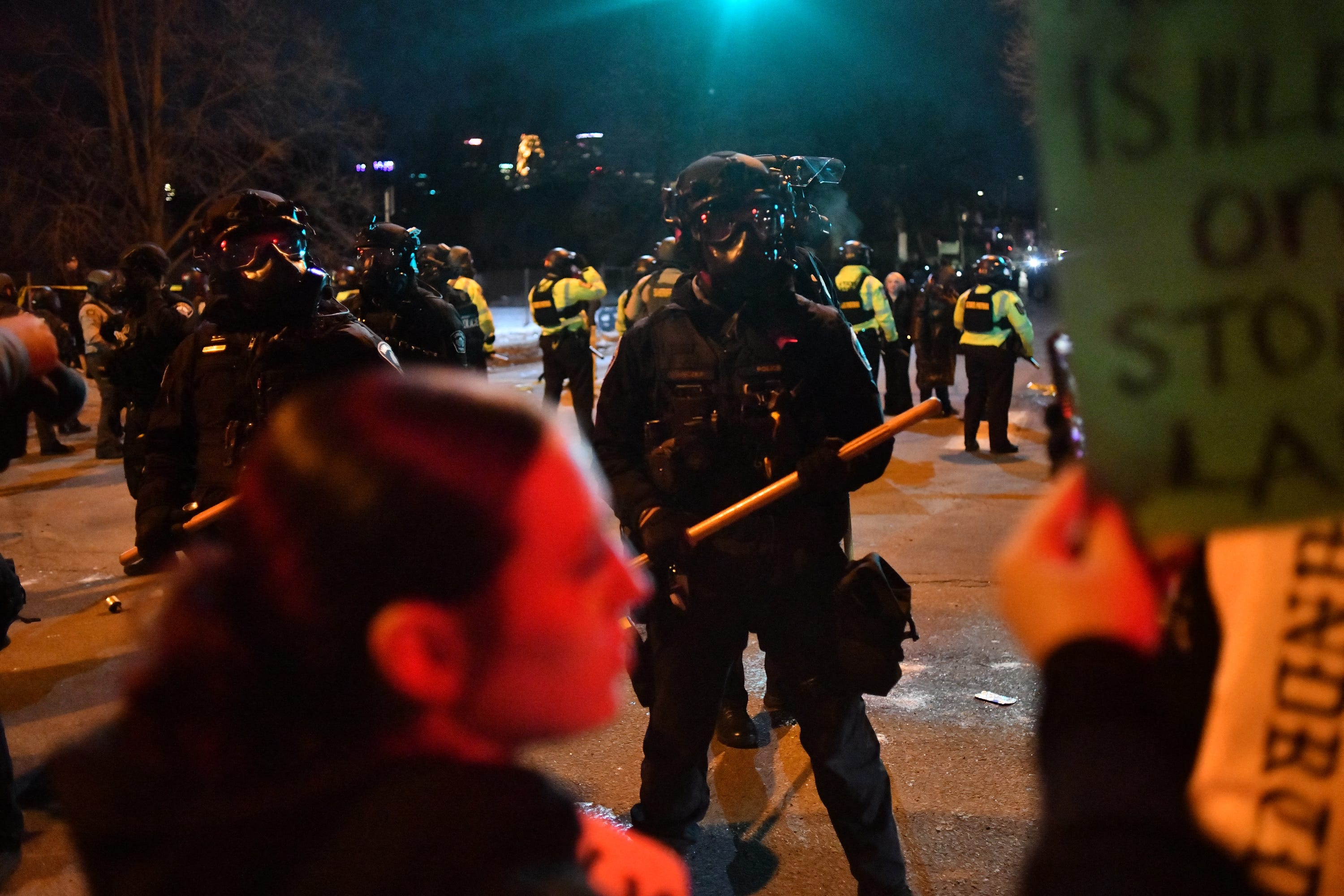
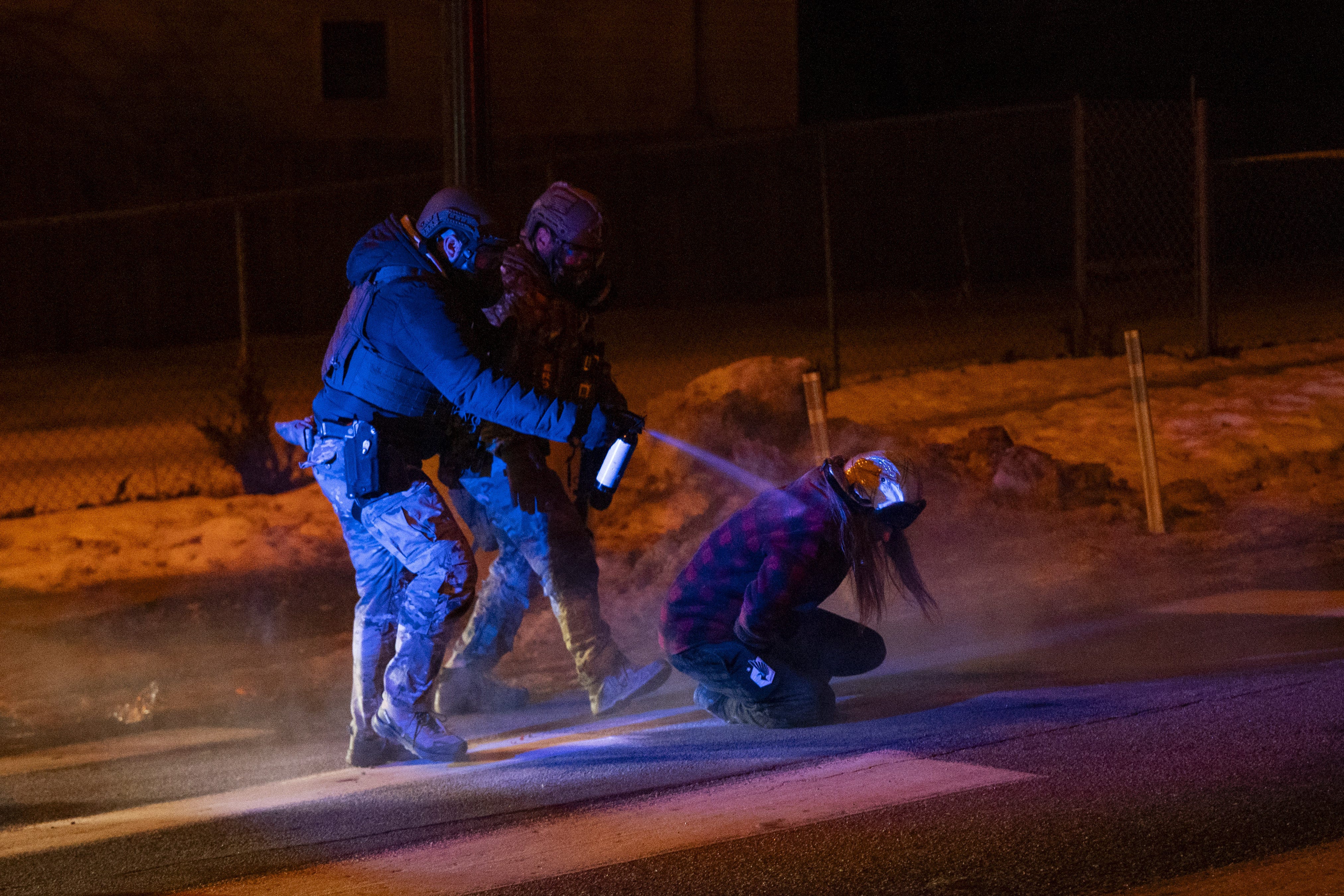
In the week since then, the crackdown has only continued. Protesters in Minneapolis have been tear-gassed and reportedly shot with rubber-coated bullets and other less-lethal projectiles. A 21-year-old protester in Santa Ana, California, said he was blinded in one eye after a federal officer shot him in the face with a projectile at close range. On Wednesday, the FBI searched a Washington Post reporter’s home as part of a leak investigation in a move the newspaper’s executive editor called an “extraordinary” action that is “deeply concerning and raises profound questions and concern around the constitutional protections for our work.” And on Thursday, Trump renewed threats to invoke the Insurrection Act to quell protests.
Just a year ago, and certainly under the Biden administration and pretty much every president before him – indeed, even under Trump in his first term – any one of these stories would have been shocking, front-page news of the “unthinkable.” These days, the demise of the First Amendment rarely breaks through the chaos and cruelty, perhaps because what Trump is doing to speech, assembly, and the press does not seem to be felt by the average American. So why do these attacks on the First Amendment matter so much? Or more to the point, why should people outside of ICE-occupied cities care if the First Amendment dies? The Founding generation certainly understood the stakes.
In his Bill for Establishing Religious Freedom in Virginia enacted on January 16, 1786 (nearly 240 ago to the day), Thomas Jefferson outlined four reasons why protections for free speech and freedom of assembly are important, which were reiterated by Justice Brandeis in a concurring opinion in Whitney v. California, a case from 1927 involving the right of a white woman to make a speech defending anti-lynching laws.
First, freedom of speech protects freedom of conscience. Jefferson wrote that “the opinions and belief of men depend not on their own will, but follow involuntarily the evidence proposed to their minds.” In order to be free, people must be able to think for themselves.
Second, protecting free speech makes representatives accountable to “We the People.” Jefferson explained that politicians and religious leaders, “being themselves but fallible and uninspired,” will always try to impose “their own opinions and modes of thinking” on other people.
Third, free speech is necessary to get to the truth. Jefferson called the truth “the proper and sufficient antagonist to error.” It’s how people know when the government is lying to them.
Fourth, free speech is central to democratic self-government. To limit a person’s freedom to speak, Jefferson wrote, “is depriving him injuriously of those privileges and advantages to which, in common with his fellow citizens, he has a natural right.”
When Jefferson laid out these principles, he undoubtedly had in mind far less severe infringements on speech than death as the consequence of dissent in America. President Trump understands that normalization will be fast. If that happens, this will be the year that US democracy officially dies. It will be hard to go back.
Kimberly Wehle, Zeteo’s legal contributor and author of ‘Constitution in Crisis,’ is a constitutional law professor at the University of Baltimore School of Law. Follow her on Bluesky.
The views expressed in this article are the author’s own and do not necessarily reflect those of Zeteo.
Don’t Miss It: Zeteo is hosting a special LIVE in-person event you won’t want to miss: Join Mehdi, Swin, Rep. Ro Khanna, Joy Reid, Jim Acosta, Sarah Matthews, and Miles Taylor discussing Trump, ICE, civil liberties, free speech, the media, and more for a powerful evening at the Howard Theatre in Washington, DC, on Tuesday, Jan 20, 2026!
Check out more from Zeteo:


Murdered. Good was murdered. Not killed. Murdered.
Great article Kim!