


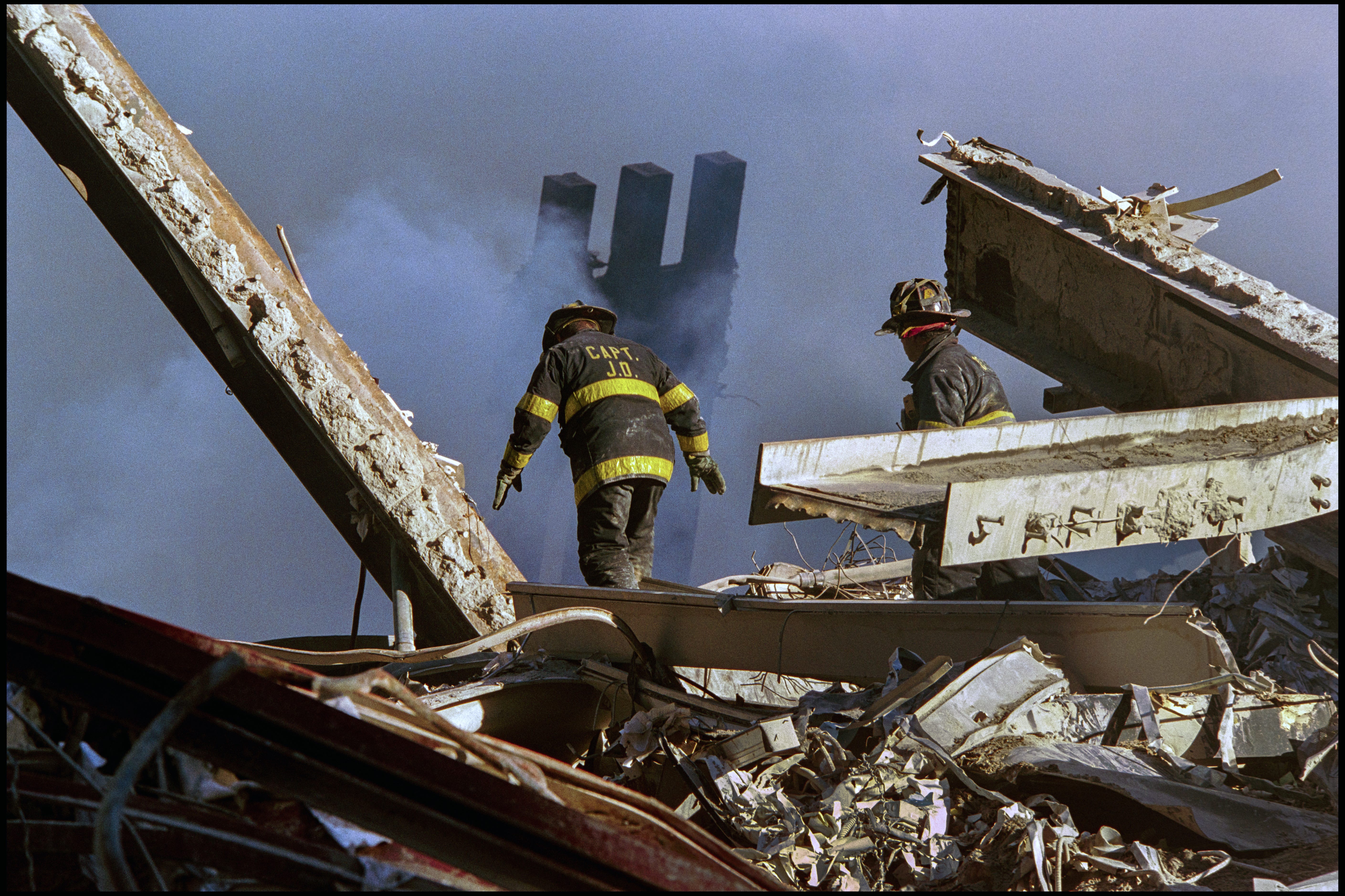
Friday marks 25 years since September 11, 2001.
Twenty-five years. Hard to believe.
For my generation, 9/11 was our “Where were you when JFK was assassinated?” moment. Almost everyone who lived through that day remembers where they were, who they were with, and how they first heard that something unimaginable was happening in New York.
I was in London, a young Muslim researcher at a British television company, sitting on the ninth floor of a skyscraper. I’d started the job only days earlier.
It was early afternoon for us when the images came on the TV. My new colleagues and I had just returned to our desks from lunch.
And… wait… hold on… a plane had flown into the World Trade Center? We all stared at the screen, stunned and confused, trying to work out what the hell was happening. Was it a freak accident? Or an… attack?
I vividly remember this random guy walking past our desks, looking up at the TV on the wall, and saying: “What have the Palestinians done now?”
Think about that.
We didn’t know what had happened. We didn’t know who was responsible. But already: Arabs. Muslims. Them.
I’ve never forgotten it. In retrospect, it was a grim little preview of the next 25 years.
Then the second plane hit.
And everything changed.
Including, oddly enough, my own life and career.
I was the only Muslim employee in the office that day. Suddenly, all of the journalists and editors on my floor were asking me about Osama bin Laden. Al-Qaeda. Terrorism. The Middle East. Islam.
I was 22 years old. A year out of university! How on earth was I supposed to have all the answers?
But that became my new reality.
The months that followed were a blur of booking guests, panels, interviews: on 9/11, bin Laden, the Taliban, Afghanistan, Iraq, the so-called “War on Terror.” One crisis after another.
Sometimes I wonder: What would I be doing today if those planes had never hit those buildings?
It’s a weird, uncomfortable, and yes, I freely admit, navel-gazing question. But I genuinely don’t know.
9/11 was a tragedy of almost incomparable proportions for the 3,000 innocent people who were killed that day and, of course, for the hundreds of thousands of innocent people killed in the subsequent decades.
For me, I can say this: it changed my career. It changed my politics. It changed my life as a Muslim.
And it changed all of our lives in ways we are still living with: Afghanistan and Iraq; Guantanamo and torture; surveillance and Islamophobia; foreign wars, repressive laws, and far-right political movements taking office across the West.
But before all of that came the day itself. The shock. The horror. The nearly 3,000 lives taken. And those images that none of us who watched them will ever forget.
So, a quarter of a century later, I want to hear from you.
Where were you on 9/11?
Where were you when you first heard? How old were you? What do you remember most vividly? What did you think and feel in those first few hours?
And here’s the question I’m especially interested in:
Did September 11 change the course of your life, too?
If you’re a paid subscriber, please do share your story in the comments below. I’ll be reading them. Plus, keep an eye on your inbox for our special week of coverage of the 9/11 attacks and the subsequent “War on Terror.”
Check out more of Zeteo’s 9/11 coverage:


I was a young mother of 2 black boys on 9/11. I was getting ready for work when the news hit the airwaves. I remember the utter shock and disbelief. I remember the grotesque hope that it was some horrible, horrible accident followed by the dawning horror that it was something else entirely when the second plane hit. So much has changed in America, the world and our individual lives since then. On a small scale, I realized later that our family travel would never be the same. In the weeks before 9/11 my husband and I traveled across country, visiting family with an infant, a toddler, 2 car seats, a double stroller, a pop up play pen, diaper bags and suitcases - multiple states, multiple airports. All of which (minus the suitcases) we miraculously took right up to each and every airline gate, with little fanfare, as we crisscrossed the country. I can’t imagine doing that now! On a larger scale, I can’t help but wonder how different things would have gone with a President Gore in the WH. Maybe 9/11 would never had happened at all with a more competent person at the helm. The installment of the compromised SCOTUS preferred candidate, aided by the young lawyer John Roberts, was also horrific. How convenient to strategically stop the Florida vote count just when Bush was ahead, in order to hand deliver him the presidency. The full and final count (much later) revealed that Gore actually won Florida. And Bush gift wrapping the Chief SCOTUS job for Roberts, years later, was quite the thank you prize. It makes me sad and mad - the greed, corruption and power lust that has no problem with trampling over the will of the people on a regular basis. Then and now. And now that my 2 sweet boys are now black men living in this fake democracy that is hell bent to exalt white supremacy, no matter the damage, cost or ill/logic, I’m also fearful of what the future holds. But still we fight. But still we rise. We must.
I was a Muslim female Ph.D. student at a prominent Canadian university. I was walking in the hallway when I reached an area with a TV. I watched in horror with one thing repeating in my mind, "let it not to be a Muslim". I knew what kind of hard times it will be for a Muslim if the attackers are Muslims.