


This piece was originally published on Maryam Jamshidi’s Substack, The Anti-Imperium. Zeteo is republishing it with her permission.
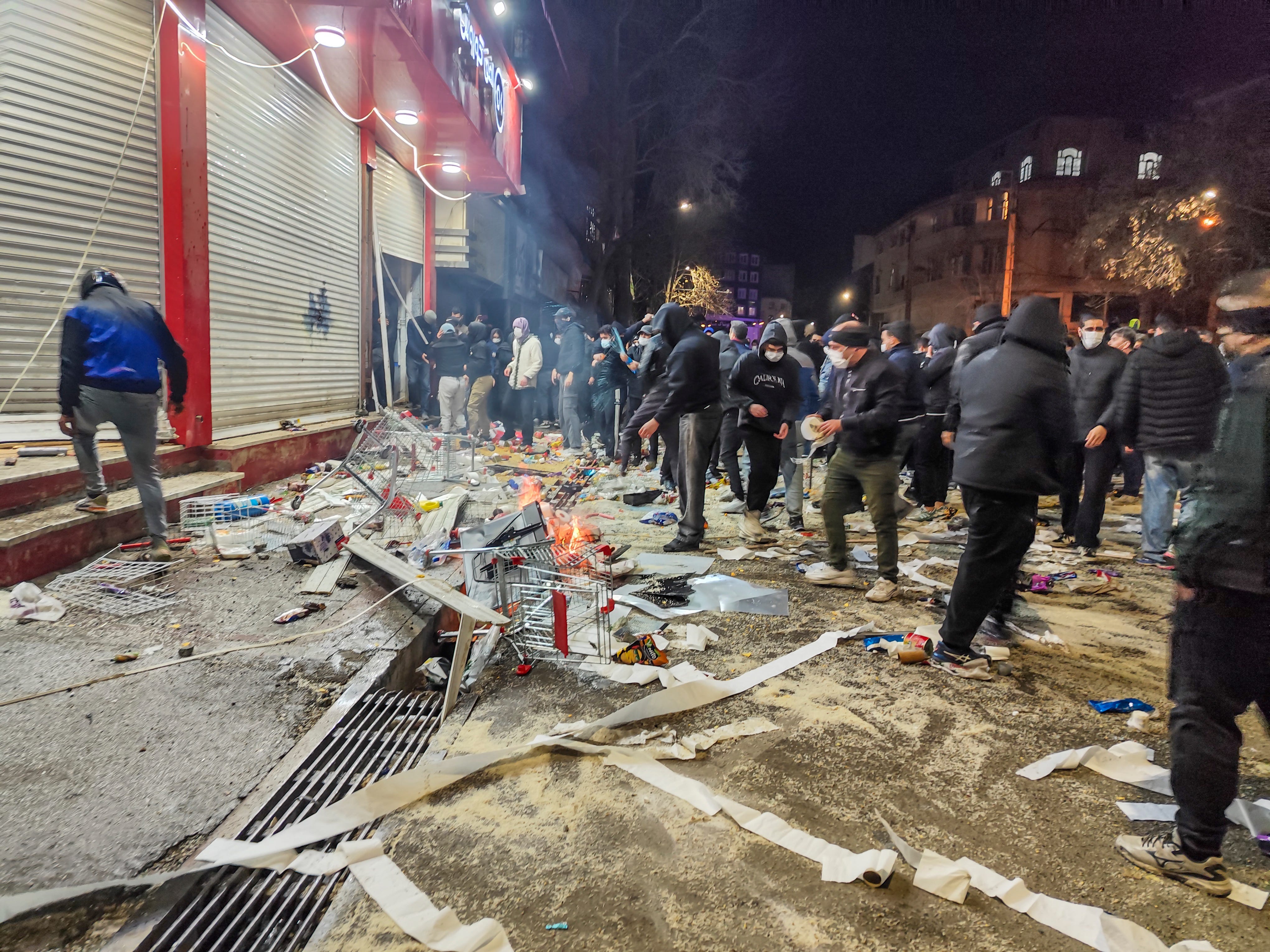
If you are Iranian, know an Iranian, or have been paying even the most cursory attention to mainstream U.S., Western, or Farsi-language media over the last few months, you’ve probably heard the claim that upwards of 30,000 to 40,000 protesters were killed by the Iranian government during nationwide demonstrations from Jan. 8-9, 2026. These massive figures emerged with lightning speed only a few days following the purported killing spree. By the end of January, they had become virtually unassailable and largely unquestioned. They were repeated over and over again by high-ranking Western government officials and public figures. Donald Trump claimed 32,000 Iranian protesters were killed during the January protests, only a few days before launching his unlawful war against the country on Feb. 28; he later raised that figure, without explanation, to 42,000. The U.S. ambassador to the United Nations, Mike Waltz, also repeatedly claimed that upwards of 40,000 Iranian demonstrators had been killed in a “weekend.” Various prominent diaspora Iranian activists and dissident groups repeated these numbers as well.
While many individuals and organizations helped turn the 30,000-40,000 death toll figure into gospel truth, two actors appear to be the most responsible for these claims: the Iranian diaspora media outlet, Iran International, and an Iranian ophthalmologist in Germany, Dr. Amir-Mobarez Parasta. Though Iran International made the first move, the work of Dr. Parasta, which purportedly relied on medical professionals inside Iran, gave the notion of a high five-figure casualty count more credibility. Both Iran International and Parasta are supporters of the Pahlavi Dynasty, which was overthrown as a result of the 1979 Revolution, and promoters of regime-change in Iran. They are dedicated followers of Reza Pahlavi, the son of the last deposed Pahlavi king, whom they see as Iran’s rightful leader.
Though reliably counting casualties in mass atrocities is grueling and time-consuming work, Iran International and Parasta chose speed over accuracy in publicizing their respective death counts mere days after the Jan. 8-9 events. Their methods for information gathering and corroboration have been vague or non-existent, less than reliable, and lacking in transparency. Despite or perhaps because of this, their work – together with a near total internet blackout in Iran during the covered period – laid the groundwork for greater and greater speculation about the number of those killed on Jan. 8-9. They also arguably helped spur similarly unreliable claims about large five-figure casualty counts from other actors.
To this day – nearly six months after the events of Jan. 8-9 – the allegation that the Iranian government killed 30,000-40,000 protesters remains wholly unproven or meaningfully corroborated. Even worse, however, it has seemingly assumed an epistemic hegemony that has drowned out the valuable data-gathering work of human rights NGOs. These organizations – particularly U.S.-based Human Rights Activists News Agency (HRANA) and the Norway-based Iran Human Rights – were also gathering death toll numbers following the January events, more slowly but still quite quickly compared to the norm. Because they used more rigorous verification procedures, their figures were relatively smaller. Even though their casualty counts were cited and relied on by some prominent Western media outlets, they failed to capture the public discourse the way the more inflated numbers did.
This post explains how claims about 30,000-40,000 murdered Iranian protesters are rooted in the work of Iran International and Parasta; how those allegations were amplified by other outlets and individuals; how they encouraged other actors to adopt similarly dubious evidence collection methods and make similarly unreliable claims about large five-figure death counts; and how they ultimately came to dominate the discourse on the death toll in Iran to the exclusion of more reliable figures gathered by NGOs. This post also describes, in detail, the reliability and accuracy issues raised by Dr. Parasta and Iran International’s figures and explains how they may ultimately undermine accountability for the events of Jan. 8-9. Even if these death counts turn out to be accurate or close to accurate, the circumstances under which they were disseminated, as well as their general politicization, may prevent the gaping wound left in Iranian society by the January 2026 protests from ever properly healing.
A Race to Count the Dead
While protests in Iran started on Dec. 28, fueled by soaring prices and other economic issues, they picked up steam during the week of Jan. 5. This was due, in part, to misguided dreams of U.S. intervention and repeated calls from Reza Pahlavi for Iranians to fill the streets and topple the government. With many protesters heeding his call and crowds growing in size over several days, the government instituted a near-complete internet and communications blackout on Thursday, Jan. 8, around 10 pm Tehran time. Many feared the internet shutdown presaged a significant crackdown on demonstrators.
On Jan. 9, Time magazine reported that 217 protesters had been killed during the blackout based on testimony from an anonymous doctor inside Iran. On Jan. 11, CNN reported a death toll of 496, based on evidence collected by HRANA, which issued its first specific casualty count for the Jan. 8-9 period that day. Up until that point, HRANA had reported 50 civilian deaths during the protest period starting December 28.
Then, all of a sudden, two days later, on Jan. 13, Iran International issued a report claiming that “at least” 12,000 Iranians had been killed. In reaching this figure, Iran International said it relied on “a source close to . . . [Iran’s] Supreme National Security Council; two sources in the presidential office; accounts from several sources within the Islamic Revolutionary Guard Corps in the cities of Mashhad, Kermanshah, and Isfahan; testimonies from eyewitnesses and families of those killed; field reports; data linked to medical centers; and information provided by doctors and nurses in various cities.”
Iran International did not provide any detail about the kind of information provided by these sources, the evidentiary basis for their claims, or how they obtained the information provided to Iran International – all of which was particularly relevant for evidence purportedly collected by government sources. Iran International also did not present any of the figures or numerical data upon which its 12,000 figure was ostensibly based. While it claimed to have reviewed the acquired information “through a rigorous, multi-stage process and in accordance with established professional standards,” Iran International did not describe that process or the “established professional standards” it had purportedly followed.
As its reporting suggested, Iran International’s 12,000 minimum casualty figure, which it described as “relatively accurate,” was seemingly pieced together from various sources. Though it admitted that accurately assessing the death count was “difficult and time-consuming – particularly because rushing to publish incomplete casualty figures risks errors in documenting events and could distort the true scale of this tragedy,” Iran International nevertheless proceeded to make its “relatively accurate” assessment and publicize its conclusions after just “two days” of review.
On the same day that Iran International released its figures, HRANA issued a report describing the obstacles the internet blackout was creating for gathering and corroborating casualty figures relating to the events of Jan. 8-9. As it noted, “[t]he prolonged internet blackout not only narrowed the channels for verification and for conveying an accurate picture of conditions inside the country, but also caused a significant portion of information to reach the outside world with delays, in fragmented form, and with limited ability to be verified.”
Despite all these red flags, Iran International’s death count was quickly amplified by various UK, U.S., and Israeli-based media outlets. From the standpoint of reach and credibility, the most important news outlet to repeat Iran International’s claim was CBS News. Recently acquired by the pro-Trump, pro-Israel Ellison family and headed by self-described “Zionist fanatic” Bari Weiss, CBS published a report on Jan. 14, citing the Iran International figure. It also went further and presented its own “evidence” backing up Iran International and suggesting an even higher casualty count.
That evidence was based on two - that’s right just TWO - anonymous sources. The first was a person reportedly inside Iran, and the other was someone in Washington. No other identifying information about these individuals was provided. Notably, neither source had first-hand knowledge of the death toll. Instead, they served as conduits purportedly conveying information gathered by others. According to CBS, the source in Iran reported that “activist groups working to compile a full death toll from the protests, based on reports from medical officials across the country, believed the toll was at least 12,000, and possibly as high as 20,000.” As for the source in Washington, that person reportedly had a “credible source” in Iran that “had told him the toll was likely between 10,000 and 12,000.” While CBS admitted that “it has not been able to independently verify the massive death toll indicated” by its sources, its report also spread like wildfire and was republished by the The Guardian, Yahoo, and Vox amongst others.
The next big death count revelation came on Jan. 18 when the UK-based Sunday Times published an article claiming the death toll in Iran during the Jan. 8-9 protests was approximately 16,500-18,000. That report was based on just one source, ophthalmologist Dr. Amir Parasta, who, much like CBS’s sources, provided information second-hand to the newspaper. That information purportedly came from a group of activist medical professionals inside Iran. Was this the same activist group CBS had cited for its claim of “at least 12,000 and possibly as high as 20,000” murdered protesters? It’s impossible to know.
Admittedly, Parasta provided more information about his sources and the basis for his claim than either Iran International or CBS News had done. As The Sunday Times reported, Parasta claimed his activist group had collected its data from eight major eye hospitals and 16 emergency departments in Iran. The Times did not disclose the nature of the data, including whether it was an individual casualty count, an estimate of deaths, or a combination of both. About a week later, on Jan. 25, Parasta spoke to Time magazine and raised his estimate from 16,500 to 30,000, though again his methodology was not disclosed. A Sky News article published on Jan. 30 also included an interview with Dr. Parasta in which he claimed upwards of 33,000 people had been killed from Jan. 8-9, again without providing much detail as to how that figure was reached (Sky News noted that it could not verify his claims and had not been shown any clinical reports).
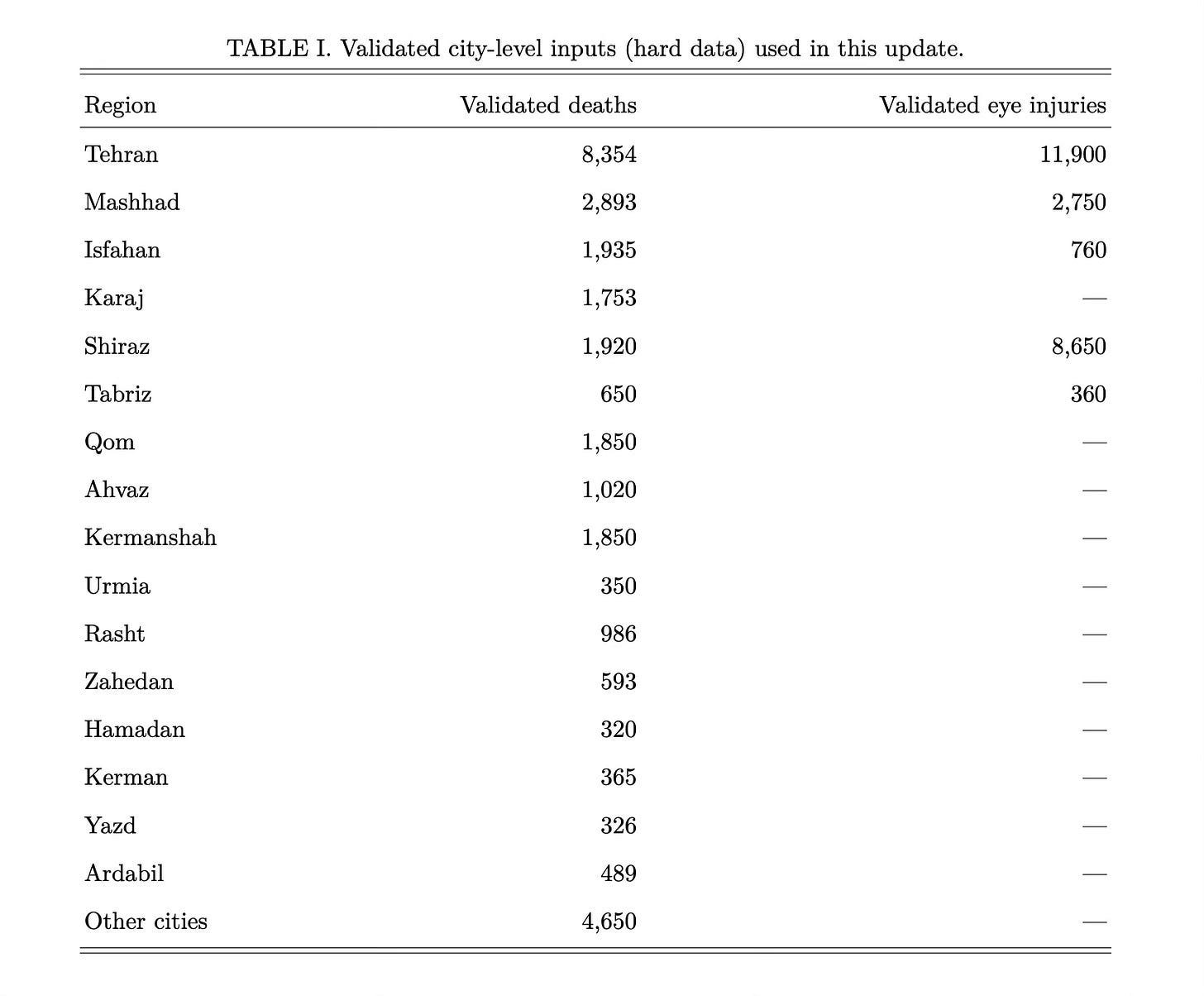
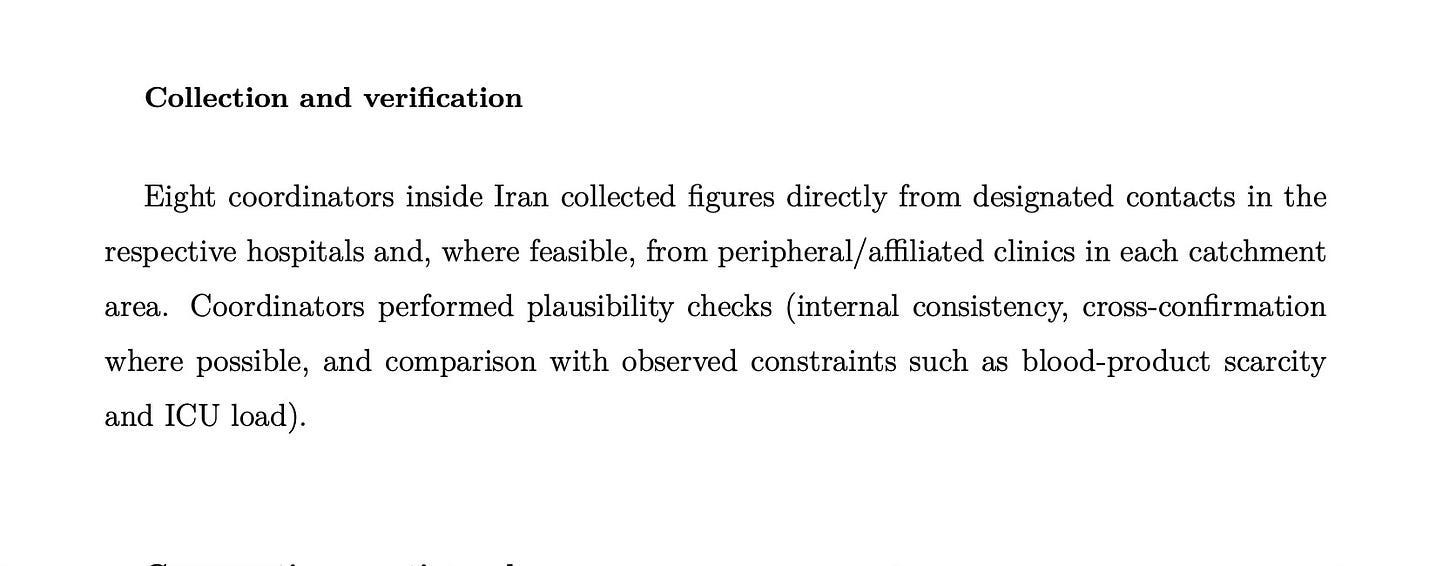
An obscure website associated with irannovin.party – a pro-Pahlavi organization – has subsequently shed light on the nature and basis for Parasta’s casualty figures. That website contains a report purportedly authored by Dr. Parasta (I have not been able to independently verify whether he is the author) that provides “validated” death tolls from various Iranian cities, gathered by eight individuals who were supposedly in contact with various medical professionals around the country and who conducted “plausibility” checks on the information they received, including “cross-confirmation where possible.” It is unclear when this report was published.
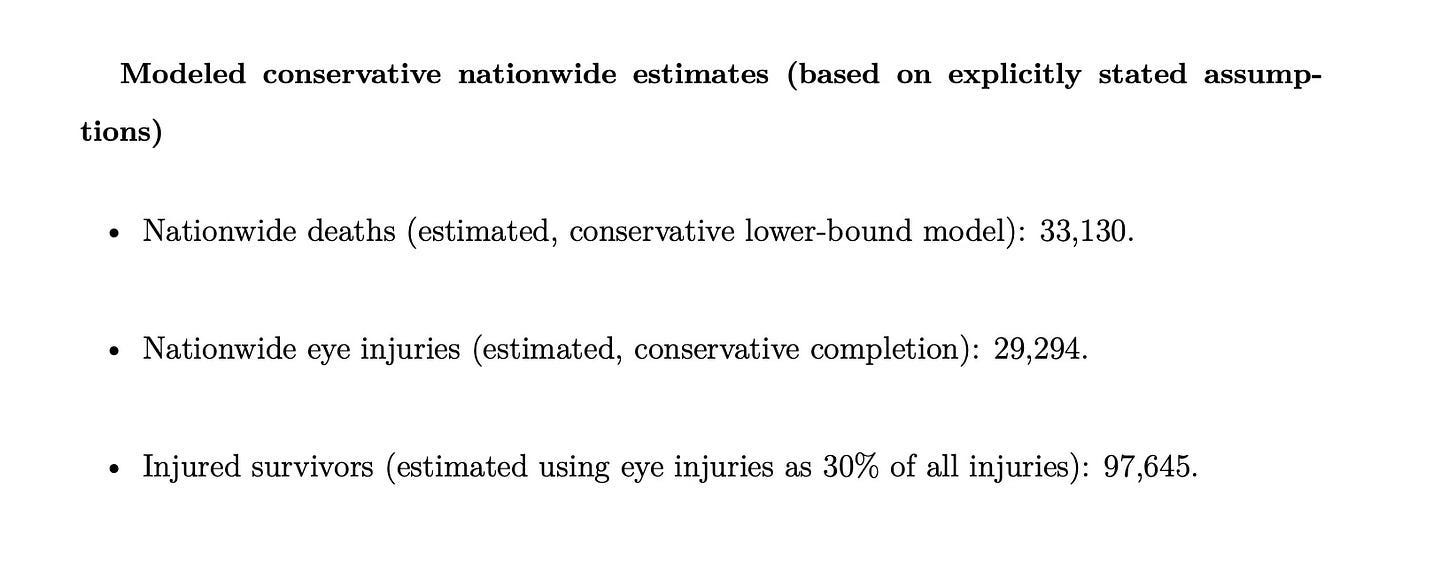
Notably, the report, which is a mere 11 pages, provides very little information about how Parasta and his team rapidly gathered and confirmed “validated” city-level death counts, which are over 30,000, given the “restricted access conditions” the report itself notes (the data cut off date for the report is Jan. 23, meaning this vast quantity of information was gathered and validated by a very small team in barely 2 weeks time). The report says nothing about whether the casualty figures were based on witness or non-witness testimony, and in particular, what proportion of the “validated” figures were, in fact, subject to cross confirmation. These omissions are notable since the figures are the basis for the report’s “conservative, lower bound” estimate that 33,130 deaths occurred nationwide between Jan. 8-9.
From the report purportedly written by Dr. Parasta:
As with the initial 12,000 deaths claimed by Iran International, Dr. Parasta’s even larger figures unleashed a torrent of supportive coverage. Together with the Iran International article, they may have also emboldened other outlets to rely on minimal, anonymous sourcing to claim a similarly high death count. Indeed, the same Time magazine article that reported Parasta’s estimate of 30,000 deaths cited two anonymous “senior officials” in Iran’s Ministry of Health who provided similar figures. Then, on Jan. 27, 2026, The Guardian published an article that cited an anonymous doctor inside Iran, who had reportedly organized a group of medical professionals—the group does not appear to be the same as Parasta’s, but again it’s hard to know for sure—and put forward a similarly high estimate of deaths based on dubious evidence gathering. As The Guardian described it, “[the doctor the reporters spoke to] and his colleagues are hesitant to provide a figure for the toll but agree ‘all publicly cited death tolls represent a severe underestimation.’ Comparing the number of dead they witnessed with hospital baselines, they estimate it could exceed 30,000, far surpassing official figures. This is based on the conclusion that ‘officially registered deaths related to the crackdown likely represent less than 10% of the real number of fatalities.’” While The Guardian article was not identical to the coverage of Dr. Parasta’s figures, it betrayed a strikingly similar framing and set of sources.
Not to be outdone, on Jan. 25, Iran International published another article claiming more than 36,500 people had been killed during the Jan. 8-9 period, again based on anonymous government sources. Reza Pahlavi also entered the fray, claiming that 50,000 Iranians had been killed without providing a shred of meaningful evidence, though that didn’t stop the media from covering his claim. Even some of the human rights NGOs that had only confirmed relatively smaller death counts went on the record in late January and speculated that 25,000 people may have been killed during the relevant period based on extrapolations from historic government underreporting of executions in Iran.
In the midst of the claims from Iran International and Dr. Parasta, other outlets, like the New York Times, the AP, the Washington Post, and the Wall Street Journal, stuck to the more reliable numbers provided by the NGOs or went to great lengths to report on the discrepancies between death count tallies. This reporting was, however, drowned out by the more spectacular five-figure numbers, which made their way into the Wikipedia and Encyclopedia Britannica entries for the Iran 2026 protests, as well as into a resolution of the European Parliament that condemned the Iranian government for repressing its civilian population.
Perhaps most notably and troublingly of all, the Iran International/Parasta figures were cited and given legitimacy by individuals connected to the UN and international judicial bodies - people who should know better than to rely on highly suspect casualty counts. In mid-January 2026, Mai Sato, the UN Special Rapporteur on the situation of human rights in the Islamic Republic of Iran, put the number of those killed during the January protests at a minimum of 5,000 – a figure based on initial Iranian government reports that were later revised—and as high as 20,000. The 20,000 figure appears to be based on Sato’s conversations with medical professionals in Iran. While it is unclear whether Sato’s 20,000 casualty count came from Parasta and his team or from other sources, her willingness to make such a bold statement based on information received from a few sources is stunning. Unsurprisingly, her comments gave the large five-figure estimates particular credibility and were repeated throughout the Western and Iranian diaspora media ecosystem, which could now claim that even the UN was projecting 20,000 deaths in Iran.
Also in late January 2026, Iranian-Canadian legal academic and former prosecutor at the International Criminal Tribunal for the Former Yugoslavia (ICTY), Payam Akhavan, spoke at the UN Human Rights Council and repeated Parasta’s initial estimate of 16,500 dead. Leveraging his work with the ICTY – specifically, his involvement in drafting the indictment for the genocide of Bosnian Muslims at Srebrenica in July 1995 – and armed with Parasta’s astronomical death count, Akhavan insinuated that the Iranian government had effectively committed a genocide against its people by comparing the events of Jan. 8-9 to Srebrenica and arguing that “at least twice that number has been killed in Iran in half the time.” A few days later, Akhavan did an interview with Piers Morgan, doubling down on this depiction. He called the events of Jan. 8-9 “Iran’s holocaust” and compared it to another specific act of genocide, the 1941 Babyn Yar Massacre committed by the Nazis against Jews in Ukraine. While Akhavan did concede that the Jan. 8-9 events could not legally be considered a genocide, the repeated parallels he drew to other genocidal events, as well as his decision to promote hastily published, highly questionable numbers in multiple different venues is quite surprising for a former prosecutor from an international criminal tribunal, who should know how challenging it is to gather evidence in situations of widespread, mass atrocities, let alone evidence of serious international crimes.
Problematic Evidence Gathering
Counting casualties in situations of mass atrocity is a painstaking process. While going too slowly or waiting too long to gather evidence creates its own problems, having a clear, rigorous, and transparent process of evidence gathering is vital to the credibility and accuracy of the resulting data. On all these scores, the numbers gathered by Iran International and Dr. Parasta fall short.
The speed at which Iran International and Dr. Parasta put forward their figures, alone, raises serious questions about the reliability of their data. One expert who was interviewed about the rapidly generated, high casualty counts from the January protests underscored this point. Comparing evidence gathering in other situations of mass atrocity, he noted:
“The most accurate information for how many people were killed in Gaza came a month after the killing began, . . . Similarly, when we look at Sudan, it took us months to get credible data and information about the killings.”
One reason it takes so long to gather casualty data is that casualty counting requires establishing a sound methodology from the outset. While the methodology can be changed or tweaked over time, having a clearly defined methodological approach before the data is gathered helps casualty recorders ensure their work is consistent, accurate, and trustworthy. According to best practices on casualty counting developed with input from the International Committee of the Red Cross, this methodology should include a process for evaluating documentary and witness-based evidence, as well as a rating system to assess source reliability, along with the use of “multiple independent sources” to corroborate casualty entries. As the best practices handbook explains, “[a]ll types of sources can be potentially unreliable and biased, whether government sources, NGOs, or eyewitnesses. Using multiple independent sources can help identify and correct these biases and give a more complete picture of an incident.”
This corroboration of casualty figures is key and is typically quite time consuming. It includes two steps: the first is to determine the internal coherence of the information and the second is to crosscheck it with information provided by other sources. This is how the best practices handbook describes internal coherence and cross-checking:
“Written or oral information becomes internally coherent when the connection between the arguments in it are logical, which is when it becomes meaningful in a real world context. Internal coherence means, among other things, that the information provided is free of contradictions and logical (or similar) inconsistencies which damage its credibility.
Crosschecking is the attempt to confirm information with other sources. It attempts to confirm one piece of information by obtaining information on the same topic from other independent sources. This includes different sources of the same type. . . . It also includes different types of sources.”
When it comes to witness testimony, issues of credibility and reliability are especially salient and need to be addressed by casualty counters. It is well-established that eye-witness testimony is often inaccurate and unreliable, particularly where the eye-witness has experienced trauma. In particular, “insider witnesses” - namely, those who were involved in the atrocities or are part of the apparatus that committed the atrocity - have, in the past, turned out to be so unreliable that many international tribunals treat their testimony “with caution.”
Corroboration of data is closely linked with quality control, which includes minimizing human error. Ideally, this process should involve different casualty recorders reviewing one another’s data for accuracy and ensuring there are no duplicate recordings of casualties, either through manual or automated de-duping.
As all this suggests, corroborating and quality checking casualty counts requires gathering and evaluating documentary and witness testimony, compiling multiple independent sources to corroborate information, and ensuring the resulting data is free of human error and duplication. Obviously, the more casualties there are, the longer this process will take. Where the mass atrocity has occurred in another country, where there are obstacles to gathering the information – say because the internet and other communication channels have been cut – or where the government is obstructing information gathering, the evidence assessment timeline may be even longer. Where those gathering the information are inexperienced, that may create further challenges to accurate data collection, especially when conducted at speed.
Given all these moving pieces as well as the rapidity at which they issued their figures, it is highly doubtful that either the figures from Iran International or Parasta represent reliable or accurate casualty counts. Indeed, the first figure of 12,000 published by Iran International may not even be a casualty count, which involves the actual numerical counting of individual deaths. Instead, it appears to be an estimate (based on unclear and undisclosed evidence) masquerading as casualty counting. Iran International’s second figure - of 36,500 - was purportedly provided by anonymous government officials reporting on various casualty figures compiled by different government entities, which obviously does not constitute casualty counting by Iran International either. Notably, Iran International provided no information about how those casualties were counted by the government or whether they were checked for reliability. While on the one hand, government sources may be particularly well-placed to convey information on casualty figures, especially where deaths are large and widespread, “insider witnesses,” as mentioned earlier, are notably unreliable and prone to exaggeration and fabrication. For all these reasons, Iran International’s figures are highly suspect
As for Dr. Parasta’s figures, while the late-breaking report on irannovin.party seems to involve significant casualty counting, the amount of time, effort, and manpower it would take for an independent organization to adequately corroborate over 30,000 deaths is measured in weeks, if not months and years, in the most ideal conditions. In a country subject to an internet blackout, described as a “complete network shutdown,” the gathering of necessary information would be more daunting (even Iran’s domestic internet remained significantly restricted into February 2026). Indeed, one NGO (Iran Human Rights) suspended casualty counting in mid-January because the scale of killings and substantial restrictions on communication with and in Iran made it impossible for them to reliably verify casualty figures.
But the reliability of the data, as well as the speed with which it was collected, are not the only problems with Iran International and Dr. Parasta’s figures. There are also issues of methodological transparency. According to the best practices handbook, methodological transparency should include the (1) types of sources used, (2) information about the data collection process, (3) how information was evaluated and corroborated (and what information presented for publication wasn’t corroborated), as well as (4) quality control. Without this information, it is impossible for third parties to verify the gathered data, determine whether it is biased or partial, or otherwise evaluate its reliability. Iran International has provided almost none of this information for any of its publicized figures. While the report purportedly written by Dr. Parasta provides some of this material, it is cursory at best; certain information, including how data was evaluated and corroborated and how quality control issues were handled, is not provided at all.
Finally, there is the vital issue of organizational transparency, which is also a problem here. Trust in data is intimately tied to trust in the organization that gathered it. As such, the best practices handbook urges organizations to be transparent about their operations, as well as their political and funding affiliations. Particularly when it comes to ad hoc groups, transparency about “those who started a casualty recording initiative and why they did so can help confront possible suspicions and mistrust.” When it comes to Iran International, while its pro-regime change, Pahlavist orientations are clear, there have long been questions about its funding sources and allegations that it has received substantial financing from Saudi-linked sources. As for Dr. Parasta, while a cursory internet search reveals his political commitments, there is very little publicly available information about his clandestine group of Iran-based medical professional, their political affiliations, or any funding sources for their evidence collection.
This lack of organizational transparency, alongside their known political commitments, raise further questions regarding the reliability and accuracy of the data Iran International and Dr. Parasta gathered. While neither has publicly embraced motivations beyond humanitarian concern, the political commitments of Parasta and Iran International likely influenced their decision to gather casualty figures, as well as how and when to disseminate them. In releasing large figures quickly, Iran International and Dr. Parasta may have hoped to further their long-held regime-change goals by providing the Trump administration with a pretext to attack Iran and install their favored leader, Reza Pahlavi.
Mere days before the Jan. 8-9 protests, the Trump administration had kidnapped the president of Venezuela and replaced him with his more compliant vice resident. According to reporting, many Iranians at the time hoped the same could happen in Iran. Indeed, that is likely why Reza Pahlavi called on Iranians to take to the streets on Jan. 8 and 9: to demonstrate to the Americans that regime-change in Iran could be as or even more successful than Venezuela. If protesters were killed, well, even better. On Jan. 2, the day before abducting Venezuela’s president, Trump had said that if Iran killed protesters, he would “come to their rescue. We are locked and loaded and ready to go.”
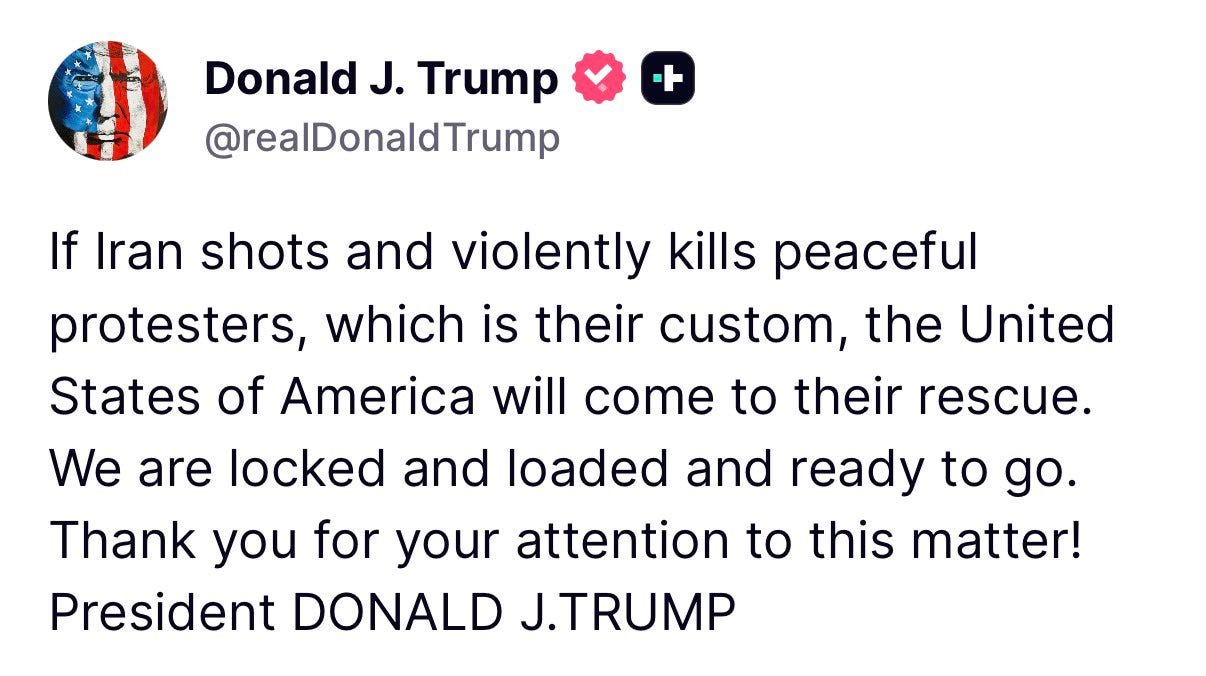
While the regime did not fall as a result of the Jan. 8-9 protests, there was certainly much bloodshed. Iran International and Dr. Parasta mobilized quickly – more quickly than almost anyone else – to shape the narrative on exactly how many Iranians had been killed during those two fateful days hoping, perhaps, that if America was indeed “locked loaded and ready to go,” it would take action after learning about such massive levels of death.
Undermining Accountability
There is no doubt that there was extreme violence on the streets of Iran during the January protests. The Iranian government itself has admitted such, claiming a death toll of 3,117, though it has primarily blamed “terrorists” linked to the United States and Israel for that violence. There may be some truth to these accusations or, at least, a reasonable basis to believe there was at least some foreign infiltration that contributed to the violence. On Dec. 29, a day after the protests began, Mossad’s Farsi language X account encouraged Iranians to take to the streets and said that it was literally and physically beside them at the demonstrations. Israeli media outlets, like Channel 14, also claimed that “foreign” actors (i.e., Israel) were arming some of the demonstrators. In early April, Trump claimed the United States had sent weapons to Iranian protesters sometime in December/January, though it is unclear to whom exactly the weapons were sent or whether they were received. Some who were in Iran in January 2026 reported that masked, darkly-clad, highly organized, and even armed groups walked among the protesters during the Jan. 8-9 period. They also reported that bodies of some of the dead reflected wounds that were inconsistent with police, military, or riot-control attacks.
No matter what happened or exactly how many were killed during the Jan. 8-9 period, those events have left Iranian society deeply traumatized and fractured. A true reckoning with the events of those days – including an investigation by a credible, independent, and unbiased international body – is, as such, crucial for Iran’s social cohesion and stability going forward. The unreliable figures of 30,000-40,000 that now dominate the discourse on the January protests will, however, make an accurate and careful accounting much harder.
For many Iranians, inside and outside of Iran, a 30,000-40,000-person death toll has become the minimum acceptable number. For others, including those who support the government, those figures are little more than politically-generated tools, put forward by regime-change organizations and individuals that facilitated the U.S./Israeli war on Iran.
This politicization of the death toll number will undoubtedly cast a shadow over any effort to fully, independently, and credibly investigate the events of Jan. 8-9. Any final investigatory report that reaches a figure near or above 30,000-40,000 is likely to be viewed as biased by some Iranians; the same goes for a report that reaches a far lower number. A report that places responsibility for at least some of the killing on non-governmental actors or other individuals who purportedly “infiltrated” the protests will undoubtedly receive enormous backlash, as well; again, the same goes for a report that does not address the question at all. While these tensions are arguably the inevitable consequences of any investigation into a politically charged event, the pre-determination of that investigation’s results by highly partisan, non-expert individuals and organizations – like Iran International and Dr. Parasta – exacerbates that possibility.
Alternatively, the epistemic hegemony that the Iran International/Parasta numbers have assumed, including in the West, may adversely impact the likelihood that an independent fact-finding investigation even takes place. Indeed, the human rights NGOs HRANA and Iran Human Rights, which had initially collected and corroborated casualty counts for the January protests, have not published any updates in months. Largely due to the communication restrictions in Iran, Iran Human Rights stopped its public reporting in mid-January, when its protester casualty count stood at 3,428. HRANA’s last report was published a few days before the February 28 war, with a casualty count of 6,448 protesters. To be sure, both these organizations have been busy dealing with the fallout from the war. It is possible they will resume counting casualties from the January demonstrations once that war comes to an end or once internet access is meaningfully restored (as of this writing, the Iranian government has just opened the country back up to international internet traffic after an 88-day blackout).
It is also possible, however, that these organizations may refrain from resuming their casualty counts since the much higher numbers put forward by others have consumed the field. They may see little purpose in continuing their more rigorous process when many view the death count as being so far beyond what they have been able to corroborate At the same time, if they continue their work, it is possible those higher numbers will influence or distort their results in some way (both organizations have said they believe the casualty count is much higher than what they have verified, though for HRANA this is likely based on the 11,744 cases that were still pending review before it stopped its public updates).
****
Once the unlawful U.S./Israel war against Iran ends, the deep wounds created by the events of Jan. 8-9 will again become impossible to ignore. Healing those wounds requires systems and processes of accountability, which in turn require accurate and reliable evidence collection. The record of what happened during those two fateful days six months ago must be independently and carefully corroborated. Unfortunately, by putting forward unreliable and hastily compiled death counts, actors like Iran International and Dr. Amir Parasta have made that task much harder to achieve.
Maryam Jamshidi is a non-resident fellow at the Quincy Institute and an associate professor of law at the University of Colorado Law School. Read more of her work by subscribing to her Substack, The Anti-Imperium.
The views expressed in this article are the author’s own and do not necessarily reflect those of Zeteo.
Check out more from Zeteo:


I have heard of 30k, 40k, 50k, 70k and even 100k killed, yet no one has been able to add any names to the list of names that the government of Iran has published. This has had as much credibility as the 40 beheaded babies that was used to justify the genocide of Palestinians.
WTH??!! How does the international leaders just IGNORE the genocide, the plight of Palestinians and Palestine. Grotesque disgusting US POTUS with the lock & loaded comment, like this ASS is going to save ANYONE!!! POTUS & ISRAEL 🇮🇱 the terrorist state built on stolen land and slaughtering indigenous people HAVE CREATED THIS MUDEROUS MESS OF INHUMANE PLAN!!!