


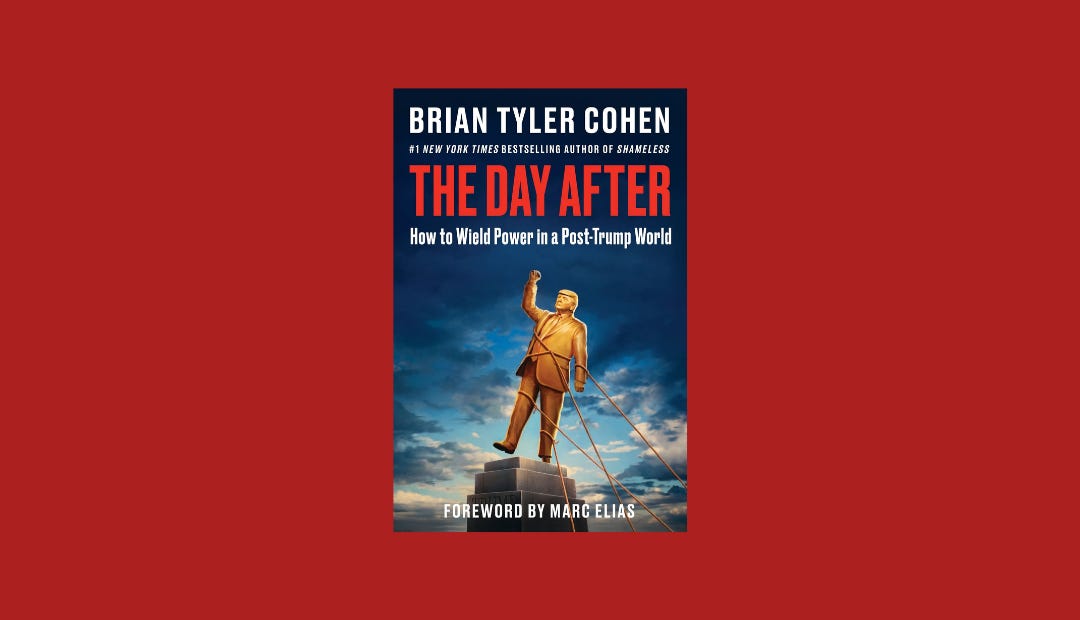
Editor’s Note: The following is an exclusive extract for Zeteo readers from Brian Tyler Cohen’s new book, ‘The Day After: How to Wield Power in a Post-Trump World,’ out tomorrow, featuring interviews with major U.S. political figures. The book is a blueprint for those who want to do far more than simply restore the status quo. From universal healthcare to Supreme Court expansion, it’s time to make democracy work for Americans – while democracy is still on the table, Brian writes.
One of the great fallacies of the Biden, Obama, and Clinton years is the notion that if only Democrats would compromise with their Republican counterparts, their goodwill would be duly reciprocated. If only they capitulate to the GOP, this time – this time – the right will lay down its arms and a golden era of bipartisanship would emerge. “I’ll hold the ball,” Lucy explains to Charlie Brown, “and you come running up and kick it.”
When Republicans are in control, they wield power in a take-no-hostages manner. When Democrats are in control, they seek compromise, practice good governance, defend the institutions of government, and even make sacrifices to the minority in the hope that their selflessness, their righteousness, and their virtue will be rewarded. As was the case with Bill Clinton, Barack Obama, and Joe Biden, they never are. Lucy isn’t known for letting Charlie kick the football.
The political truth is this: Democrats like to signal their virtues, while Republicans like to swagger their virility. Democrats quaintly believe that being good is good enough to win elections. They think that Americans will admire them for standing up for civil rights and democracy, expanding healthcare, or saving the planet. They think that they can even win over Republican support by moving to the center and offering some juicy morsels of compromise. Republicans, on the other hand, think that Americans will admire them for looking strong, for wielding power, for extracting personal wealth from public well-being. Compromise is not part of their vocabulary.
Democrats love to tell themselves that good policy makes for good politics. They believe that they can unite the country by being smarter or more sincere than the other side. It’s a messiah complex: Their nation-saving goodness will shine through their policies and become the popular success they surely deserve at the ballot box. Surely Republicans – at least the reasonable ones – will fall into line when they see how popular their perfectly moderated policies are?
Except that’s not what happens. Every time.
Just before he lost the House to a Republican wave in 2010, Obama explained that he had been too busy to explain effectively what the Democrats were doing to save the economy. “We had to move so fast, we were in such emergency mode, that it was very difficult for us to spend a lot of time doing victory laps and advertising exactly what we were doing, because we had to move on to the next thing,” he told a town hall in Seattle that October. “... We did not always think about making sure we were advertising properly what was going on.”
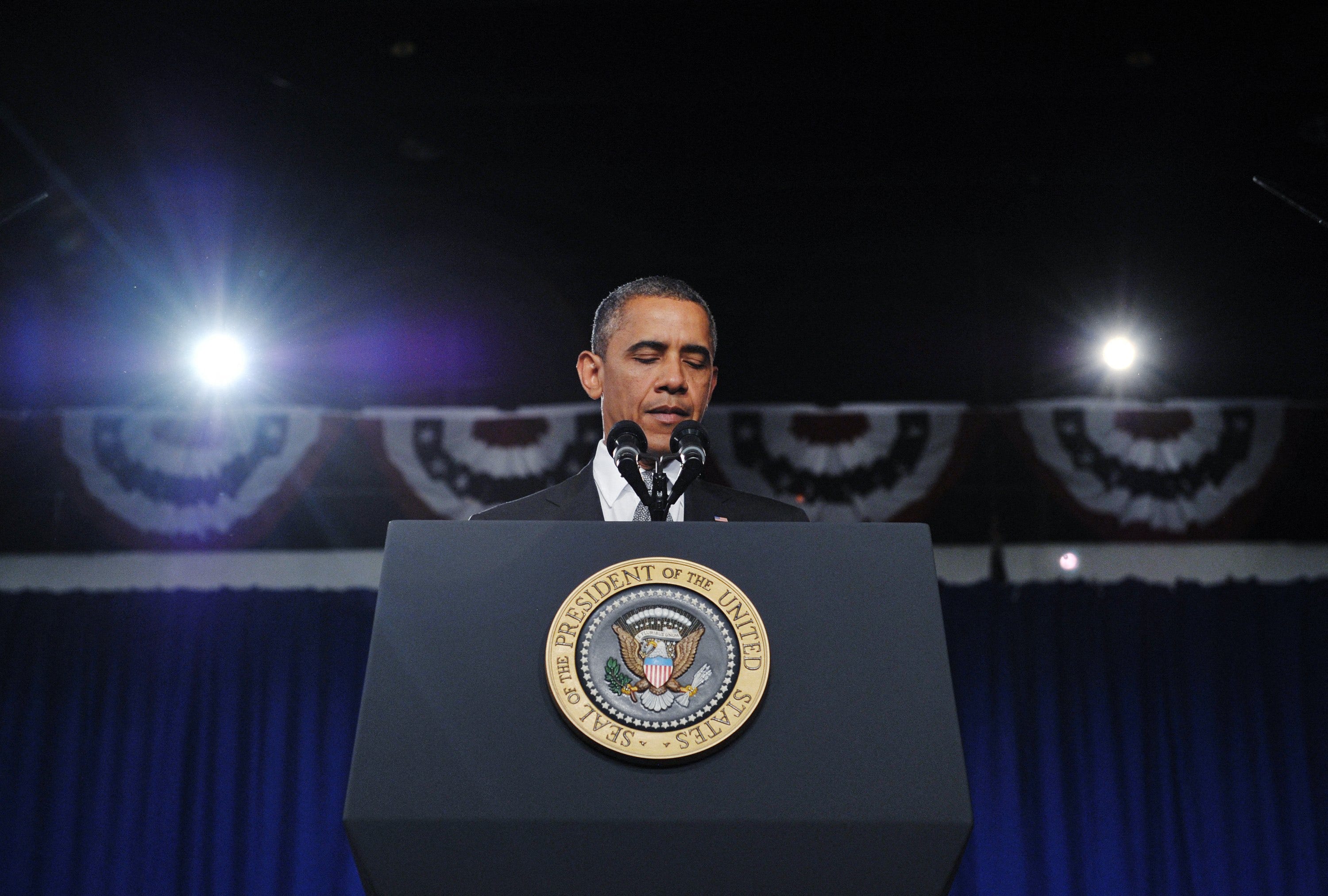
But two years later, as his re-election campaign was gearing up, he was saying the same thing. “The mistake of my first term,” he explained to CBS News, “...was thinking that this job was just about getting the policy right. And that’s important. But the nature of this office is also to tell a story to the American people that gives them a sense of unity and purpose and optimism, especially during tough times.” Now, this is from the Democratic president, whose communication skills are generational, historic, inspirational. His inner circle in his first term was full of seasoned messaging experts such as David Axelrod, Robert Gibbs, and Rahm Emanuel.
Well into his second term, Obama was still blaming his party’s problems on its members’ failure to sell their great works. This is how he analyzed the Republican sweep of Congress in the 2014 midterms, which paved the way for Trump’s election two years later: “When you start governing, there is a tendency sometimes for me to start thinking, ‘As long as I get the policy right, then that’s what should matter,’” he told CBS News. “. . . I think that one thing that I do need to constantly remind myself and my team is it’s not enough just to build the better mousetrap. People don’t automatically come beating to your door. We’ve got to sell it. We’ve got to reach out to the other side and, where possible, persuade. And I think there are times, there’s no doubt about it, where, you know, I think we have not been successful in going out there and letting people know what it is that we are trying to do and why this is the right direction.”
People like to say that the definition of insanity is doing the same thing over and over again while expecting different results. How many times have you heard Democrats blaming their messaging skills, communication choices, or the other side’s media advantages without taking a long, hard look in the mirror? Maybe, just maybe, the problem isn’t the message or the advertising but the core belief that voters will reward good policy – or that they even value the kumbaya politics of national unity. That mindset is built on the notion that the majority of voters sit in the political center and will vote for leaders who govern like centrists, with more deference to the status quo than meaningful change.
That’s not how politics works today. But it is how Democrats govern. An investigation into the failings of the Biden administration, compiled with the help of nearly four dozen former officials, found that those officials were hamstrung by their own inhibitions. They chose incremental policies due to “risk aversion” and were reluctant to pick “the fights worth having.” Among those fights was one of the most basic values of the party: standing up for workers against corporate wrongdoing. Julie Su, the acting secretary of labor under Biden, told the Roosevelt Institute that her own department hadn’t fully gone after corporations for offenses such as wage theft and weak safety protections. “What we needed was to meet that moment with boldness,” she said. “There was too much hesitation.” Instead, the administration was afraid of losing in court; afraid of publicity about their enforcement actions; afraid of politicizing corporations; afraid of alienating voters in the middle of a country that no longer had much of a political middle. They were, in essence, afraid of themselves.
It wasn’t just the Labor Department; the Biden administration was afraid of “high- profile funding flops” even as it secured huge funding for green energy investments. Apparently one bad investment in the Obama years had been enough to inject so much fear and hesitation that it had slowed down the whole process. It’s no coincidence that the bad investment in the solar panel maker Solyndra was one of the right-wing media’s favorite “scandals” in the Obama years. To say it wouldn’t register as a blip in the Trump era would be an insult to blips.
It’s the same fearful attitude that led Attorney General Merrick Garland to wait a full year before announcing to the world that he intended to pursue anyone involved in the Jan. 6, 2021, insurrection “whether they were present that day or were otherwise criminally responsible for the assault on our democracy.” It took another three months for him to sign a memo approving the investigation into Trump. Even then, he was only bounced into moving things forward by the January 6th Committee hearings that summer. Garland then decided to wait until after the midterm elections in November to get started with the appointment of Special Counsel Jack Smith. In fact, he was so careful to avoid the accusation of a political witch hunt – and so fearful of upsetting Republicans – that he rejected three recommendations to expand the inquiry to include the man who had instigated the insurrection. Having wasted half his time in office, Merrick could only watch the clock run down as Trump gladly wasted the second half with legal delays.
It was typical of the Biden team, who tied themselves down in the pursuit of good government, relying too heavily on the bureaucratic process and measurements such as cost-benefit analyses. Their deep belief in good policy was well-intentioned but totally self-defeating. They couldn’t do enough because they were afraid of doing too much. They didn’t want to pick fights in case someone picked a fight with them.
Democrats aren’t stupid. They can read the same polls as Republicans do. They know what the voters want. The Biden team knew enough about the political pain of rising prices to call their landmark tax and spending package the Inflation Reduction Act of 2022. The law invested $783 billion in climate-friendly energy sources, as well as another $110 billion on Obamacare insurance subsidies. That was separate from the $1.2 trillion Infrastructure Investment and Jobs Act of November 2021. Which had nothing to do with the American Rescue Plan Act, which had pumped $1.9 trillion of stimulus into the covid-wrecked economy eight months earlier. All that spending dwarfed anything the Obama administration had managed to shovel out the door. But if you asked a hundred Democrats today to name the achievements of the Biden team, how many would name any one of those huge deals? You wouldn’t need all the fingers on one hand to count them.
Was that a communication problem? Sure. But it’s a symptom of the sickness, not the cause of it. Investing in the country’s infrastructure and its transition to a green economy is obviously a good policy. But it is not great politics when the country is still struggling to emerge from the pandemic and its citizens are grappling with the cost of living and fearful of uncontrolled immigration.
Doing good isn’t really good enough. It doesn’t win over voters, who value change more than moderation. Yet time and again, that’s how Democrats have positioned themselves: as the cleanup squad after another disastrous term of Republican rule. Bill Clinton was cleaning up the deficits after Ronald Reagan and George H. W. Bush. Barack Obama was cleaning up the wars and financial collapse after another Bush. Joe Biden was cleaning up the pandemic after the first Trump term. And the next Democratic president will be cleaning up after the corruption and autocracy of the second Trump term. But they won’t get any credit for it, because the voters care about today and tomorrow, not yesterday or the next decade. They also won’t get any credit because the cleanup will take so long.
They never do. Back in 2004, President George W. Bush was limping toward re-election as the war in Iraq turned into a quagmire of thousands of dead American soldiers and hundreds of thousands of dead Iraqi civilians. His Democratic opponent, Senator John Kerry, turned to former President Clinton for campaign advice. After all, Clinton had won two presidential elections, including one against Bush’s father. He had left office with approval ratings in the mid-60s, even after his impeachment, so his political skills were clearly formidable. Kerry had been right about the disaster of the Vietnam War back in the early 1970s and felt he was right about the war in Iraq now. Clinton, however, had some blunt truths to deliver to Kerry, even as the polls suggested a close contest. “When people feel uncertain,” he said, “they’d rather have somebody who is strong and wrong than someone who’s weak and right.”
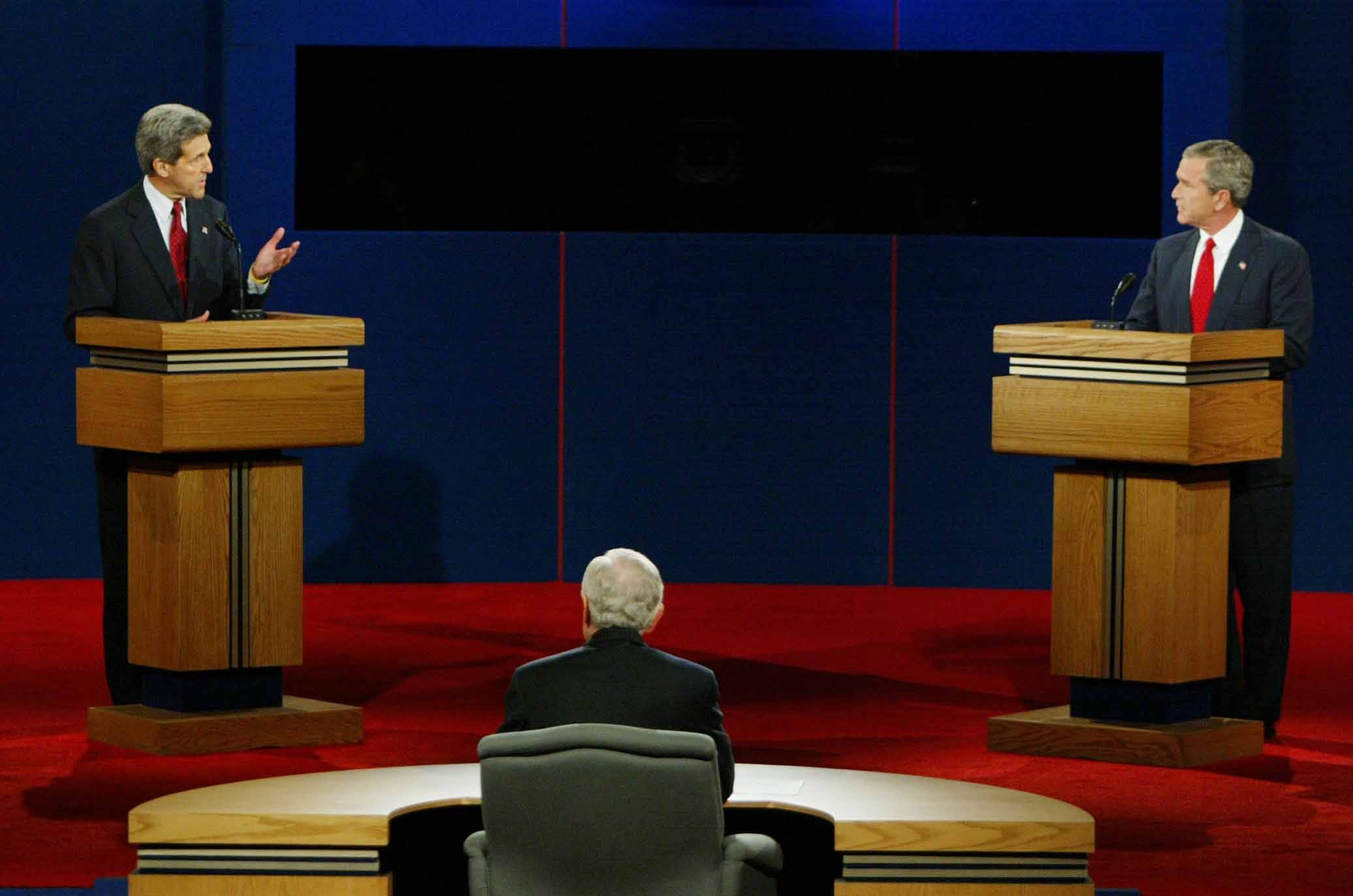
Bush went on to win the popular vote by 2.4 percentage points – the largest margin of victory for a Republican president in the last 40 years. Over that same period, Republican presidents have won the popular vote only twice. For context, when Trump won in 2024, it was by a margin of only 1.5 points. Strong and wrong beat weak and right.
Somehow, when people talk about an evenly divided country, they are talking only about the times when Republicans win the White House. Joe Biden beat Donald Trump by 4.5 points in 2020 popular vote. Barack Obama won his first election by more than seven points in 2008 and his re-election by 3.9 points.
In the aftermath of the 2024 election, in which Trump won the popular vote by 1.5 points, I appeared on an episode of Piers Morgan’s YouTube show ‘Uncensored,’ where he said to me, “You’ve been all caught napping at the wheel. You fell asleep at the wheel, and you let him drive by and take the whole shebang. I think Democrats should take a long, hard look in the mirror and admit you’ve just been completely pounded into total, shameful, humiliating oblivion. And you’ve gotta start again, and you’ve gotta find politicians that actually resonate with the American people. And it’s not the current shower you’ve got. Sorry.” I asked him, “So Piers, in 2020, would you have said the same thing about the Republican Party that lost by a 4.5 percent margin nationally?” He replied simply: “No.”
By any reasonable measure, the so-called populist right isn’t all that popular. Which poses the question: Why do Republicans run the White House as if they have a huge mandate to wield power, while Democrats run the White House with great concern about coalition building and signaling their virtues?
The Democrats who won re-election took a different tack: They muscled their way back to power by destroying their opponents. Was the Clinton economy humming in 1996, when it was time for his re-election? No. Was the Obama economy humming in 2012? Also no. Because they could hardly brag about the good times, both of them attacked their opponents early and often. Bob Dole was an old fool with a right-wing mob behind him. Mitt Romney was an out-of-touch corporate vulture with a right-wing mob behind him. Neither of them could understand the needs of working Americans.
Compare that to Joe Biden’s re-election strategy. Donald Trump could have looked as old and befuddled as Bob Dole. He could have looked as weirdly rich as Mitt Romney. Instead, the billionaire who loves gold-painted mansions was a phony populist with some intuitive understanding of Americans living paycheck to paycheck.
Biden’s pitch to the country before the 2022 midterms (in which the Dems lost the House) was about what he called “the soul of the nation.” Speaking in front of Independence Hall in Philadelphia, he practically hugged the founding documents of the nation and declared, “As I stand here tonight, equality and democracy are under assault. We do ourselves no favor to pretend otherwise.” It was little different from the central argument of Kamala Harris’s brief campaign.
They weren’t wrong about Donald Trump and his MAGA mob; they were just wrong about the voters. Eight in 10 voters, including 68% of Democrats, said that the economy was very important to them, according to the Pew Research Center. Healthcare came second at 65% of voters, ahead of crime and immigration. Gallup found that the economy was the only issue among 22 options that a majority of voters ranked as “extremely important.” That was the highest since the Great Recession of 2008.
Democracy, the soul of the nation, healing a fractured nation: all good stuff, doing good for America, with good government and good people. The kind of stuff that moderates think will appeal to voters across the country. It was just all terrifically bad politics.
For his part, Barack Obama believes this is just a burden that Democrats must bear. “I think we have to acknowledge that we’ve got the harder job,” he told me. “We believe in government as a tool for good, as a potential force to create more jobs, and as a way to make sure that the planet doesn’t roast. To make sure that as we move forward, and the economy grows, that everybody – and not just some – are benefiting, and that kids are getting a good education. What that means is that we have to think about the consequences of our actions. We have to try to figure out how do we get working majorities to actually pass laws, and to implement those laws, and to make things happen. Tearing stuff down doesn’t require that at all.”
Still, even a great consensus-builder like Obama acknowledges that Democrats have been too quick to defend political institutions that should be treated as a means to an end – not an end in themselves. “I do think that there has been some unwillingness on the part of Democrats in the past to break down some of the institutional barriers for us getting stuff done just because, well, it’s always been done that way,” he told me. “I’ll give you an example that frustrated the heck out of me when I was president, which was the filibuster in the Senate. The Senate is already structurally skewed and anti-majoritarian, right? It’s hard for majorities to get stuff done, whether it’s trying to pass civil rights legislation in the 60s or trying to get gun control legislation. Because even though majority [of] people support it, Delaware and Wyoming have the same number of senators as California. That would require a constitutional amendment [to change]. You then compound that with a filibuster. And the truth is that Democrats for some time have been traditionalists in wanting to preserve that, when it blocks us from making government effective, which in turn makes people feel like government is corrupt and not caring about them. Which then gives folks like Trump an opening.”
Still, even with a filibuster-free presidency, Obama would want Democrats to avoid copying Trump-style politics. “I don’t want us to simply duplicate the behavior of the other side,” he said. “I don’t want us to have a slash-and-burn strategy where we don’t care about the rule of law. We don’t care about some of the guardrails around our democracy. We start lying and having no regard for the truth, the way the other side seems to be comfortable with right now. Because if that’s how we fight, then we lose what we’re fighting for. But that doesn’t mean we have to get punked or be saps, or cling to traditions just for the sake of tradition.”
Adapted from Brian Tyler Cohen’s ‘The Day After: How to Wield Power in a Post-Trump World,’ out July 14 from HarperCollins. Copyright 2026.
Brian Tyler Cohen is a progressive content creator with 14 million subscribers across all platforms. His first book, Shameless, was a #1 New York Times bestseller.
The views expressed in this article are the author’s own and do not necessarily reflect those of Zeteo.
Check out more from Zeteo:


Obama was a phony from day one. I voted for him the first time, but within a week, knew that was a mistake. (Remember his cabinet?) He could have had Healthcare for All immediately, but he instead told the oligarchs, "Don't worry, nothing is going to change." His finally creating Obama Care was a cop-out. He's a corporatist and always was, a con-artist. Now, he goes about pretending he's a statesman spewing words of wisdom. As I said, what a phony. BTW, all our presidents and Congress, and now SCOTUS, back that s..thole, Israel. And ANYONE WHO SUPPORTS ISRAEL IS A MONSTER.
This is way too soft on Democrats. Did it a lot more wrong than just poor messaging. How about bailing out Wall Street? Or not Prosecuting Trump? Drowning in AIPAC money? Abandoning the citizens in favor of the donors? Funding and arming a genocide? I could go on.