

There’s No Such Thing as a 'Defensive Weapon'
Politicians call them 'defensive weapons' to make arming Israel sound unobjectionable, but the US military, Netanyahu, and Trump all know better.

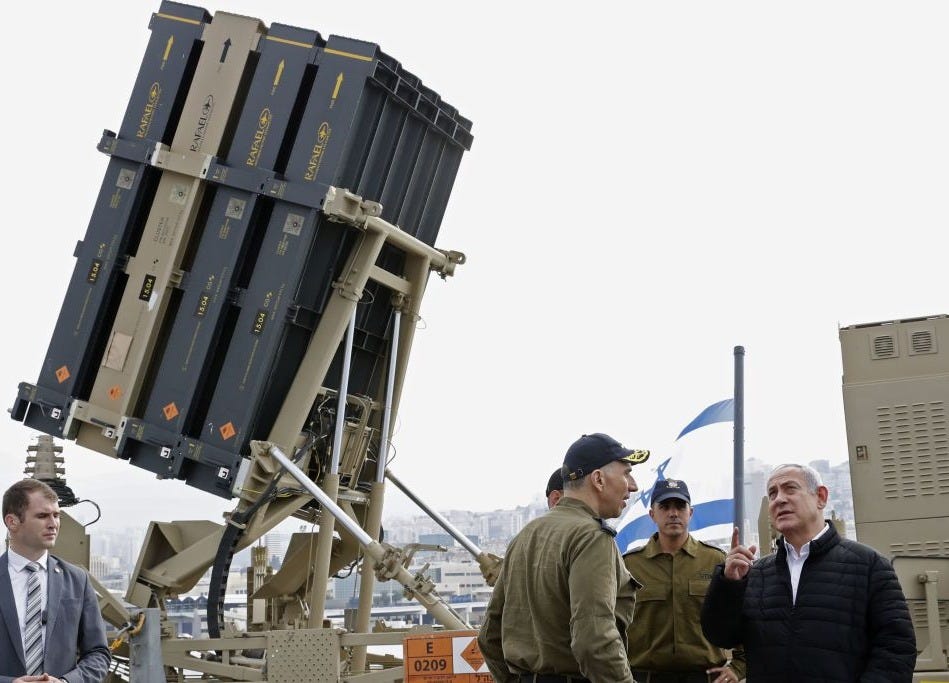
Progressive presidential contender Congresswoman Alexandria Ocasio-Cortez made headlines earlier this month when she pledged to oppose funding any weapons for Israel, including “defensive capabilities,” a call soon echoed by fellow progressives, including Senator Bernie Sanders. On Wednesday, after Senator Elissa Slotkin joined other possible centrist presidential hopefuls in casting their first-ever votes to block weapons sales to Israel, she reassured pro-Israel constituents by promising she would “continue to support sending Israel much-needed defensive weapons like Iron Dome.”
So What Exactly Is a ‘Defensive Weapon?’
To supporters of arming Israel, it’s an invaluable turn of phrase that implies a transferred weapon will only be used for the legally and morally unobjectionable purpose of self-defense. The “defensive weapons” in question are a series of Israeli air defense/anti-air systems jointly funded and developed by the US and Israel. Politicians often refer to these colloquially as the “Iron Dome,” the name of one of the systems. Proponents of US funding for these systems argue they are purely defensive in nature and are needed to protect civilians and save lives. Who could object to that?
US military doctrine, for one. In joint military doctrine, there’s no such thing as a “purely defensive” weapon. That’s because any weapon can be used in support of offensive or defensive operations. Even air defense weapons, though they confusingly have “defense” in the name. But there’s nothing inherently offensive or defensive about any given system. In other words, per US military manuals, it’s not what you have, it’s how you use it.
The military does recognize protective capabilities—the weapons and equipment that help keep people alive during their mission. We can cut through the euphemisms hugging “defensive” weaponry if we understand that protective doesn’t mean defensive.
Think about the helmet and pads on an offensive tackle in the NFL. Certainly protective for him, but not defensive for anyone, least of all the players he’s knocking over. Or think of the gas masks border patrol agents put on before throwing tear gas at protestors in Minneapolis. Or the armor on Israeli tanks shooting at tents in Gaza.
Even Netanyahu and Trump Know Air Defenses Aren’t Purely Defensive
If you still don’t believe anti-air weapons fit into this protective-not-defensive category, take it up with bleeding-heart peaceniks like … Benjamin Netanyahu and Donald Trump.
As Reason editor Matthew Petti has pointed out, Netanyahu vociferously opposed Russia’s sale of its long-range S-300 air defense system to Iran in 2015, with the Times of Israel reporting Netanyahu claimed “the deal would threaten the very survival of Israel.”
The Obama administration also registered its displeasure at the time, with Obama issuing an extra warning to Iran not to transfer these weapons to Yemen’s Houthi rebels. Flash forward to earlier this week, when Trump threatened China with “big problems” if it supplied Iran with new anti-air weapons. That’s a lot of stress for weapons that purportedly do nothing but save innocent lives.
Nobody can attest to the cruel irony of the term “defensive weapons” better than the victims of Israel’s recent military campaigns. The more “defensive weapons” available, the bigger the offensive operations launched by the Israeli military and the higher the body count.
In response to escalating tit-for-tat attacks between Iran and Israel, Biden made the unprecedented decision to deploy a 100-soldier THAAD air defense battery to Israeli soil in October 2024. Days after the US air defense unit arrived, the Israeli military launched what was at the time its largest bombing run on Iran.
Netanyahu didn’t attack Iran directly again until the “12-Day War” in June 2025—incidentally just two months after Trump deployed a second THAAD to Israel.
And it beggars belief that Netanyahu would have urged Trump to join him in his latest battle against Iran without the confidence that layers of Israeli, US, and Gulf state air defenses would cushion the blow from inevitable Iranian retaliation.
It’s hard to say these “defensive weapons” protect civilian life when, without them, the thousands of civilians killed in Iran and Lebanon would probably still be alive today. Likewise, Israeli civilians, ostensibly the beneficiaries of these weapons, would be going about their daily lives as they were on February 27 instead of living in bomb shelters.
Notably, reports that the Israeli military is close to running out of air defense interceptors might explain why Netanyahu is grudgingly willing to go along with a ceasefire with Iran – at least until he can reload.
If More Weapons Make Israel’s Government More Aggressive, Does It Matter Who Pays for Them?
Calls to make Israel pay for its own weapons are mostly in reference to excluding Israel from a program called Foreign Military Financing. That program awards countries US taxpayer dollars, provided they use it to buy American weapons. Or, uniquely in Israel’s case, spend it on their domestic defense industry.
However, pro-Palestinian advocacy group IMEU warns that demands to end military funding for Israel, but not arms sales altogether, are a Netanyahu-approved “bait and switch.” The point of this strategy is to keep weapons flowing to Israel while mollifying the public by obfuscating continued US spending through joint weapons development schemes.
Additionally, selling – instead of gifting – weapons to Israel may circumvent Leahy Laws that prevent the US from transferring arms to human rights abusers, but don’t apply to commercial sales. Congress would have to take individual votes rejecting proposed sales, as the Senate did this week.
That Netanyahu and US Zionists are trying to weatherproof the US-Israel security relationship from outrage over Gaza should be considered an immense win for the anti-genocide, anti-war camp – i.e. most Americans – though it is certainly not a final victory.
And ending military financing for Israel would have some constraining effect on Israel. Without $21.7 billion in US subsidies for its post-Oct. 7 military operations from 2023 through 2025, the Israeli military may have chosen its targets more sparingly. For comparison, Israel spent $77 billion from its own treasury.
But Israel is still a wealthy enough country that can afford the weapons it needs to wreak havoc on the region. And anyway, the real value of US arms transfers isn’t that they’re free, it’s that they’re weapons Israel literally can’t get anywhere else.
Ultimately, the fundamental criticism of “make Israel pay for it” rings true: The moral, legal, and strategic logic of enabling Israel’s genocide in Gaza, ethnic cleansing in the occupied West Bank and Lebanon, and war of aggression in Iran are the same whether the US bombs are sold or gifted.
Any debate on the costs of military support for Israel must also highlight the price of deploying the US military in support of Israel. Combat operations in the past six weeks have now dwarfed the costs of post-Oct. 7 military aid to Israel. But even before this war started, US military operations for the various post-Oct. 7 wars cost about half as much as military subsidies to Israel over the same period.
There is also a dearer price most politicians avoid discussing for fear of appearing insufficiently thankful to the troops: US casualties. But hundreds of military personnel have been wounded in the post-Oct. 7 wars, and at least 16 killed between the current Iran war and the 2024 attack on a US base in Jordan.
If you were wondering how US troops ended up wounded in Israel during the current war, they probably belonged to the air defense units Biden and Trump sent there.
But Wouldn’t Israel Be Unsafe Without US Military Aid and Protection?
That was the argument put forth by the Biden officials who innovated the policy of unlimited, unconditional military support for Israel back in 2023 – an argument former Secretary of State Antony Blinken is still making today.
But in 2026, we have ample evidence – gathered at horrific cost – that arms transfers, including “defensive weapons,” only give license to new wars that have done anything but protect civilians. Leaders and lobbies who truly want to bring an end to Israel’s reign of terror will object to all forms of support for the Israeli military.
Harrison Mann is a former US Army major and executive officer of the Defense Intelligence Agency’s Middle East/Africa Regional Center who resigned in protest of his office’s support for Israel’s war in Gaza under the Biden administration. He is currently with the group Win Without War and recently became a Zeteo contributor.
The views expressed in this article are the author’s own and do not necessarily reflect those of Zeteo.
Don’t miss these other stories from Zeteo:


We need to stop sending ANYTHING to Israel! They are creating enemies for themselves and for the idiot US politicians supporting them that are making us also in more danger. This is just ignorant to keep supporting Netanyahu with his love of war to stay in power. It doesn't help Israel on the world stage, it's not making them (or us) safer but, instead it's creating MORE Hamas/Hezbollah enlistees and why wouldn't they? When your innocent parents, children, and other relatives get killed then wouldn't that piss you off!!!! When your olive trees, and house get bulldozed, and property taken over by settlers, wouldn't that piss you off? It's what's happening so it HAS to STOP!!!!
This is such an important point. Thank you, Major Mann. And thank you for your principled resignation. So, beware of politicians like Elissa Slotkin who still make distinctions between offensive and defensive weapons. I didn’t realize before reading this article what a huge military budget Israel has, even without U.S. aid. Thus, the economic in addition to moral reasons for cutting off aid are compelling. Why are we subsidizing this wealthy rogue nation that is committing more war crimes than Russia?