


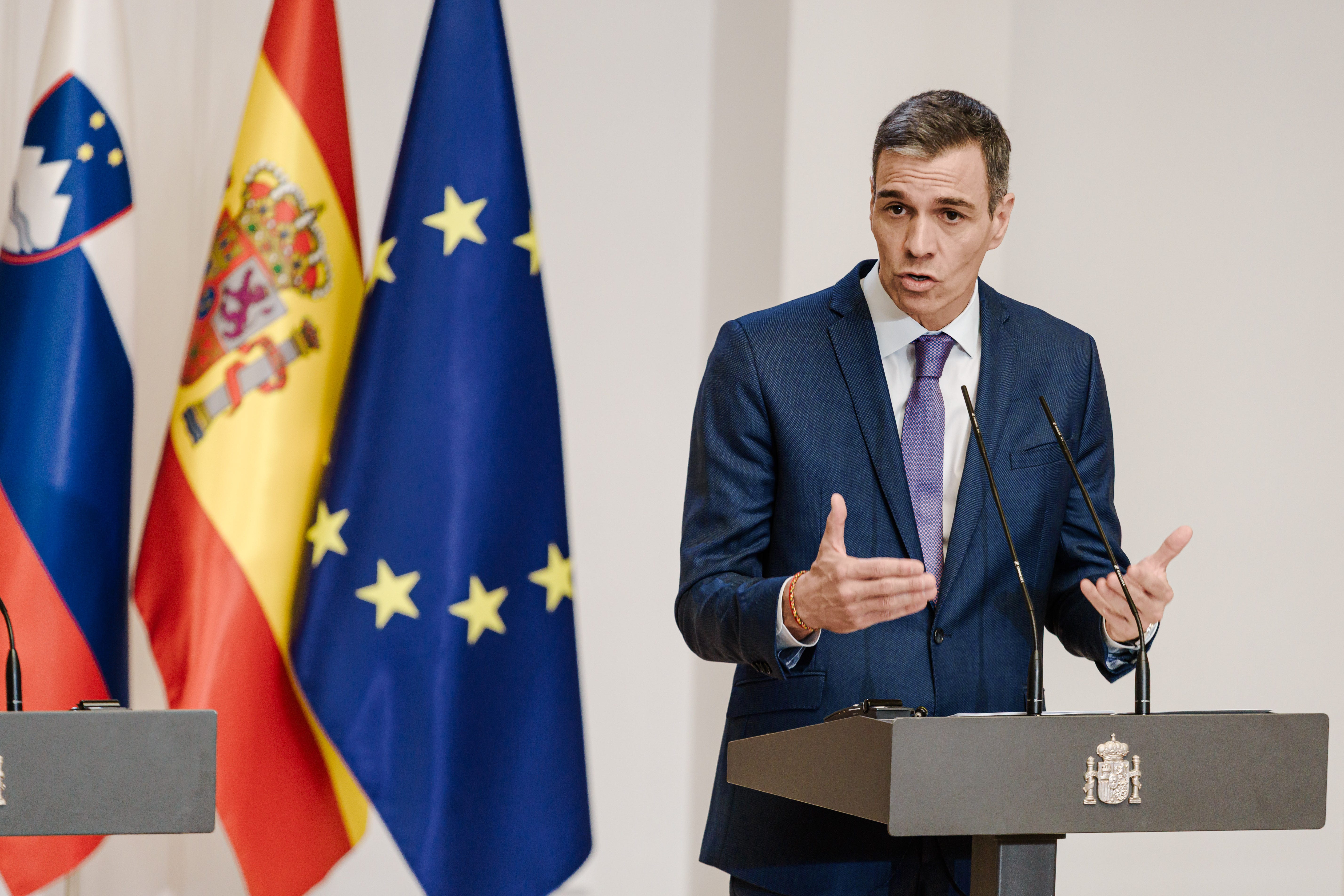
For those wondering if there are any Western leaders upholding the minimum values of a democracy and basic human rights, the answer is just the one: Pedro Sánchez, the prime minister of Spain. Sánchez has been an outlier, a voice of dissent in a time of genocide and endless warmongering. In the aftermath of the United States and Israel’s reckless attacks on Iran, Spain was amongst the few Western states to reject yet another illegal war on a Muslim state. “Twenty-three years ago, another US administration dragged us into war in the Middle East,” Sánchez declared in a speech. “No to violations of international law. No to the illusion that we can solve the world’s problems with bombs. No to repeating the mistake of the past. No to war,” he later added in a tweet.
It’s a position long in the making.
Though Spain, among others, recognized Palestine as a state – a largely symbolic act that has yet to yield, and isn’t expected to produce any material changes for Palestinians – the country has gone much further than its fellow Europeans. Sánchez’s Spain (along with a small handful of other countries) withdrew from Eurovision over Israel’s participation, called for a sports ban on Israel, was an embarkation point for the Global Sumud Flotilla that tried to reach Gaza, has long supported the Palestinian refugee agency, UNRWA, and grants nationality almost automatically to those born to stateless parents. Spain has long been supportive of the Palestinian cause. It was under a conservative government that all political parties adopted a symbolic resolution calling for a Palestinian state more than a decade ago. In fact, Spain was the last country in Western Europe to establish official relations with Israel; they didn’t do it until 1986. The frost is less to do with Spain’s 800 years of Muslim rule – a period of high culture, art, and architecture that is remarkably well preserved – and more to do with the country’s isolation under General Francisco Franco’s decades-long dictatorship. Having cold relations with Europe, Franco concentrated on building links to South America and the Arab World. That said, Spaniards argue that support for Palestine has nothing to do with anything historical but is simply a belief that no people should be subjugated and occupied.
President Donald Trump was less than thrilled by Spain’s stance against his carpet bombing of Iran, which was seemingly conducted without any thought or strategy or understanding of Iranian history, politics, or geography. “Spain has been terrible,” Trump sulked in response to Sánchez’s refusal to join in the bombing. He called the country an “unfriendly” ally. “We’re going to cut off all trade with Spain,” the US president continued with Trumpian aplomb. “We don’t want anything to do with Spain.”
A Lonely Anti-War Voice
Though Sánchez has been under fire in recent months at home – his Spanish Socialist Workers' Party (PSOE) has been accused of corruption, and his wife and brother have been accused in cases of alleged graft and influence peddling (they deny wrongdoing and Sanchez called the allegations against his wife a “harassment and bullying operation”) – the Spanish prime minister is nothing if not a political survivor. In 2018, he came to power after engineering the first successful no-confidence vote in Spanish history against Prime Minister Mariano Rajoy. In 2023, analysts were sure that he would be voted out, but Sánchez corralled separatist parties behind the scenes to keep himself in power.
His critics, including those on the left, say Sánchez is all bark and no bite, pointing out that despite cutting arms to Israel since January 2024, his government has reportedly allowed more than 60,000 pieces of mainly American military equipment and hardware to transit via Spain. The arms embargo, they say, could be made much tougher. During the Global Sumud Flotilla’s second voyage to break Israel’s siege, Sánchez sent a Spanish military ship to accompany the flotilla. The move earned him much praise. But then, as the ships neared Israel’s “illegally declared maritime exclusion zone,” Spain backed off. They would not approach or intervene. Optics, Sánchez’s critics argue, is all this is, insisting his anti-war, anti-genocide stance is pure pandering to voters ahead of Spanish elections next year. Fine with me. More politicians should experiment with doing what a majority of their voters want. Sánchez hasn’t pushed back directly on those charges but noted that “when we said ‘no’ to war, there was a wave of pride in being Spanish, not only within our own country but among many societies across the world.” Indeed, not since former French Foreign Minister Dominique de Villepin, who recently called for sanctions against Israel and demanded reparations for Iran, has there been such a charismatic European voice against war and Western adventurism.
Last September, Sánchez accused Israel of “killing innocent boys and girls with hunger” and “exterminating a defenceless people.” Spain, he said, would play its role to “stop the genocide in Gaza and to go after its perpetrators,” and would formalize a de facto prohibition on military sales to Israel, would disallow the use of Spanish ports and airspace to cargo laden with fuel and weapons headed to Israel, and ban those “directly involved in the genocide” from entering Spain. It’s unclear who that refers to since most men and women in Israel serve in the Israeli military, which I call IOF, after the age of 18 and remain on reserve duty until at least the age of 40.
Spain recalled its ambassador to Tel Aviv, a move that Israel predictably called “antisemitic.” A designation that has been rendered beyond meaningless by Israel and its defenders. Spain’s recalling of its ambassador might be more than just the politics of optics, however, since Iran reportedly promised passage through the Strait of Hormuz to any state willing to expel Israeli and American ambassadors.
But Europe is a lonely continent for an anti-war state, forget about leaders of principle. They simply don’t exist, at least among the G7. Among Sánchez’s peers is Keir Starmer, the former human rights lawyer turned prime minister of the UK, who declared that Israel had “the right” to cut electricity and water to Gaza after October 7. Doing so, in fact, is a war crime according to the Geneva Convention. One of Starmer’s ministers, Sarah Sackman, the courts minister, recently made the news for knowing even less about the law than her boss. She declined to call the Iran school massacre in Minab – revealed to be the result of a what was reportedly a US double-tap strike on a school – “a war crime.” Scores of dead schoolchildren were, Sackman shrugged, “the realities of war.” It is probably a coincidence that she once clerked for the Israeli Supreme Court, a body that has consistently upheld Jewish supremacy and apartheid.
Then there is France’s Emmanuel Macron, fond of scolding protesters and spending as much money as possible on makeup, whose presidency can be summed up as what happens when you give a banker political power: i.e., nothing. And who can forget Chancellor Friedrich Merz of Germany, who has never met a genocide he didn’t like and enjoys a good guffaw with a fascist, any fascist. So much so that Spain accused Germany of behaving like a “vassal” to the US. All three have likely broken international law. Britain went to court to defend their weapons sale to Israel during the genocide; the others either welcomed the wanted war criminal Benjamin Netanyahu, rolling out the blood red carpet for him, or looked the other way when he wanted to use their airspace.
In fact, very few anti-war leaders exist in the West. While people take to the streets against the wars of the West, all Western leaders do in response is criminalize protests as Starmer’s Labour government recently did, banning Sunday’s pro-Palestine march planned to mark Al Quds Day (hundreds still showed up to protest, and about a dozen were arrested). Sánchez may be shoring up support ahead of elections, but perhaps other Europeans should think of doing the same instead of dragging their populations into a deeply unpopular and catastrophic war.
Fatima Bhutto is an award-winning author and journalist. ‘Gaza: The Story of a Genocide,’ a collection of essays she co-edited, and her memoir, ‘The Hour of the Wolf,’ are available now.
The views expressed in this article are the author’s own and do not necessarily reflect those of Zeteo.
Check out more from Zeteo:


Sánchez is the only Western leader treating international law as binding rather than optional. “No to violations of international law. No to the illusion that we can solve the world’s problems with bombs” isn’t radical, it’s the minimum standard for democratic governance.
Spain kicked US aircraft out of Rota and Morón bases. Faced Trump’s trade embargo threats. Maintained position despite diplomatic isolation. That’s not virtue signaling, that’s operational refusal to enable war crimes.
The gradient I’ve been documenting—some people are people, some people are variables—works globally too. Spanish bases can’t be used to bomb Iranian schools. Other European leaders allow their bases, provide defensive cover, then claim they’re not participating.
Sánchez proves you can say no. The fact he’s alone proves how thoroughly authority has decayed everywhere else.
—Johan
The response of most European "leaders" to the genocide in Gaza has been absolutely disgusting! What is happening to the Western world??