

In 2002, Iraqi exiles led by Ahmad Chalabi helped sell George W. Bush’s catastrophic war on Iraq. Today, as Donald Trump follows in Bush’s footsteps in Iran, a similar question looms: where do Iranian Americans stand?
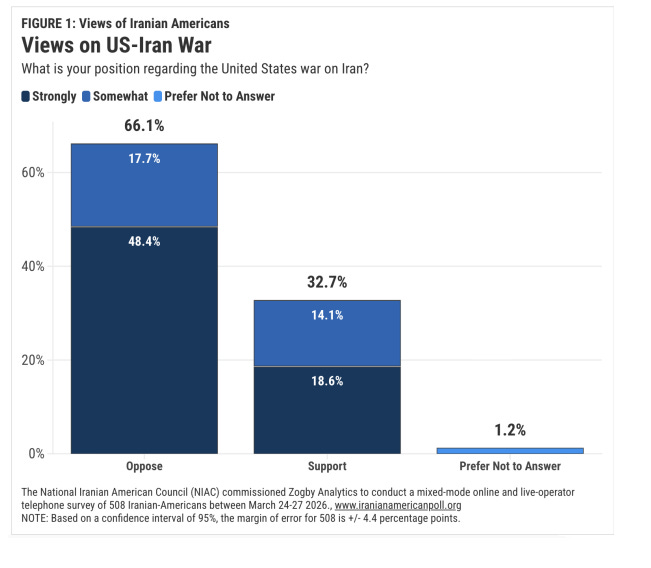
In new polling conducted one month into the war on Iran by Zogby Analytics and commissioned by my organization, the National Iranian American Council, there is a clear answer: Iranian Americans overwhelmingly oppose this war.
A Community in the Crosshairs
Iranian Americans have been heavily propagandized in recent years. Ten years ago, virtually every major Iranian diaspora figure, including those who now support the war – from Shireen Ebadi, to Nazanin Boniadi, to even the son of the deposed Shah Reza Pahlavi – shared our organization’s position in support of the Obama-era nuclear deal. As Iranians inside Iran celebrated the historic accord in hopes of a brighter future, polling of Iranians in the diaspora showed broad support for the agreement – and strong opposition to war from even some of the most fervent opponents of the Islamic Republic.
But while Iran hawks and hardliners failed to block Obama’s nuclear deal, they redoubled efforts to put the US and Iran back on the war path – including by working to reverse the broad support inside Iran and among the diaspora for US-Iran diplomacy.
Networks like Iran International were launched with millions in funding from Saudi Arabia and support from Israel to promote regime change. Organizations like the “Iran Disinformation Project” were established with funding from the Trump State Department to attack Iranian-American opponents of war. And many formerly pro-deal voices shifted to support tearing up the deal and imposing “maximum pressure” sanctions. Prominent figures like Reza Pahlavi were cultivated by the Israeli government and became the beneficiaries of Israeli-funded online influence operations. And Iranian Americans who dared oppose war or sanctions were threatened, doxed, and intimidated into silence in what appeared to be a coordinated campaign.
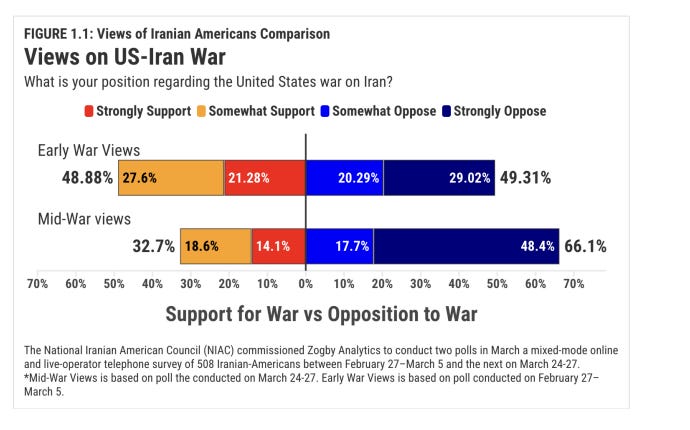
The end result of this steady barrage of propaganda, combined with the Islamic Republic’s violent repression and a crumbling sanctions economy, was a steady winnowing of opposition to war among Iranian Americans. When we polled the community before the 12-day war in June 2025, a majority opposed military action (53%) but by smaller margins than in the past. By the time we polled Iranian Americans at the outset of the current war, the community was nearly evenly split on the question of initiating the conflict.
But now, one month into the war, that dynamic has shifted back to where it once was. Iranian Americans overwhelmingly oppose the war and want Trump to end it now through a negotiated off-ramp. There is no mandate from this war from the Iranian-American community: while some may want us to reprise the role of Chalabi, they don’t have the support of the community behind them.
Two-Thirds of Iranian Americans Oppose the War
In our new polling conducted by Zogby Analytics from March 24-27, 66% of Iranian Americans say they oppose the US war on Iran, with just 33% in favor. This is a 16-percentage-point swing from the beginning of the war, when Iranian Americans were evenly split, 49%-49%, on the war.
There are a number of potential explanations for the initial divide. Support for war among Iranian Americans likely spiked in the aftermath of the horrific Iranian government crackdown that killed thousands of Iranians amid anti-government protests in January. Those feelings of grief and despair were likely buttressed by fantastic claims laundered by Persian media outlets and diaspora activists that the US and Israel would only strike “the Islamic Republic” while somehow not striking Iran in what would be a “rescue mission”; that tens of thousands of defectors were lined up to quickly depose the regime once the fighting started; and that a transitional government led by the son of the deposed shah who hasn’t set foot in Iran in over 40 years would quickly sweep into power.
But while the opening phase of the war may have been celebrated by many when the Supreme Leader Ayatollah Khamenei was killed, soon we learned that over 150 girls were killed in a US bombing of Minab. And now, after a month in which thousands of Iranians have been killed, and we began to see wanton destruction of civilian infrastructure that evokes recent memories of the destruction of Gaza, our community’s flirtation with war has ended. The community has returned from a period of ambivalence and increased openness to war to a clear position opposed to war with Iran.
Iranian Americans Want Change – But Not From Foreign Intervention
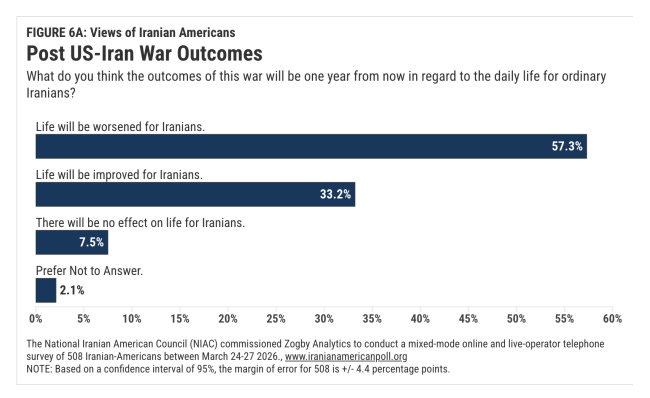
When asked what the impact of the war will be one year from now, Iranian Americans’ views are overwhelmingly negative.
A majority of Iranian Americans say life in Iran one-year from now will be worse for Iranians (57%).
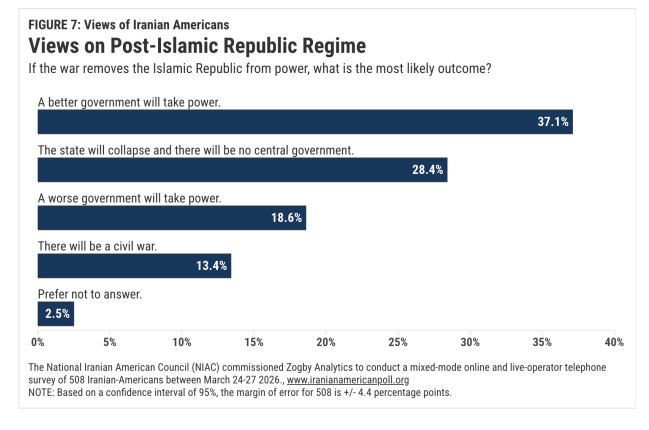
A majority also believes the Islamic Republic will remain in power (53%) after the war, but if the war does achieve its initial objective of “regime change,” just 37% of Iranian Americans say it will lead to a better government taking power. 60% anticipate negative outcomes from US-led regime change, including state collapse, a worse government taking power, or civil war.
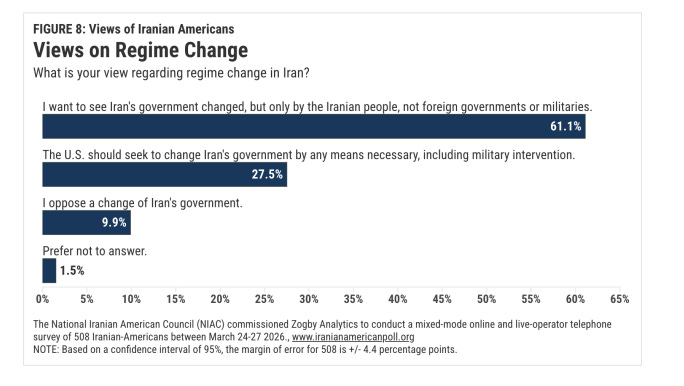
On the question of “regime change,” a majority of Iranian Americans do want to see Iran’s government changed (61.1%) – but they say only if it is changed by the Iranian people, not through foreign intervention. Just 27.5% said the US should pursue regime change through military intervention or other action.
Now What?
If the president or lawmakers care to hear what Iranian Americans really think about this war, and not just to use them as puppets to promote a war, the message is stark. Some 70% of Iranian Americans say the US should end the war now. Despite the significant opposition to Iran’s government, over 65% of Iranian Americans say the US should negotiate an agreement with that government to end the war. And the number one thing that Iranian Americans say the US can do to help Iranians is to end the war.
Jamal Abdi is the president of the National Iranian American Council, which was founded in 2002 to advance peace, civil rights, and the priorities of Iranian Americans. Previously, he served as an aide in Congress focused on foreign policy, national security, and immigration.
The views expressed in this article are the author’s own and do not necessarily reflect those of Zeteo.
Check out more from Zeteo:


I am a Iranian American and I have a very, very large family here in the US. I have many family members mostly elders that are in full support of this war. It’s tearing our family apart because the younger generations are not in support of this war.
Thank you for this. It fills in a lot of gaps for me re the disinformation machinery