


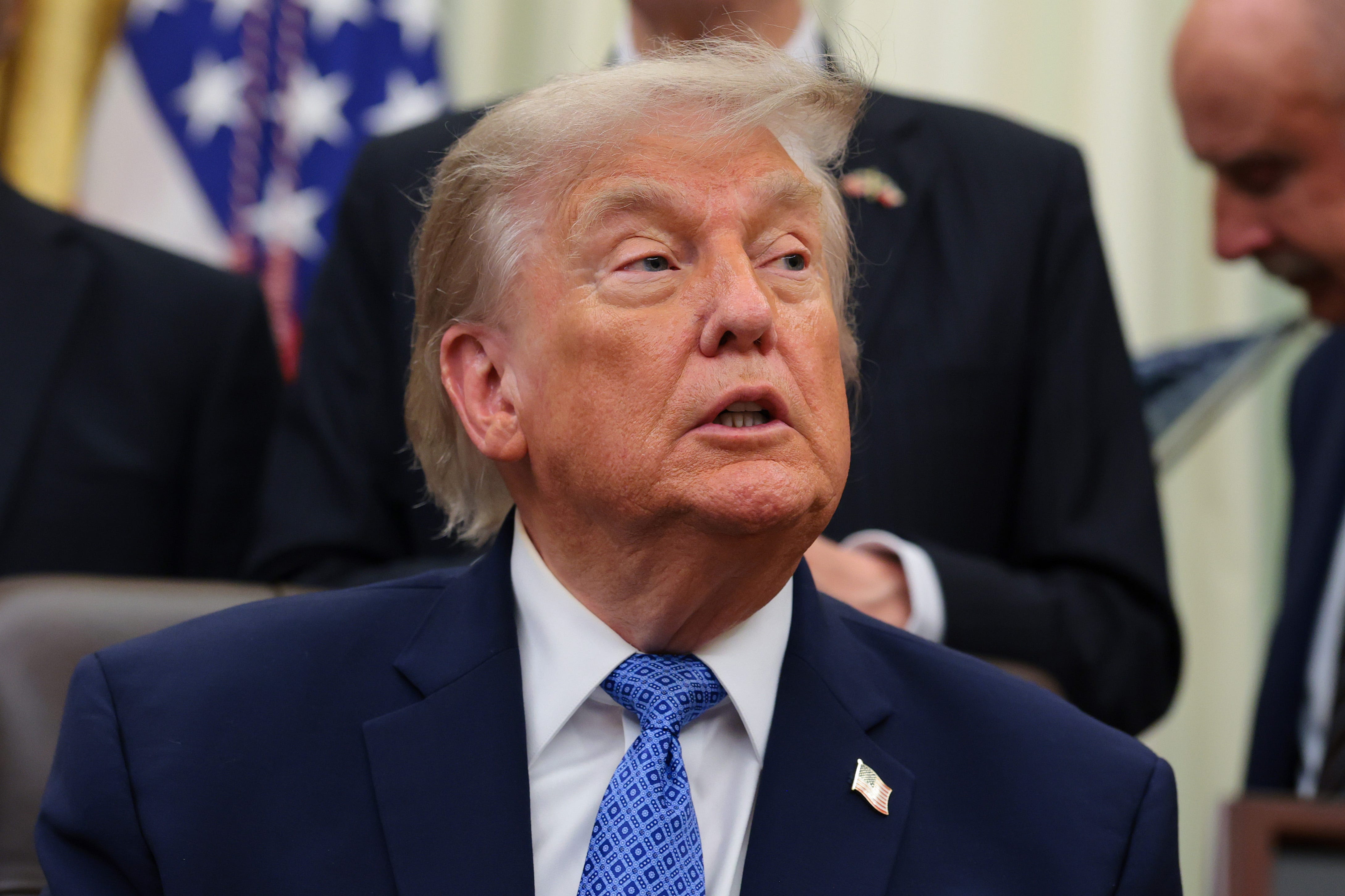
Donald Trump ordered the U.S. military to strike drone, missile, and radar sites in Iran on Friday, in response to an Iranian drone attack on shipping in the Strait of Hormuz the day before. The strikes came amid a supposed 60-day ceasefire to allow for talks aimed at ending the war.
One exasperated senior U.S. official told Zeteo the U.S. strikes showed Trump had “started a forever war.”
Earlier on Friday, Trump told reporters at the White House they would “find out soon” if he was going to order new strikes, in response to the Iranian attack on a Singapore-flagged ship that Tehran said was using an unapproved route through the Strait.
“I don’t like the fact that they took a shot yesterday, actually four of them,” Trump said. Asked why he would order a strike when he had said ceasefire talks had been going well, Trump said of Iran: “They’re a little bit different.”
Ebraham Azizi, a senior Iranian national security official, responded to Trump’s comments by saying the U.S. should “respect the rules” of the Strait of Hormuz, over which Iran claims control, and “not mistake control for escalation.”
U.S. Central Command then said it conducted “a powerful response” to the Iranian strike on the ship that was “exiting the Strait of Hormuz along the Omani coast at the time of Iran’s attack.”
The statement continued: “The unwarranted aggression against commercial shipping by Iranian forces clearly violated the ceasefire. Furthermore, Iran’s dangerous behavior undermined freedom of navigation as commerce increasingly flows through the vital international trade corridor.”
The New York Times quoted a U.S. official as saying the strikes hit targets along the Strait and on Queshm Island.
After the U.S. strikes, Azizi said: “The U.S. attacked Iran in the middle of negotiations once again. The failed U.S. president has shown he has no commitment to the principles of negotiation or a ceasefire. This reckless violation of the ceasefire will, as always, lead to retreat and regret on their part. The blame game does not work anymore.”
In a statement carried by Iranian state media, the Islamic Revolutionary Guard Corps said the U.S. had violated the ceasefire and any further strikes would be met with a “more extensive” response.
Vice President JD Vance, who has been leading U.S. negotiators in talks held in Switzerland, said: “Iran signed a ceasefire agreement. We have honored it. If they have disagreements about how the MOU is being applied, they can pick up the phone. But violence will be met with violence.”
As the markets closed for the weekend – the time when Trump has privately told U.S. officials he prefers bombing Iran – several administration officials and others close to the Trump White House told Zeteo that this was the scenario many predicted, or feared.
Trump, they said, had started not just another disaster in the Middle East. He had quite possibly started the exact kind of conflict that he at least said he would keep the U.S. out of: a never-ending war that stretches far past the American government’s “mission accomplished” moment, that commits U.S. forces to combat well past the patience of voters and the elite, and that has reverberating unintended consequences for years if not decades to come.
Friday’s events were further evidence that’s precisely the road Trump put the U.S. on, where any idea of a meaningful exit strategy is proven immediately laughable.
A Trump administration official referred to the latest events as another instance of “peacetime bombings,” an intentionally ironic term that further underscores how Trump and Israeli Prime Minister Benjamin Netanyahu’s attacks on Iran have produced perhaps the most Orwellian war of our lifetimes.
Check out more from Zeteo:


"Folly often does not spring from a great design, and its consequences are frequently a surprise. The folly lies in persistence – pursuit of a policy contrary to the self-interest of the constituency or state involved, despite the fact that a workable alternative course of action was known to exist.”
Barbara Tuchman: The March of Folly: From Troy to Vietnam
Does this surprise anyone?