

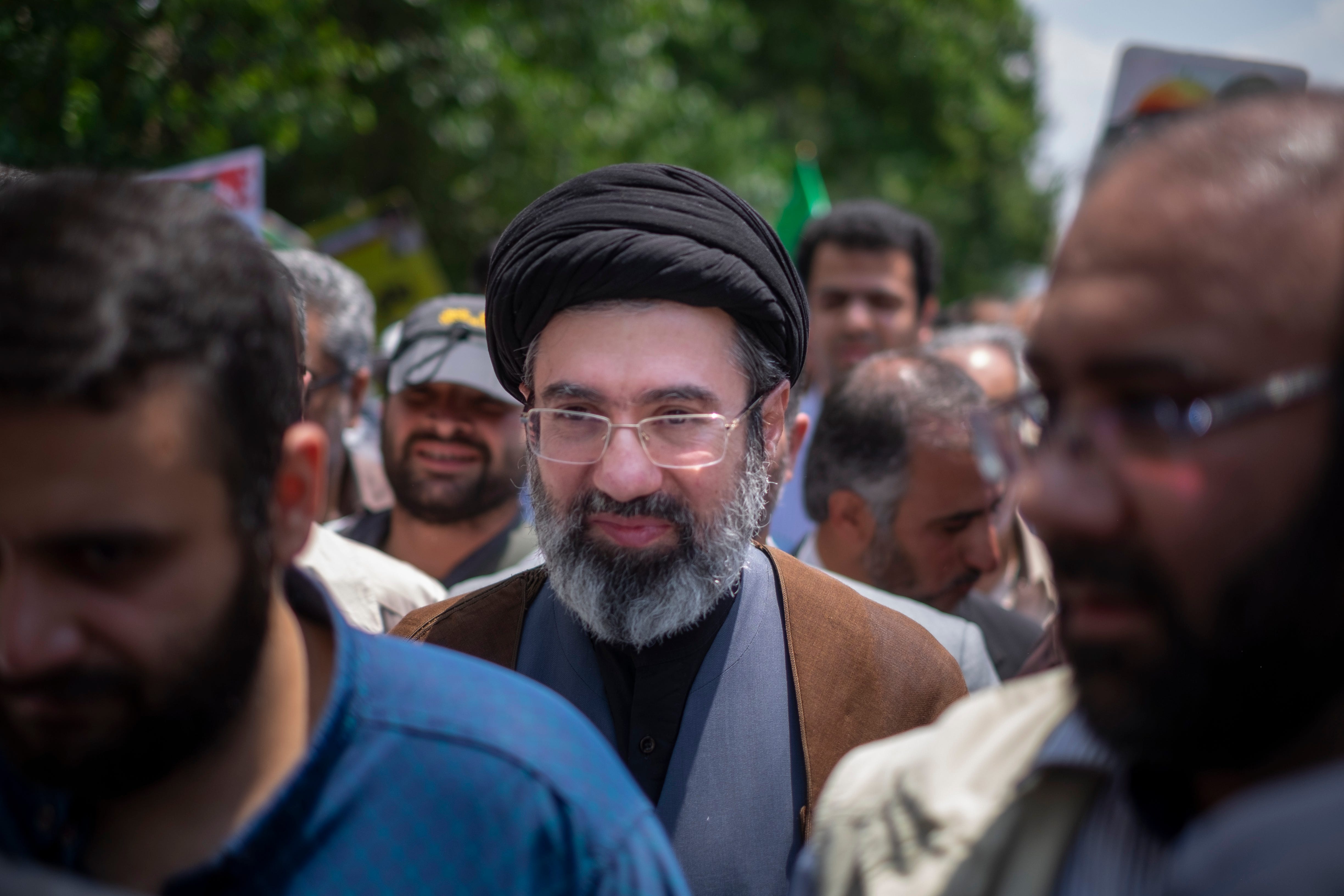
Before the US and Israel launched their war on Iran, Mojtaba Khamenei was an unlikely choice to succeed his father. The Islamic Revolution had ended the monarchy, and the revolution’s founder, Ayatollah Ruhollah Khomeini, had been explicit in denouncing primogeniture. Even former Ayatollah Ali Khamenei, Mojtaba’s father, had putatively written a letter to the Assembly of Experts, which chooses the supreme leader, asking that it not consider his son. Moreover, January’s mass protests meant that choosing another Khamenei would invite even more demonstrations and deepen the divide separating the people from the state. And yet, the majority of council members chose Mojtaba anyway – sending a defiant message to the US, Israel, and the world.
This was a choice made during war, and at a time when the country is facing an existential moment. Mojtaba’s selection was meant to signal stability and continuity at home and defiance abroad. In his first public statement as supreme leader, Mojtaba endorsed Iran’s war strategy and confirmed the Islamic Republic’s resolve to realize its war goals. This should not have come as a surprise. Mojtaba had been deeply involved in the strategy that his father and Iran’s military leaders had devised after the 12 Day War with Israel in June 2025. That war ended with a tenuous ceasefire, and Iran expected that it would soon give way to another attack by an Israel determined to realize the war objectives that had eluded it in June.
Iran cannot match the United States and Israel’s capabilities in waging war, but it knows how to endure, expecting that survival would constitute victory. The opening act in Israel’s war strategy has been to eliminate Iran’s civilian and military leaders to paralyze and collapse the state. To avoid that fate, Iran has diffused decision-making authority across its government and military institutions. Rather than make decisions top-down, it has created a decision-making mosaic to survive the killing of its leaders. Mojtaba is now in command of that mosaic, but he will not replace it.
Pleasing the IRGC and the Regime’s Base
Mojtaba was the choice of Iran’s Islamic Revolutionary Guard Corps (IRGC), whose influence has grown politically during the time of war. Mojtaba is himself a veteran of the Guards and has been closely associated with the force over the past three decades. Israel’s decapitation campaign has brought about a generational change in IRGC leadership. The commanders who led in the Iran-Iraq war of the 1980s have largely been replaced by a younger generation, who rose through the ranks when Mojtaba was deeply involved in shaping the IRGC, starting in the early 2000s. These new commanders are veterans of Iran’s wars in Lebanon, Iraq, and Syria. There, they devised asymmetric strategies to fight the US and Israel. Those wars have now arrived on Iran’s borders. As the IRGC mobilizes for a long asymmetric war with the US and Israel, it sees in Mojtaba a leader who knows the Guards well and shares their outlook. That succession has come amidst a war that has given the IRGC’s priorities an outsized influence in deciding who should lead Iran. Mojtaba’s reign confirms and deepens Iran’s commitment to resistance against the United States and Israel.
The Assembly of Experts was also persuaded by the imperative that Iran needed a supreme leader who was ready to immediately assume power, and who commanded the requisite authority to maintain unity and coherence of the state at the time of crisis. The choice reflects the imperative that it rally the core supporters of the regime rather than appeal to a broader spectrum of Iranians.
Mojtaba’s own life story is important in this regard. His authority and legitimacy come not from his standing as a cleric or experience as a mandarin of the Islamic Republic, but rather from his father’s legacy and “martyrdom” in war. These are particularly important to the regime’s core supporters, who most closely identify with the core values of the Islamic Revolution of 1979.
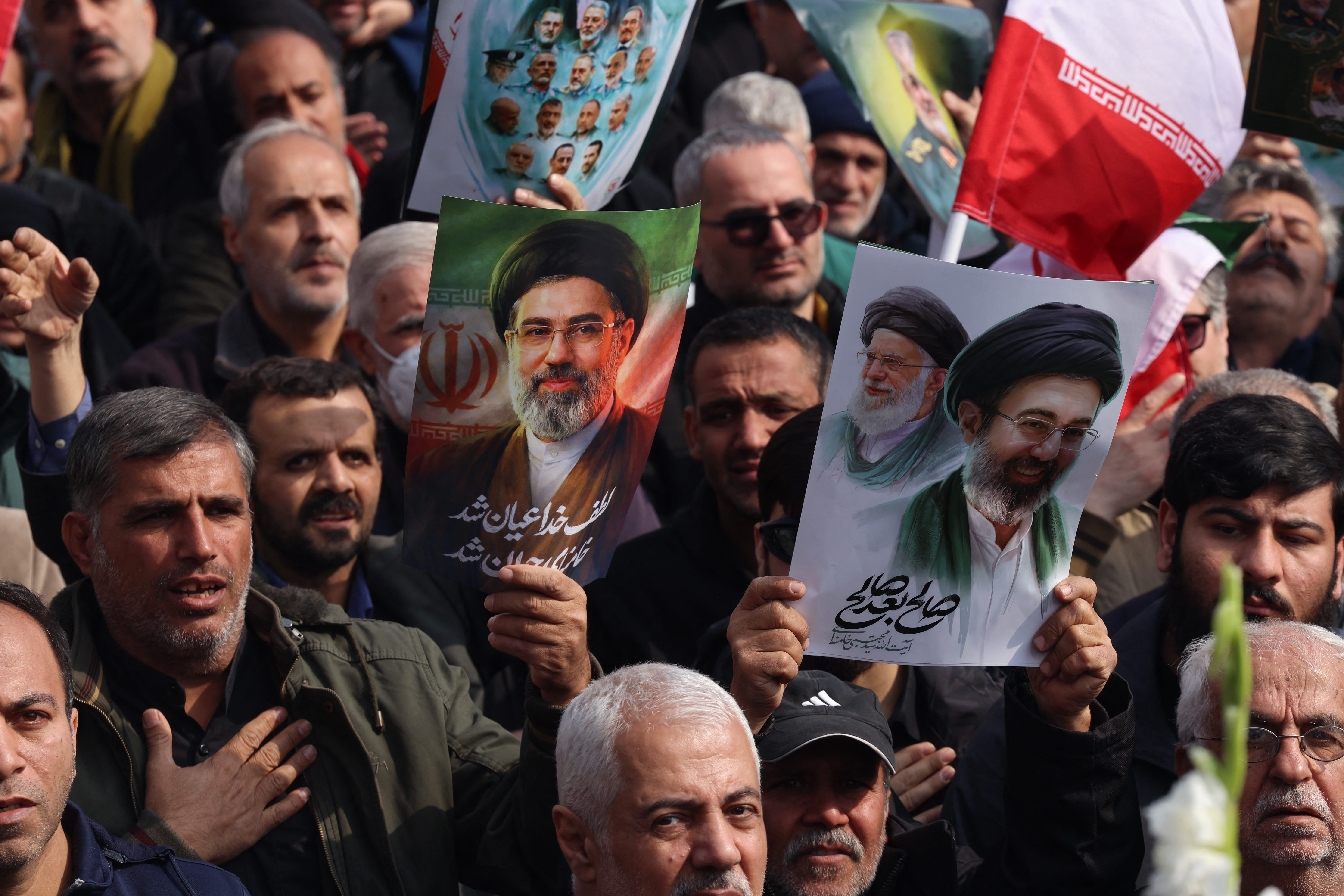
Ayatollah Ali Khamenei ruled over Iran for 36 years. The Islamic Republic is largely his creation. The regime’s base of support closely identifies with him. His worldview has shaped state institutions and is deeply embedded in the thinking of its leaders and ardent followers. In death, this outsized political authority has gained a sacral quality. He did not die in hiding in a bunker or a tunnel, but was “martyred” during the holy month of Ramadan in his house, unbowed before the US and Israeli threat. His death shocked all Iranians, but for the regime’s base, it was a deeply emotional event with profound religious meaning. That emotional and political capital strengthens the state at a time of crisis if his successor, too, carries the name Khamenei.
Mojtaba’s own suffering during the war also highlights this religious and political narrative. The attack that killed his father also killed his wife, son, sister, niece, and brother-in-law. His mother was likely severely injured, and it’s reputed that Mojtaba himself was badly injured. To faithful supporters of the Islamic Republic, this evokes the suffering of Shia Imams, imbuing Mojtaba too with religious charisma that overshadows his religious and political qualities, but more importantly resonates with the regime’s base of support.
A Leader With No Restraints
The war America and Israel have inflicted on Iran has brought about regime change, but not the one imagined by President Donald Trump. Instead of producing willingness to submit to America’s will, it has birthed a more strident and unbending Islamic Republic. The new Islamic Republic is not restrained by the caution of the supreme leader and the IRGC commanders who were killed.
The West saw Ayatollah Ali Khamenei as a radical revolutionary, but in practice, he – and the military leaders he handpicked – had restrained the more aggressive impulses that lurked below the surface in Iran. He had dismissed talk of building nuclear weapons, issuing a fatwa banning them. He prevented the IRGC from building longer-range ballistic missiles. In one speech, he admitted that IRGC generals were unhappy with that decision. The generation that has taken command of the Guards was also unhappy with Iran’s symbolic responses to the killing of General Qasem Soleimani in 2020, to the assassinations of Hamas and Hezbollah leaders, Ismail Haniyeh and Hassan Nasrallah in 2024, or to the American bombing of Iranian nuclear sites in 2025. Those restraints are no longer there. Those now in charge of Iran think that prudence and restraint have only encouraged American aggression. They are likely to pursue more aggressive nuclear and missile policies and be more willing to seek deterrence and defense and escalate confrontation with the United States and Israel.
Vali Nasr is an Iranian-American professor at Johns Hopkins University, author of Iran’s Grand Strategy, and a former State Department spokesperson.
The views expressed in this article are the author’s own and do not necessarily reflect those of Zeteo.
Check out more from Zeteo:


Let us hope that they can control Christian and Jewish Zionism have undermined the underling principals of International Law such as the Universal Declaration of Human Rights. These principals were developed over the centuries and compounded after WWII. If the US and Zionists are permitted to continue with impunity, the human race will revert to barbarism.
If we had planned an attack to fire up Iran, we couldn't have done better. The horrific thing is there was no plan on our side, but a LONG RANGE plan inside of Iran. They do not have the option of seeing war as a distraction but rather, something they have had a plan A, B and C for.
We don't. We are the silly children who blow up a car without caring who is inside. We didn't know that entire family of Mojtabe Khamenei was killed. Actually, Trump couldn't point out Iran on a map and because of that? We have set the world on fire. All because Israel finally found an idiot president to push buttons for it's genocidal destruction of the middle east.