

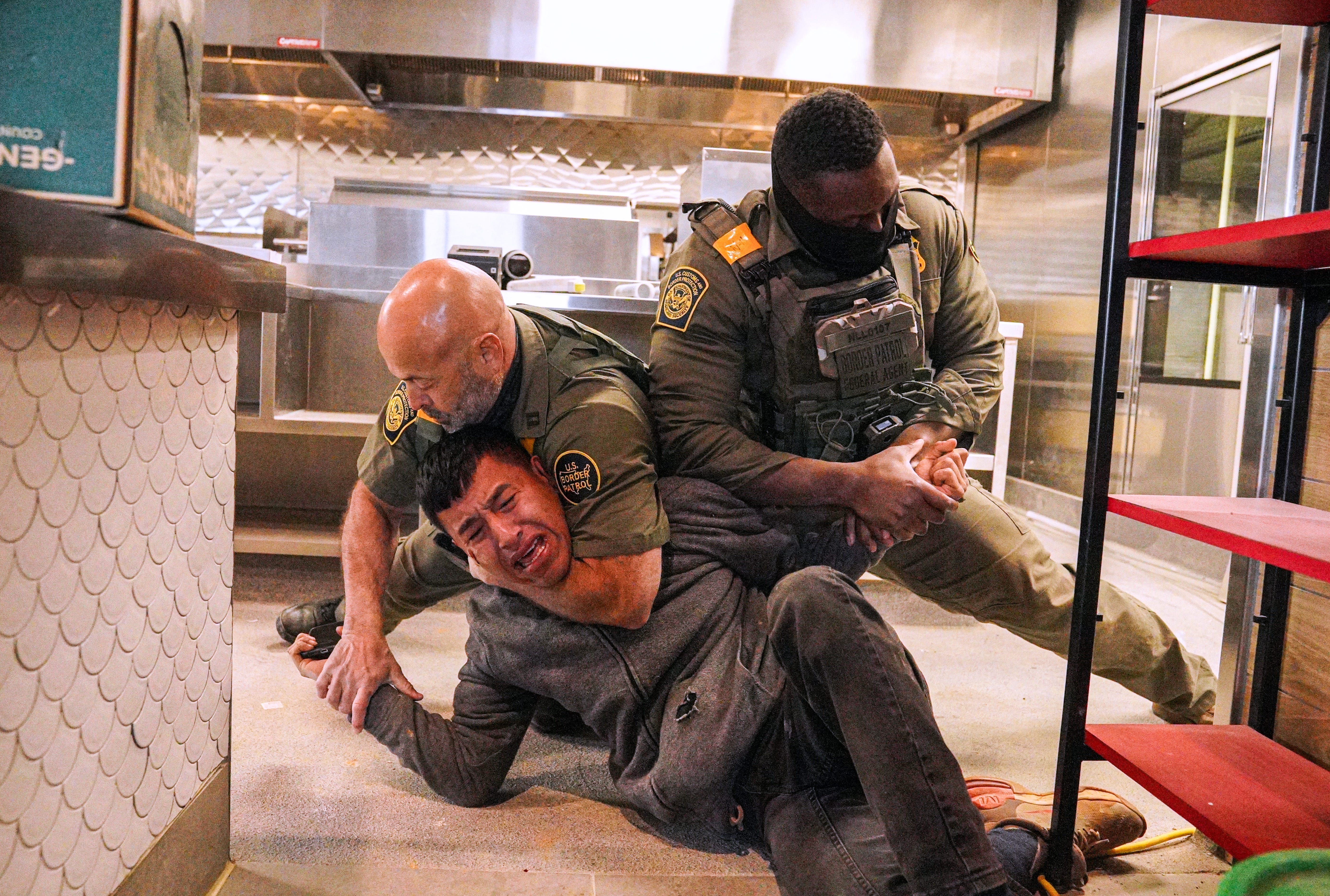
The first time I saw the photo, I stopped breathing.
A man, who appeared to be a restaurant worker in Charlotte, North Carolina, pinned to the floor of a commercial kitchen, his face twisted in pain. One federal agent’s arm locked around his neck. Another officer forcefully driving the man’s arm behind him. The scene was captured by an image taken by a Getty photographer.
After serving for nearly a decade as a public defender in Brooklyn, I know the names prosecutors give to what I was looking at: Assault. Strangulation. Felony. Every state has different ways to describe it and different punishments associated with it. I looked up the law in North Carolina, where this took place: “Assault inflicting physical injury by strangulation,” I learned, is a Class H violent felony, punishable by up to three and a half years in prison.
I posted the photo on X and shared the language of the statute above it. My point – though unstated – was simple: If any of my clients had done what those agents did, they would already be in handcuffs facing years behind bars. But when the state does it, it’s rebranded as “enforcement” or even “safety.”
Millions of people saw the tweet. And then the replies came.
Some were straightforward and, though upsetting, expected: “He’s illegal. He deserves it.”
Others proclaimed the force was somehow justified because the man was “resisting arrest.” I saw that same allegation play out countless times as a public defender. So often, when I met a client at first appearance, read the charges, and saw “disorderly conduct,” “obstruction of governmental administration,” “resisting arrest,” or “assault” of an officer, I would then meet a bloodied and bruised person, disproportionately Black or brown. The logic was always the same: if the police action was excessive, officers just invented a lawful reason to justify their violence.
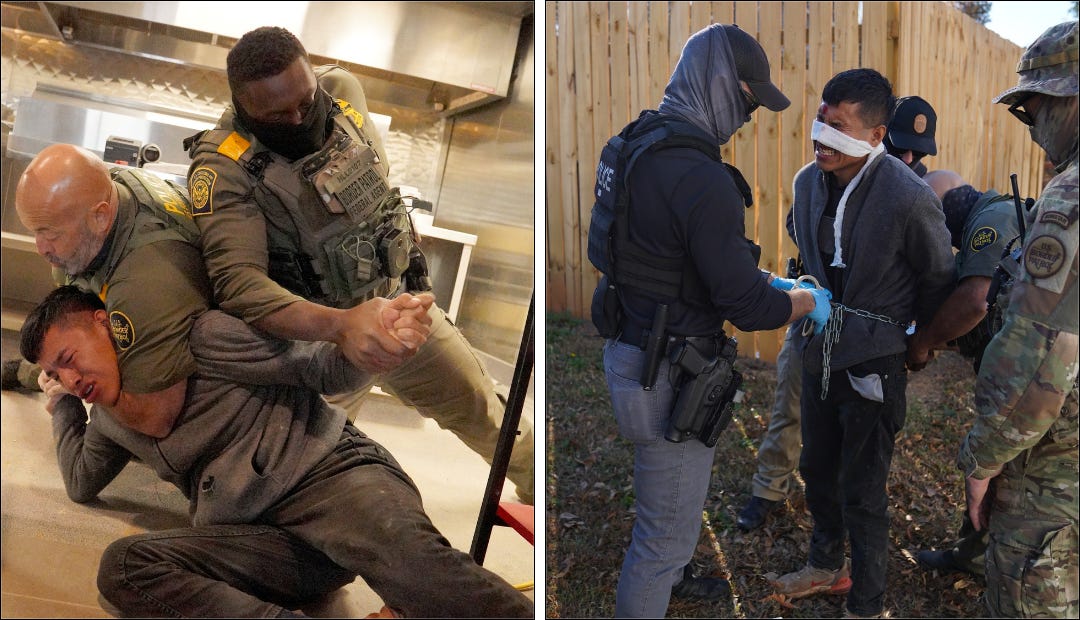
But the most revealing replies weren’t the openly racist ones or the predictable “resisting” chorus. It was the people who insisted that the man had a knife in his hand.
He didn’t. The photo clearly shows a cell phone in one hand and nothing at all in the other. But the replies were frantic: circling shadows, zooming in on pixels, drawing in arrows, and calling me all versions of “dummy” for not seeing what so clearly they saw.
And then I started zooming in too. Enlarging the photo, comparing angles, Googling other Getty images from the same sequence to show that the man’s hands were empty. I even double-checked with AI to make sure I wasn’t missing anything. I responded impatiently with my own photographic evidence and comparisons that they were seeing a shadow, not a blade; that they were hallucinating a blade.
And then I stopped. I had been dragged into disproving a lie instead of naming the truth. The imaginary knife wasn’t the point. The need for the lie was. Why do so many people tolerate, even cheer, violence when it’s carried out by someone in a uniform? Why is it so easy for two armed men choking a restaurant worker on the floor to be rebranded as just “law enforcement”?
People hallucinated a weapon because the reality demanded too much of them. The reality was that a man, who apparently had just gone into work earlier that day, was needlessly and violently headlocked by government agents on the floor of his workplace.
This is the psychology of state violence in America. When the American public sees agents of the state assaulting a civilian, we interpret the image through the dominant narratives about public safety that have been pummelled into our psyche by the media and politicians for decades. We imagine that the person being attacked is somehow dangerous, and that the violence of the state agents is some form of public safety, or even self-defense. When the reality of the image contradicts this dominant narrative – a man’s face contorted in agony, stone-faced officers bending his body at impossible angles, at some point bloodying his – we imagine threats into existence to stabilize the dominant narrative that tells us this person is a dangerous criminal. We hallucinate a weapon to avoid acknowledging that this violence is being done in our name.
I saw this all the time as a public defender. Well-meaning prosecutors would twist themselves into knots to explain away officers’ misconduct even when violence, lies, and perjury were right in front of them on video. Later in 2020, my colleagues and I helped the New York Times analyze dozens of videos of NYPD violence during the George Floyd protests, including videos of what a Human Rights Watch investigation revealed was a large-scale coordinated assault on protesters in Mott Haven, Bronx. It was right there before our eyes – excessive force, civil rights violations, conduct that would be charged as a violent felony if it were anyone without a badge – yet people insisted protesters “must have done something.” They were blocking traffic, interrupting the normal course of business, “threatening” or “interfering” with police in some way. Police, meanwhile, said they feared for their safety. City leaders congratulated the department for its “restraint.”
Since Rodney King’s brutal beating at the hands of police in Los Angeles in 1991, American police officers have routinely been acquitted for attacking and even killing people despite video evidence showing their excessive force. Although the video of King’s beating showed that he was lying motionless on the floor as police officers attacked him with a billy club, the officers argued King was a threat to their safety and were acquitted by a California jury. In 2017, after officers shot and killed Philando Castile in his own car, dash cam footage revealed that Castile told police officers he was legally carrying a weapon. Several conservative commentators describing the scene argued that the video showed Castile telling officers he was going to pull out his gun. But this did not match the objective reality of the video. Again, Americans falsely attribute aggression to the victims of it and even hallucinate weapons or threats in order to justify and enact violence against them.
State violence that is occasionally captured in spectacularized images—such as the videos of police attacking King, Castile, and George Floyd; and the Charlotte image I reposted—is in fact very routine when people come into contact with law enforcement. But most of the time, unless someone films it, we never know it happened. And when we do see it — clearly, unmistakably — it collides with everything we’ve been taught about people with badges.
The American public needs to see more images of law enforcement aggression to confront the violence being waged in our name and unlock a lifetime of hardened perceptions and beliefs. This is exactly why I’ve spent years urging people to record ICE and police; why I helped create videos teaching immigrants and bystanders how to safely document arrests; why I’ve said, over and over, that filming ICE is not just protected by the First Amendment, but “the most American thing you can do.”
But what will it take for some of us to stop distorting these images? This is the reckoning we need. We must confront the lengths we will go to justify state brutality, especially against people of color and immigrants.
The Charlotte image has forced thousands of people to show, publicly and unmistakably, what they are willing to excuse. The man in the photo will carry the trauma of that day–and whatever he is now facing in custody and beyond–for the rest of his life. The rest of us have to decide whether we will carry the truth.
Scott Hechinger is an American civil rights attorney, former public defender, and the founder and executive director of Zealous, a nonprofit organization that trains public defenders and activists to use media, technology, the arts, and storytelling to shape criminal justice policy. He is also a lecturer at Columbia Law School, the University of San Francisco School of Law, and the University of Chicago Law School.
The views expressed in this article are the author’s own and do not necessarily reflect those of Zeteo.
Check out more from Zeteo:


Every brutality photo and video kills me a piece at a time, but I look and I share, and I fight a little harder. I think (hope) the Internet comments are just bots.
So grateful to Scott Hechinger for his noble, invaluable work.