


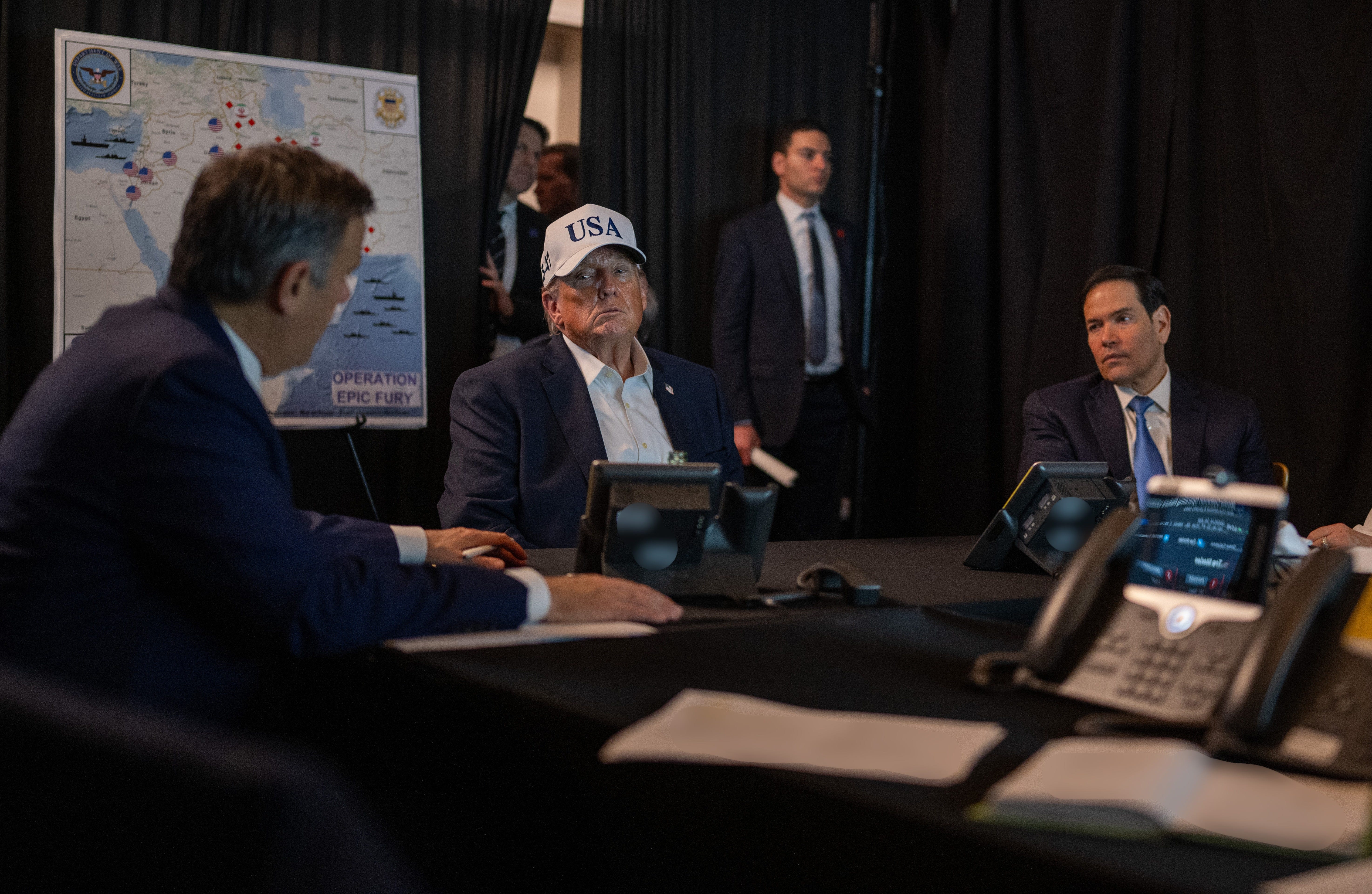
Earlier this week, Donald Trump was asked whether he was surprised that no one briefed him in advance that Iran might respond to an American attack by targeting Gulf countries. His response? “Nobody. Nobody. No no no.”
That is evidence that either Trump is lying or his administration has so cut itself off from experts that no one briefed him on what was essentially common wisdom amongst US experts – that major strikes on Iran could prompt Tehran to respond by targeting oil infrastructure and US bases across the Middle East and closing the Strait of Hormuz.
For the past 15 years, I’ve participated in and helped run scenario exercises and war games on Iran both at the Pentagon and then outside of government. These exercises are not about predicting the future with certainty. They are about understanding the possible consequences of choices.
And on Iran, the lessons from these exercises were remarkably consistent and quite similar to what we’ve seen play out over the past two weeks. Here are five things Trump should have known and would have known if his administration had listened to experts:
1. When the regime feels existentially threatened, Iran will escalate
In most war games, conflicts began at a lower level: an Israeli strike, a proxy attack, a miscalculation. At that stage, Iran usually calibrated its response. It retaliated, but tried to avoid drawing the United States fully into the conflict because it knew that a full-on war with the US represented a massive threat. That pattern held in real life during the Israel-Iran exchanges of 2024 and 2025.
But once the United States entered directly, and once the regime believed its survival was at stake, those restraints would disappear.
At that point, Iran’s playbook was well understood: strike US bases, harass shipping in the Gulf, activate proxy forces across the region, and target oil infrastructure and civilian assets. The goal was to impose costs, spike oil prices, and create international pressure on Washington to stop.
This was not hard to foresee. It was one of the most consistent conclusions in the exercises I saw. What we are watching now was entirely predictable.
2. It is easy to close the Strait of Hormuz. It is hard to reopen it
One of the central lessons from these scenarios was always how easy it was for Iran to disrupt the Strait of Hormuz because of its geographic proximity and how much harder it is for the United States to restore confidence and safe passage.
We used to assume that a full closure – especially with mines – would be a last resort because it would also block Iran’s own exports. But what this war has shown is that Iran does not actually need to shut the strait entirely. It only needs to create enough uncertainty through drones, missile attacks, threats, and selective disruption to scare off shipping and drive up prices.
At the same time, Iran has still managed to move significant amounts of oil, especially to China. That means it can inflict pain on the global economy while still generating revenue for itself.
When I studied such scenarios and brought in economists and energy experts, we concluded that a major war could send oil prices soaring up to $175-$200 per barrel for a couple of months and leave a lasting risk premium on global markets with prices at $80-$100 long after the fighting stopped. That basic logic still holds.
3. Russia always wins
Whenever a Russia team was part of these games, they usually sat back and benefited.
That is exactly what is happening now. Higher oil prices benefit Russia as a major exporter. Pressure to stabilize global markets eases sanctions on Russian energy sales. And American attention, military resources, and political bandwidth that might otherwise go toward supporting Ukraine are redirected to the Middle East.
For Vladimir Putin, this is close to ideal: more revenue, less pressure, and a distracted United States.
None of that is surprising to anyone who has spent time thinking seriously about this kind of conflict.
4. The aftermath is incredibly costly
After Iraq, US policymakers understood that the real danger was not just how a war starts, but what comes after. So we spent a great deal of time gaming out post-conflict scenarios for Iran.
The conclusion was sobering. Short of a full-scale invasion and regime change – which was simply too costly – an air and naval war would likely leave the regime in place: weakened, damaged, and humiliated, but still standing. Its military would be degraded. Its economy and infrastructure battered. But the regime would survive, and it would almost certainly become more aggressive and more willing to take risks.
In that world, the United States then faces the prospect of containing a wounded but still dangerous Iran for years. Think of Iraq in the 1990s after the first Gulf War: a hostile regime that survived and required an expensive, long-term American military commitment to keep boxed in.
The difference is that today the United States does not have the same freedom of action as the only global superpower that it had in the 1990s. China is a major competitor. Russia remains a serious threat. We do not have the luxury of getting bogged down again in a prolonged Middle East containment mission.
5. Buying time was always the best option
What these war games ultimately taught me was that when it comes to Iran, all the options were bad, but war was among the worst. The smarter alternative was to contain, deter, pressure, negotiate, and wait for 86-year-old Supreme Leader Ali Khamenei to die and see if a more pragmatic or moderate leadership followed.
That could take different forms. Barack Obama tried diplomacy through the Joint Comprehensive Plan of Action, which successfully constrained Iran’s program until Trump walked away from the deal. More recently, in the aftermath of the brutal crackdown on protesters, there were options to intensify sanctions enforcement, increase Iran’s isolation, and exploit the regime’s internal mounting domestic dissatisfaction to let the regime crumble from within.
By escalating to war, killing Khamenei, and forcing a leadership transition under conditions of extreme threat to the regime, the United States and Israel ensured that at the moment of truth, the dominant imperative inside Iran was not any kind of rethinking but instead simply survival. And so it is no surprise that the outcome is a new hardline leader close to the Islamic Revolutionary Guard Corps. A historic opportunity lost.
The bottom line is simple.
A major US-Iran war is not some unknowable black box. People have spent decades studying it, gaming it, and thinking through its consequences. The conclusion has been consistent: it would be enormously costly for Iran, for the United States, for the Middle East, and for the global economy.
There are no real winners in such a war – except, perhaps, Vladimir Putin.
That is why, for decades, presidents of both parties listened to experts and tried to avoid it until Trump ended all of that.
Ilan Goldenberg is the senior vice president and chief policy officer at J Street. He served as Iran team chief in the Office of the Secretary of Defense during the Obama administration. Subscribe to the Word on the Street Substack for more of Ilan’s writing.
The views expressed in this article are the author’s own and do not necessarily reflect those of Zeteo.
Check out more from Zeteo:


All about bad tactics, not about bad morals. Shipping matters, but so does killing innocent people.
It's good to know they should have known better, or perhaps even did, but continued on this path anyway. Nevertheless, honest criticism ought to deal with the fact that this war should never have happened, not because the tactics weren't properly thought out, but because it was, and still is, the wrong thing to do.
Thank you so much, for presenting the entire picture, world wide. We tend to focus only on our country and we miss the forest for the trees. We are part of the world and for so long our size fooled us into a sense of false security. AND an excuse to not look at this country in context.
I appreciate Zeteo for the world wide understanding that what we do, affects the entire world