



In 1901, in a sleepy Northern California town called Livermore, a man named Dennis Bernal donated an Ohio-made light bulb to the local firehouse that is still burning today. You read that correctly: Bernal’s light bulb has been burning for over a century.
At the time the Livermore bulb found its forever home, the light bulb business was booming in the U.S. and around the world. New companies were jumping into the lighting game, competing to invent longer-and-longer-lasting bulbs. But monopolies quickly swallowed the competition.
These country-by-country monopolies were turning healthy profits – until 1923. Manufacturing wasn’t the problem – they had that down pat. They were running up against what we might call the Livermore problem: There simply weren’t enough repeat customers.
They needed a plan to bring customers back, fast. So the president of German lightbulb monopoly Osram, William Meinhardt, did what all good executives do: He called a meeting. In late December 1924, Meinhardt brought his international competitors to snowy Geneva, Switzerland, for a clandestine confab to discuss their growing crisis. They hatched a simple plan: Short-circuit the lifespan of the light bulb.
It was elegantly sinister. If the bulbs burned out faster, customers would be back in stores more often. They called themselves the Phoebus Cartel, after the Greek god of light. With a little engineering and a lot of coordination, the Phoebus Cartel succeeded in doing what the Livermore bulb never would: burning out. Sales rose across the globe.
These days, CEOs don’t need to clink their scotch glasses in smoke-filled rooms or travel all the way to Geneva to hatch a deal to keep their prices high. They’ve got software for that! Across the economy, companies are deploying sophisticated algorithmic pricing tools to collect, analyze, and share troves of product and pricing information.
The promise of this software was that it would make markets more competitive by increasing price transparency. Comparison shopping would get easier, driving prices down. But these technologies haven’t lived up to their promise. Instead, they’ve served as a kind of duck call for gougers, helping them find each other faster. And once they do, these tools make it even easier for them to share information and coordinate strategies – not to compete, but to gang up on you. You are simply out-numbered. And as lawmakers have learned the hard way, gougers hide behind these arms-length technologies to evade price-fixing laws.
Have you ever wondered why your rent is so damn high? Ask any economist or housing expert and they’ll tell you the reason is simple: There’s not enough housing. There is some truth to this. We absolutely need more affordable housing, and where housing is scarce, prices do rise. But the simple supply-side story misses something crucial: corporate power.
In recent years, corporate consolidation and algorithmic pricing tools have made those imbalances worse. Landlords no longer need to collude over backyard barbecues to fix prices – they can do it online, aided, by a new breed of real estate tech firms.
Let’s consider the story of one of the biggest algorithmic price-fixing scandals of the last four decades. In 2024, the Department of Justice filed a 115-page complaint alleging price coordination against the Texas-based tech company called RealPage. The lawsuit described how RealPage’s “pricing algorithm enables landlords to share confidential, competitively sensitive information and align their rents” – a practice that, according to the New York Times, impacted more than 3 million apartments across the country.
According to ProPublica, this software was so prolific among large landlords that as many as 70% of apartments in some neighborhoods were owned by companies using RealPage’s price-coordination algorithm.
In some cities, RealPage’s scheme may have driven up rents by as much as 25% in recent years. In Denver, for example, families in nearly half the city’s multifamily rental units saw RealPage’s recommendations add a new line to their budgets – pushing rents up by more than $130 a month, or over $1,600 a year.
The FBI uncovered a trove of smoking guns on RealPage’s servers. Executives and landlords hadn’t been shy about touting their product – even the legally dubious parts. One exec praised the benefits of eliminating competition: “[T]here is greater good in everybody succeeding versus essentially trying to compete against one another in a way that actually keeps the entire industry down.” Translation: We all win when tenants lose.
Landlords were even more blunt. “I always liked this product because your algorithm uses proprietary data from other subscribers to suggest rents... That’s classic price fixing,” one wrote. What’s not to like?
You might be thinking: Isn’t this just business as usual? Landlords have been overcharging tenants and skimping on maintenance since the dawn of time. Rents have been too damn high for decades.
But here’s what’s new: Before RealPage, your landlord still had to compete. However imperfect, that competition put downward pressure on prices and gave tenants at least a fighting chance at finding a better deal.
RealPage changed the game. It allowed landlords – big and small – the ability to act like a cartel. A decade ago, a conspiracy among landlords would have been inconceivable. The rental market was too fragmented: too many owners, too many units, too many tenants. No one had enough control. But algorithms changed the math.
The Department of Justice’s complaint against RealPage offered a rare glimpse under the hood of its YieldStar algorithm, revealing how the system kept rents elevated – even in a down market. One of its key features was the market minimum effective rent, or what the DOJ called RealPage’s “hard floor.” YieldStar surveyed all leases for a particular floor plan and generated a pricing chart that included both a minimum and maximum rent based on the available data. But, according to the court filings, YieldStar was programmed never to recommend a rent below the minimum rent, effectively creating that “hard floor” for rent prices.
So what about the maximum rent? Was there a “hard ceiling” to match? Nope. YieldStar treated the maximum rent as a bar to clear. It was merely a “soft ceiling,” a suggestion – not a constraint. The algorithm recommended rent prices higher than the so-called maximum for a given floor plan.
RealPage had a plan for every scenario: a plan to take advantage of a tight market, a plan to raise prices quickly and drop them slowly, and a plan to ensure rents never fell below a “hard floor” But what about an economic downturn, when demand was low? Surely then the algorithm recommended rent reductions? Nope. RealPage had a plan for that too – and it was called “revenue protection mode,” which prioritized maintaining revenue by leasing fewer apartments at higher prices.
But couldn’t landlords override these recommendations if they wanted to fill units? In theory, yes. In practice, it wasn’t so easy. Its “auto-accept” feature defaulted many landlords into outsourcing their pricing decisions altogether. As one RealPage economist put it, they’re “trust[ing] the science.”
RealPage’s scheme was bigger than the sum of either its human or algorithmic parts. The company’s sprawling portfolio, its system of “checks and balances,” and its data empire made it possible to coordinate price hikes on a scale never seen before. But the technology also gave landlords and property managers something equally valuable: cover. It gave them plausible deniability – the sense that they weren’t acting like greedy price-fixers, just doing what the smart software said.
RealPage both enabled price-fixing and sanitized it. It made participating feel less like a conspiracy and more like good business. If a competitor called me and said, “Hey, let’s collude to fix prices,” I’d probably tell him to get lost. But if that same competitor told me he was using new software that increased profits by 15%, I might ask where to sign up.
New algorithmic tools have quietly transformed how companies price nearly everything – and they are coming for every line item in your household budget. From rent, hotel rooms, and airline tickets, to meat and potatoes (yes, there’s even pricing software called PotatoTrac), corporate profiteers are using technology to squeeze consumers with ever more precision. It’s so incredibly lucrative, it’s almost too good to be true. Which explains why price-fixing is already illegal.
When a company supplies the hub, the data, and the enforcement, collusion – whether tacit or intentional – follows. Each of these examples, from the light bulb manufacturers to the landlords, demonstrates how companies can coordinate to choke off competition, bring supply and demand to heel, sanction defectors, degrade product quality, manufacture scarcity, and overcharge consumers.
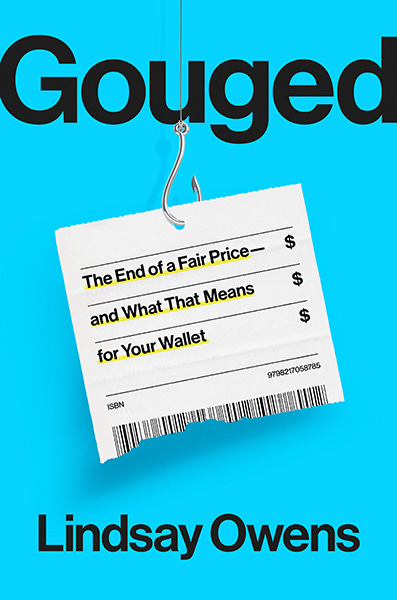
The above excerpt is from Lindsay Owens’s Gouged: The End of a Fair Price – and What That Means for Your Wallet, out now from Viking.
Lindsay Owens is President and CEO of Groundwork Collaborative. She is the author of Gouged and the Gouged newsletter.
The views expressed in this article are the author’s own and do not necessarily reflect those of Zeteo.
Check out more from Zeteo:


