


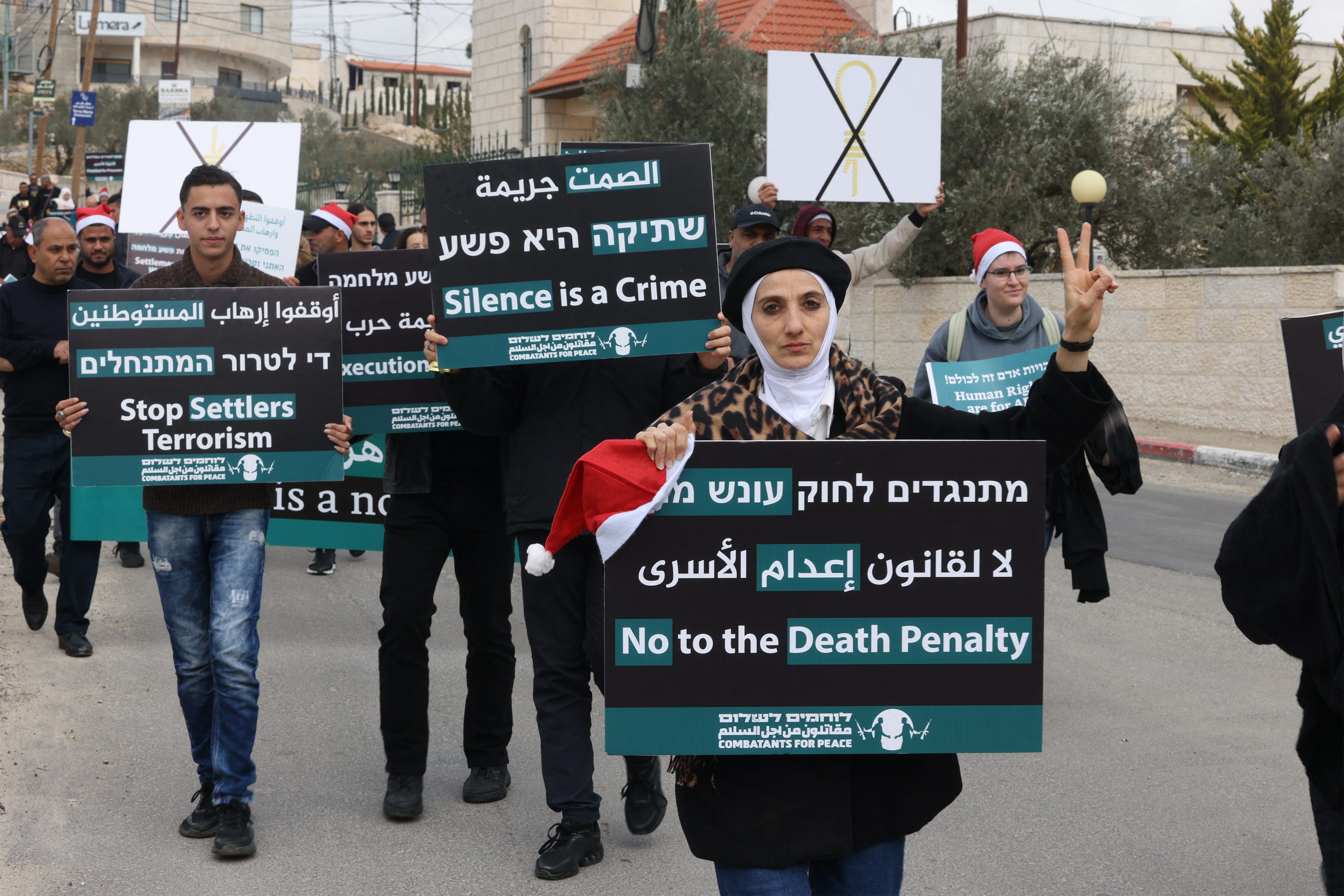
UN experts, including special rapporteur Francesca Albanese, are urging Israel to withdraw one of the most extreme bills in the country’s history, which would impose a one-sided death penalty targeting Palestinians.
The bill, which is being fast-tracked in Parliament, would authorize two types of cases for a death penalty: one imposed by Israeli military courts in the occupied West Bank for purported acts of “terrorism” that cause death, even if unintended. If convicted in military court, execution would be the mandatory sentence. The second track would apply in Israel and occupied East Jerusalem for Palestinians convicted of intentionally killing Israelis, and execution would be the maximum sentence.
“Israel does not have authority to enforce laws against Palestinians in the occupied Palestinian territory,” the UN experts said on Wednesday. They cited several ways the bill, if passed, would violate international law, including the right to life. They also highlighted that vague definitions of terrorism under Israeli law would be applied under either track.
The UN experts noted that the International Court of Justice in 2024 concluded that Israeli restrictions in the occupied Palestinian territories constitute racial segregation and apartheid.
The UN experts’ call comes a day after Amnesty International condemned the bill as a violation of international humanitarian law, and noted that the legislation was not an “isolated development” but is happening in the context of Israel’s genocide in Gaza and intensifying brutality against Palestinians in Israeli detention.
Legislators are also weighing a bill to prosecute people accused of participating in the Oct. 7 Hamas attack through ad hoc military courts. According to Amnesty, the bill would effectively expand the scope of crimes that could be punishable by death and eliminate judicial safeguards.
“If adopted, these bills would distance Israel from the vast majority of states which have rejected the death penalty in law or in practice, while further entrenching its cruel system of apartheid against all Palestinians whose rights Israel controls,” the group said.
The Palestinian Centre for Human Rights in November blasted the bill as a “new episode in the ongoing series of oppression” that reveals “yet another facet of Israel’s apartheid regime.”
‘Only in Nazi Germany’
Israel largely abolished the death penalty in 1954, except for crimes under the Genocide Act and for treason. But the Palestinian Centre for Human Rights noted that Israel has already carried out extrajudicial killings of thousands of Palestinians through other methods: assassinations – or what Israel often describes as “targeted killings” – including of children and civilians, sniping operations, shootings at military checkpoints, shooting West Bank protesters, and killing Palestinians in prison through systemic abuse and torture.
Israeli officials often describe Palestinians in detention as “terrorists.” An investigation by The Guardian, Local Call, and +972 magazine, based on classified Israeli intelligence data, found that only one in four detainees are fighters. The vast majority are civilians, including hundreds of children.
The death penalty law would not apply to the killings of Palestinians, including by Israeli settlers who have ramped up assaults. In 2025, OCHA recorded 1,828 settler attacks in the West Bank and 240 Palestinian fatalities in the West Bank, including 55 children. Settlers were responsible for at least nine killings.
The bill is being championed by ultranationalist National Security Minister Ben-Gvir, who was convicted of supporting a terror group in 2007.
It has been opposed by liberal groups inside Israel, including the research institute Zulat, which called the death penalty “primitive, murderous vindictiveness.”
“The bill is nationality-based, so that only someone who harmed a Jew is sentenced to death. This means a unique inculcation of categories of race and nationality, which existed only in Nazi Germany,” Zulat executive director Einat Ovadia said at a Knesset meeting in December.
At the same meeting, Foreign Affairs Minister Eden Bar Tal acknowledged that the bill runs counter to the global trend opposing the death penalty, but purported that Israel was dealing with issues that the Western world had not encountered.
Zazim, an Israel-based group that has called for recognition of a Palestinian state, organized a petition to oppose the bill, and it had garnered over 5,300 signatures as of Wednesday.
The Knesset’s National Security Committee is scheduled for a meeting on the death penalty bill next week, and it is expected to be broadcast live. If the committee approves the bill, it will pave the way for final readings and passage into Israeli law.
Have a tip for Minnah? Reach out on Signal at minnahfarshad.94.
Check out Zeteo’s special series examining the real death toll in Gaza:


Where is the outrage from other nations in this racist bill. Can someone confirm for me... A settler murders a Palestinian while attacking their home vrs a Palestinian killing a settler while defending their home. Just to be clear, only tge Palestinian will get the death penalty while the Israeli Settler probably not?