


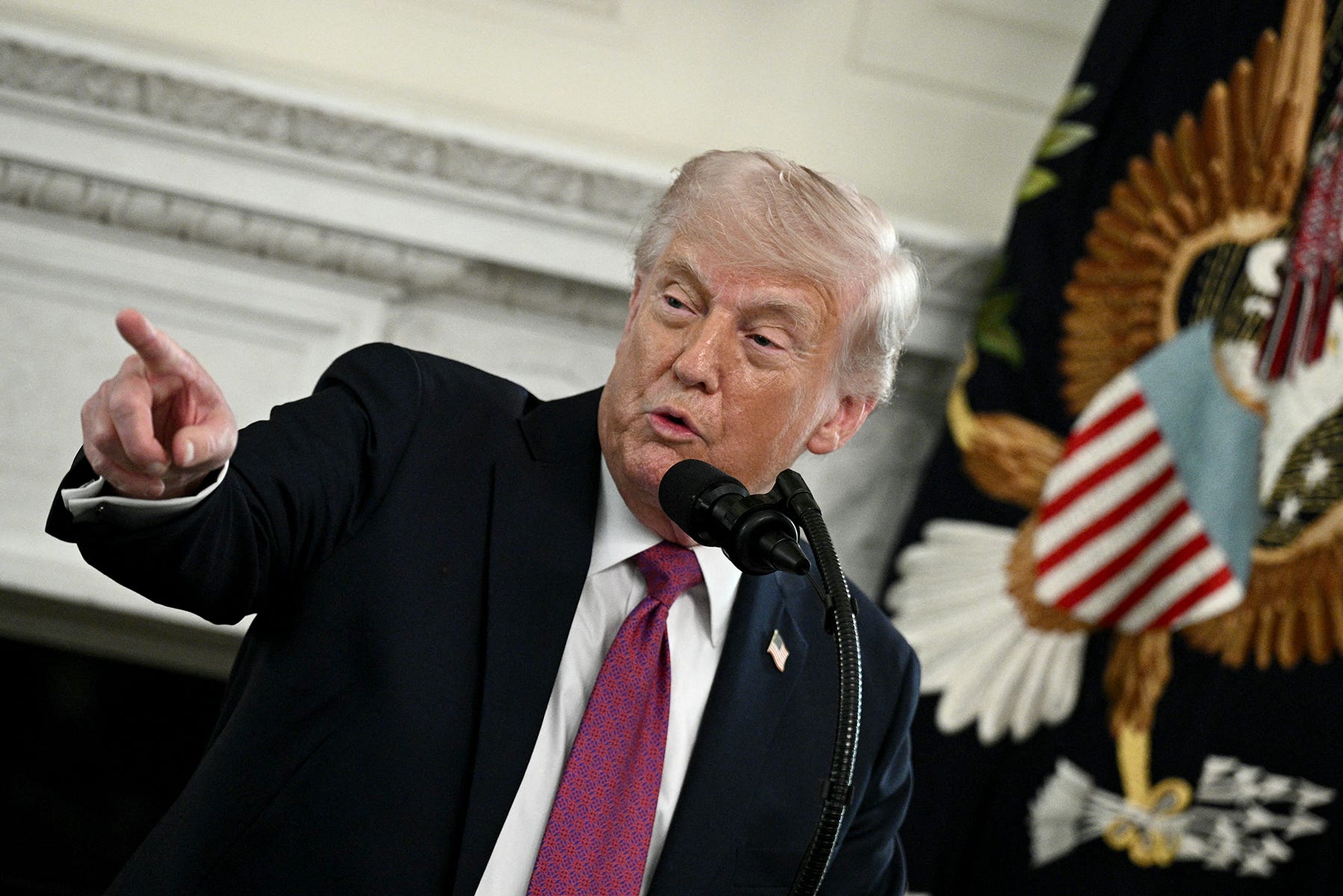
Donald Trump’s musings about dictatorship once sounded almost funny. Nobody laughs anymore.
Trump has not created a dictatorship. He has, however, dragged the US further toward authoritarian rule than many of us thought possible. His corruption of the legal system, subordination of Congress, embrace of state violence, and hostility toward free elections led the sober-minded centrist Jonathan Rauch to write earlier this year: “Yes, it’s fascism.”
How Trump has managed to do that, contravening the values that made the US the world’s leading democracy, remains hard to fathom. But at least part of the answer lies in his use of techniques that earlier historical figures have used to amass and centralize power.
Laurence Rees, a former head of history at the BBC and best-selling author, has made studying those techniques his career’s work. His books and video documentaries explore how skillful, if repugnant, Nazi leadership drove ordinary Germans to monstrous wrongdoing during World War II. In January 2025, as Trump returned to the White House, Rees published ‘The Nazi Mind’ in an attempt to explain the inexplicable.
To state the obvious, Donald Trump is not Adolf Hitler. MAGA is not Nazism. No despot or movement in history compares to the Third Reich, and the nature and scale of evil it perpetrated.
Moreover, Trump’s handiwork appears less formidable today. Most of America recoils from his second-term grotesquerie. If permitted free and fair elections, voters will punish his Republican Party this fall – just as Hungarian voters have now punished Trump’s authoritarian role model Viktor Orbán.
But the lessons Rees identifies remain relevant to the crisis confronting 21st-century America. And that is not merely because Trump and a disturbing number of his young fans have at times expressed admiration for Nazi strength and ruthlessness.
“Everything is fragile – often a great deal more fragile than we think,” Rees writes. He lists 12 “warning signs” of how authoritarians can corrupt democracy.
All sound familiar.
Spreading conspiracy theories. Nazis persuaded rank-and-file Germans that their problems stemmed from the machinations of Jews. You can hear unmistakable echoes as Trump factotums blame immigrants for violent crime, stolen tax money, even high housing costs. “The mass looting of a civilization,” spits White House propagandist Stephen Miller.
Using “them” and “us.” Would-be dictators rouse supporters by exploiting their primal instinct to sort friends from foes, scapegoating those who seem different. Trump’s rants and social media feeds show this.
Leading as a hero. Myths of heroism helped elevate authoritarian leaders from Napoleon to Hitler to Castro. Having created an image of business success, Trump promotes fantasies about his personal qualities by invoking aspirations for the Nobel Peace Prize and Congressional Medal of Honor; he depicted himself as Jesus on Truth Social.
Deploying the photograph of Trump bloodied with a raised fist after a 2024 assassination attempt, he and his supporters have declared he was “saved by God” to save America.
Corrupting youth. Those under 25, their brains not fully matured, show particular vulnerability to the lure of extremism. The conservative writer Rod Dreher has estimated that 30% or more of Gen Z Republican operatives identify with Groypers. Trump has sprinkled such Nazi-adjacent loons through his administration.
Andrew, a 20-year-old white Christian landscaper, told the conservative City Journal last year, “Hitler was a nationalist. He was like, we have to take Germany back for Germans, and I feel like we should do that for America.”
Conniving with the elite. “Dictators frequently do not seize control on their own,” Rees says. “Instead, power is handed to them by others.” Among those empowering Trump: tech billionaires, Wall Street executives, Republican congressional leaders, the conservative-led Supreme Court.
Attacking human rights. Authoritarians make subverting the rule of law and curbing press freedom job number one. Trump and his administration have tried hard on multiple fronts, from threatening regulatory punishment of news networks to denying due process to arrested immigrants to ginning up baseless prosecutions of political adversaries.
Exploiting faith. Promises of a utopian future resembling an imaginary past represent a critical tool for rallying adherents. Thus Trump, behind a facade of religious inspiration, constantly predicts America’s return to a “golden age” that allegedly existed once upon a time.
Valuing enemies. Identification of hostile forces binds authoritarian movements together. Trump and MAGA use labels such as “domestic terrorists,” “Communists,” and “radical left, country-hating Democrats.”
Eliminating resistance. Would-be dictators often face institutional opposition from the church and the military, among others. Trump seeks to cow the Vatican, while Defense Secretary Pete Hegseth weeds out generals for insufficient loyalty. The administration applies legal pressure to Democratic lawmakers and progressive organizations that challenge him.
Escalating racism. The modern GOP assembled its national majority with white conservatives repelled by the Democrats’ embrace of civil rights. Trump and prominent followers have taken today’s racial politics to another level by asserting the inherent superiority of white societies in the style of 20th-century eugenicists – who included Hitler.
Killing at a distance. Violence up close is harder to commit than at physical remove. Trump and his aides revel in aerial strikes on boats in international waters or targets in Iran, as if playing video games.
Stoking fear. “One of the most potent political statements of all is, ‘Be frightened, they are coming for your homes and children,’” Rees concludes. Trump has sounded that theme since he rode down the golden escalator in 2015.
Trump has used that bracing playbook to damage our country and the world. But Rees concludes his book on a note of optimism, which should hearten those seeking to reclaim America’s democratic heritage.
“Adolf Hitler employed every one of the techniques above,” he writes. “But in the end – at enormous human cost – something tremendous happened. The Nazis were defeated.”
John Harwood is the former chief Washington correspondent for CNBC and White House correspondent for CNN. He has interviewed every president from George H.W. Bush to Joe Biden. Sign up for ‘The Stakes with John Harwood’ to get all of his columns in your inbox.
The views expressed in this article are the author’s own and do not necessarily reflect those of Zeteo.
Check out more from Zeteo:


The Third Reich was one of the most horrific regimes in history, and it is distinctive for its industrialized, bureaucratic approach to genocide. However, it is not accurate to say that no despot or movement compares. The transatlantic slave trade subjected millions to generations of enslavement, as well as sustained physical and psychological torture, with effects that continue across generations. The Armenian genocide, the Rwandan genocide, and mass atrocities in places like the Congo under Leopold and Cambodia under the Khmer Rouge demonstrate that large-scale, deliberate human destruction has taken different forms across history. In the present day, the scale of civilian suffering and destruction in Gaza, along with ongoing violence and displacement affecting civilians in Syria and Lebanon, has drawn global concern, condemnation, and legal scrutiny. Rather than placing these atrocities in a hierarchy, it is more accurate to recognize that both history and the present contain multiple examples of extreme and devastating human cruelty.
I agree with the author’s broader argument, which is why that line stands out so much. It doesn’t just read as defensive; it reflects a deeper bias in how we frame historical suffering. Elevating the Holocaust as uniquely beyond comparison, even in the context of making a broader warning, risks reinforcing a hierarchy where certain tragedies, particularly those involving Europeans, are treated as more singular or definitive than others. That undercuts what is otherwise a credible and important point.
The same kinds of biases that shape how we rank and remember suffering are often part of what allows those atrocities to happen in the first place. When some lives are implicitly treated as more significant than others, it becomes easier to justify, ignore, or minimize harm.
Well. Isn’t that “tremendous cost” just what we who understand are fearing most and desperate to avoid?