


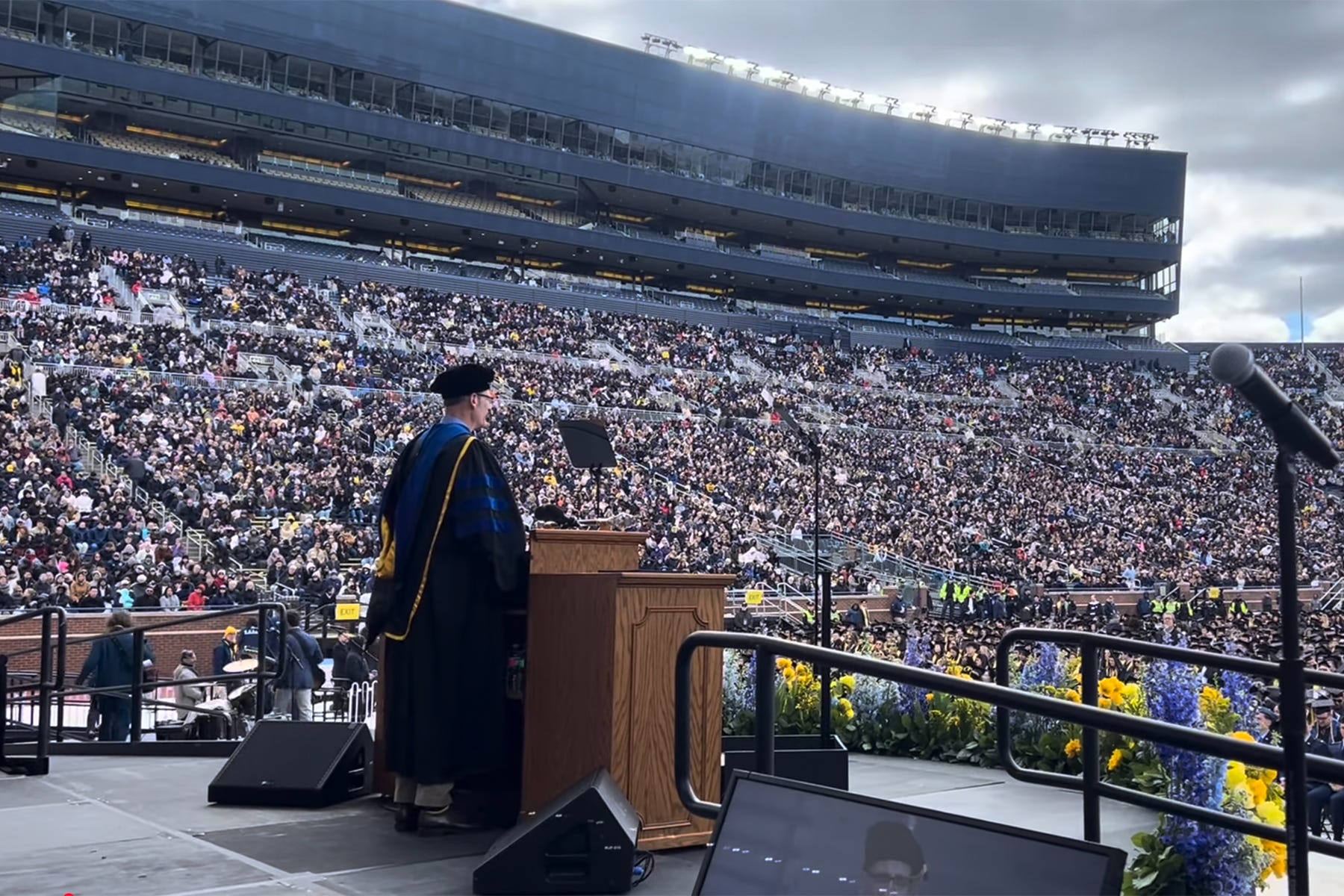
This weekend, University of Michigan Professor Derek Peterson delivered rousing remarks to graduates at their commencement ceremony. He honored the school’s trailblazers, including the first Jewish professor, who helped open the door to Jewish students; activists who pushed to expand the curriculum to reflect Black history; and pro-Palestine student activists.
“Sing for Moritz Levy, the first Jewish professor at the University of Michigan, appointed professor of French in 1896. He was to open the doors of this great university’s generations of Jewish students who found Ann Arbor a safe haven from the antisemitism of the East Coast universities. Sing for the students of the Black Action Movement, whose members demanded a curriculum that would reflect the experience and identity of Black people in this country,” Peterson said to a roaring crowd.
“Sing for the Pro-Palestinian student activists who have over these past two years opened our hearts to the injustice and inhumanity of Israel’s war in Gaza,” he continued.
Peterson’s statement echoed remarks he made at a commencement ceremony last winter, where he celebrated those who defended humanity in southern plantations, Hitler’s Germany, apartheid South Africa, and Palestine.
Yet, his latest remarks have unleashed a political uproar. Republicans – from those running to be university regents, to former presidential candidate Nikki Haley, to Senator Rick Scott – have all targeted Peterson and even threatened the school.
The school’s own president has thrown Peterson under the bus.
What is going on? We spoke with the professor – a historian, this year’s chair of the university’s faculty senate, and an elected member of the American Academy of Arts and Sciences – to hear his side of the story.
This interview has been edited for clarity and length.
What was your reaction to the reaction of your speech?
I’m mystified at the reaction to the specific comment I made. The speech was largely about student activists. I gave it with the intention of fortifying our graduates’ resolve. I wanted them to leave Ann Arbor with examples in their minds of people who had tackled seemingly intractable problems out of a sense of conviction, using the knowledge that they gained, the sense of mission that they gained through their university studies, to tackle problems head on. I was not speaking with the intention of being a provocateur. I’m an educator, and I teach at a public university, a university that prides itself as being the best public university in the world. So my speech was meant to give them a sense of public, political vocation, and to help them as students and graduates, recognize that the vocation of a publicly-educated student is not to go off and get rich, it’s to go off and help serve the public that, among other things, helped to finance your education.
It’s one sentence in the context of a larger speech, but it’s that little piece that was the pivot around which a whole field of debate has now emerged, and it’s that that’s led my university’s president to disavow my speech. One of the members of the Board of Regents is musing about ways to deny faculty tenure. It’s a strange predicament. I’m not a provocateur, I’m an academician. And it’s a strange position to be in.
The university president said your remarks were “hurtful and insensitive” and that they “regret the pain” these “inappropriate” comments caused. How did you find that message?
Look, I don’t deny that people have suffered in the aftermath of Oct. 7. I have no time for apologists for Hamas. I think the events of Oct. 7, 2023 were absolutely abhorrent. The grief that it caused some members of our student body to have lost relatives and loved ones and friends on Oct. 7, I accept that is a real emotion. I probably should have found a way to honor that. I didn’t expect this to be a controversial speech.
If I’d have done it again, knowing what I know now, I would say something like, ‘Sing for Jewish students who, since Oct. 7, 2023 have found ways to keep the memory of the innocent, dead, alive in their hearts and in our lives as an institution,’ something like that – inexpertly worded, but I would have tried to find a way to honor the reality of the pain that Jewish students and faculty suffer in the memory of those events.
It’s a delicate question, though, because I accept the awfulness of what happened on Oct. 7 and accept also, and am likewise horrified at what Hamas did to wound a great many people. I don’t though regard what happened on Oct. 7 as a kind of license for the awful violence that the government of Israel unleashed on an innocent people. So, to set up an equivalence rhetorically between Oct. 7 and the awful genocidal campaign in Gaza would be unfaithful to my calling as an educator. So I would have to think a bit more carefully. I would want retrospectively to find a way to acknowledge the pain that Jewish students felt, while also pushing back on [Israeli Prime Minister Benjamin] Netanyahu’s constant efforts to instrumentalize that memory in order to legitimate the campaign in Gaza.
The university president also said your remarks “deviated” from what you shared before the ceremony. Is that true?